Tuesday, December 21, 2021

A Florida Road Trip Down Memory Lane: From Tallahassee to the Villages to Tampa/St.Petersburg

Christmas on the St. Petersburg waterfront under a bright gold full moon.

Andy and I took another Florida road trip, this time to visit friends we stay in touch with the best we can on social media, cell phones, and passing photos back and forth.  We aimed to see them face-to-face, in person, and have those long conversations we remember still, and the warmth and comfort that goes with them. Time for a trip down Memory Lane. 

The Villages have everything.
Recreation Center & nature trials
.
When Andy first mentioned a trip to the Villages to see old friends, I pounced on it. "Well sis, if we're going there, why not go down to Tampa/St. Petersburg." I lived in the Tampa Bay area on the Gulf coast of central Florida before taking off for Ukraine with the Peace Corps in 2009, and I loved it. Miss my friends.  I'm so glad she said "great idea," because it turned out to be fantastic and wonderful for both of us, a friendship tour. 


Andy, Linda, and I
First stop, The Villages, to visit Linda and Rodney, with whom Andy's been friends for decades when they lived in Tallahassee. It was fun and heartwarming. We learned that the Villages now has 120,000 residents, 55 golf courses, every activity for seniors imaginable, and 3 zip codes. It's perfect for Linda and Rodney. It was fun being there because we're seniors who know how to laugh and how to keep these aging issues of concern in some perspective. We stick with the positive, enjoy every moment, fully in the now, satisfied and at peace. We had a lovely tour, a great lunch, and good conversation flowing easily between what's happening today and where we were before. We toasted to friendship and good health, and expressed hope we'd visit each other again soon. 

Bayfront Hilton
courtyard
Next up, with Andy driving (a good long-distance driver) and me navigating (pretty good), we headed south and west, a return to the "10 Years a Floridian" chapter of my life. I never thought I would say it, but I grew to love the place. It happened as I worked for the Florida Humanities Council, the NEH state program whose main job is helping Floridians learn about and promote their state. 


"Make Florida Home." That was the theme. Millions of people come and go in Florida, most born in other places, from some place else, attached to other states. It infuses the culture here.  It's a challenge to build that sense of place and attachment that makes you care for it. Snowbirds. Even if they come every winter for decades, or move here permanently in retirement, they call any state but Florida "home." How do you make people care about the State or get them to appreciate its cultural traditions and sacred places? Care about preserving it? How do you encourage them to appreciate its past and present, both the paradise and the Noir? In short, how do you entice them to "Make Florida Home?" 

Whenever I'm back in Florida I do feel at home. I came to know the state and to care for it. Familiarity breeds attachment. That was the purpose of the Humanities Council's award-winning magazine, The Forum, as well, which explored all aspects of the State's history and culture, its natural and built environments, its literature, art, music, folklife traditions. It still does.  

My Old Northeast neighborhood, decked out for Christmas.

I was back in St. Petersburg, back home. The Bay sparkled; the aging brick streets, uneven as ever, rose up to greet me; the houses, the bungalows and variety of architectural styles were beautiful, decorated in their holiday finest; and a short walk to Beach drive and along the Bay to downtown brought comfort and joy. 

The development downtown amazes. It is filled up with high rises on every available space, along with great Museums, lots of tourists attractions, cafes and restaurants. It's like New York City on Tampa Bay, I marveled. Sandie and Christopher snidely snickered. "Overdeveloped," they said.  They live downtown, and they've seen it happen. 

Still, I savored the flaura and fauna, the exotic flowers blooming like happy faces under the Florida sun and the balmy weather, the Live Oaks and ancient Banyon trees across from what once was the iconic Moon Under Water English pub. We spent lots of time there. My grandkids played around those Banyon trees whenever they visited their Nana. So many happy memories.  

A fav memory photo:
Sandie & me
But best of all was seeing dear Sandie and Christopher. It's been too long we all agreed, hugs and love flowing. They were friends with our brother Loren, too. Christopher helped Loren self-publish his memoirs, "An Asperger Journey."  Sipping wine and savoring memories, Sandie brought out the lovely Indian elephant sculpture that Loren had given her as a gift many years ago. We shared time. We shared meals and thoughts. We had an evening meal at Cervice's because it was a place we spent so much time together.  It's no longer the Moon, but we shared a lovely dinner of tapas and wine at "what used to be." And as an added bonus we got to bask in the waterfront under a brilliant gold moon.  Just like old times.

But th
e good times continued the next morning with Sue Johnson, a friend going back to Ohio days. Sue is an art therapist, a talented artists, and a Tai Chi master teacher. We had a lovely breakfast at the historic Hollander hotel, a place her daughter stays when she visits her mom. We just took up from where we left off a few years back in St. Pete, our memories bridging Ohio and Florida, and lots of space in between. Sue updated Andy and I on the museum world in St. Pete, the Chihuly Collection and her new favorite, The Museum of the Arts and Craft Movement. Just three-years-old, this architectural wonder was founded by philanthropist and collector Rudy Ciccarello. Sue said the art was incredible. She made it sound so fantastic that I will have to return to St. Petersburg just to see this museum.  

After musing about my next visit, Andy and I wound our way over the Howard Frankland bridge to Tampa to see dear friend Linda Ketley. She is an intrepid entrepreneur to this day, restoring houses and making them beautiful, helping friends with buying and displaying art and rare artifacts from around the world. Linda had just learned her sister Julia from England had died. We felt sad for her. Linda's family lives in the UK, where she has dual citizenship. I have always loved her international view of life and her multicultural interests, intrinsic to a beautiful woman whose Dad was Chinese and her mom English. Our  thoughts are with Linda during this grieving time. 

Our friendship tour was coming to an end, but we had one more stop to make in Tampa as we headed home to Tallahassee. We were going to see another friend with Ohio roots, the incomparable Dan Bitter from Toledo's Old West End days.  We've been friends ever since, even though Dan fell off our roof and broke his arm when he was painting our house. That's a story in itself.  

Dan is a walking encyclopedia of knowledge with never-ending curiosity. "I'm reading a book now on advances in Astronomy and space," he tells us. Just like Dan! He marvels at what's going on out there, among the planets and asteroids in the forever universe.

This is why I am Dan's ever-loving friend. He is the most brilliant guy I know, and also the kindest, most compassionate, a wonderful listener and loyal friend. And on top of all that, he made us a delicious crepe from a recipe he got from our mutual Old West End friend Sandy Frank.  He  topped it off with drops of fresh lemon and powdered sugar, and voila, the perfect crepe!   

Nor is it any wonder that Dan's home and big yard is an oasis for progressive souls, free spirits, and extra-talented friends who come to his place for movies, crepes on Sunday, and eclectic conversation among kindred spirits. Dan collects all good people and puts them together in memorable and meaningful ways. And, true to form, it happened this visit, too.  

Dan connected Andy and I with Marie Haley, whose lifelong partner was award-winning crossword puzzle maker Merl Reagle. Okay, puzzle fans, you know who he is. Merl died a few years ago, but his crossword puzzles live on.  Dan made sure Marie came for his Sunday crepes when he learned that Andy is an "incorrigible puzzlehead," as Merl called them. 

And guess what? Marie, who was also Merl's publicist and marketer, came with Merl's "100th Anniversary Crossword Book," published in 2013, and gave this gift to Andy, who was thrilled. The book of puzzles, which Andy, pen in hand, is already filling up, was in honor of Arthur Wayne, the inventor of the "strange, addictive interlocking mind game called the crossword puzzle." Marie regaled us with stories, including the time Steven Spielberg, a huge Merl fan, made a get well call to Merl when they lived in Los Angeles and he was in the hospital. 


Andy with Dan's bouquet of 
Florida Lilies
And so our friendship tour ended. We drove back to Tallahassee full of gratitude for friends. "That was the best Christmas present we could give each other," Andy said. 

As we got closer to home, I read a quote from Merl's book that wrapped it up: "The fact that puzzles are all about things that cross and intersect makes them a great metaphor for people staying connected to each other." 

"Perfect," Andy said.   

Dan's Spider Lilies, lovely and very fragrant


Thursday, December 16, 2021

Monticello, Florida: Southern Hospitality


The John Denham House, Italianate, 1874,
a picture of Southern charm.

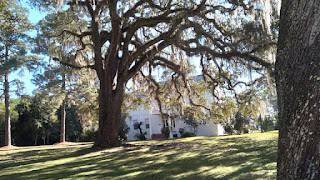
My sister Andy and I took a road trip to Monticello, in Jefferson County, Florida. You can gather that the town's namesake is Jefferson's Monticello and all the history that surrounds it. It's just about 16 miles up the road from Andy's, straight East on Mahan Drive/Highway 90, under a Canopy of Live Oaks dripping with Spanish Moss. 

When I'm in Florida, and I lived in St. Petersburg for ten years, it doesn't usually feel like the deep South, but it sure does this visit.  I'm learning more about northern Florida, that Tallahassee was all plantations from very early on, and they extended to Monticello and beyond. I even recognized the names of the streets as we were driving east, many belonging to old Plantation masters, the land made bountiful by the free labor of slaves.  

"The more you know, the more you see," I mused to Andy. She understood.  The antebellum era, Reconstruction, Jim Crow have deep roots here. It's a story we need to understand, how it infused our  history and culture. We recognize as well that the history is now overlaid by modernism, evolving cultural traditions and norms, incredible economic expansion, growing diversity, and changes to the land. .  

Andy brought us back to the present, pointing to a sign, Monticello Heritage Trail. We're here! "Look out for the Court House in the center of this picture," Andy said. And sure enough, it came into view. A large white, silver-domed, elegant structure in the center of the town, two tall pine trees standing guard at the entrance,  beckoning us closer. I could have been riding around the Ring of Kerry in Ireland, it was such a joy to see. 

We drove around the Court House, looking this way and that, getting the lay of the land. The 1890s red brick Opera House was to our right, and to our left a charming street of  antique shops like Huckleberry's, a Wag the Tale humane society thrift shop, cafes and restaurants, a clothing boutique, commercial buildings and stores. We could see why the Monticello heritage district is on the National Register of Historic Places, its sites and beauty as old as the moss-covered oaks.  


Off the main street a bit, we stopped by two lovely churches, one a white structure with a distinctive silver steeple reaching to an azure blue sky, the other a wooden structure with amazing embellishments, carvings and beautiful stained glass windows all around.  I googled it when we got back to Andy's and learned it is a Carpenter Gothic architectural style, built in 1885.  Fascinating. Next time I hope we can get into that church and see the windows up close. . . 

The Perkins Opera House, 1890

We walked in and out of shops, bought a few Christmas gifts at Huckleberry's and Wag the Tail, and then stopped for lunch at The Brick House restaurant.  We had freshly caught grouper and fried green tomatoes. Andy had fried pickles. It was down home Southern delicious. 

We continued exploring after lunch, each of us pointing out houses and structures that got our attention. I loved the landscape, gently rolling hills (possibly old Indian mounds), the trees, the bright green leaves of camellias in pink and white. 

We came upon two historic houses next to each other, both on the National Historic Register, according to the markers. The John Denham House, photo at top, is currently a Bed and Breakfast. Denham was a Scottish immigrant and a cotton merchant. His home is still perfectly lovely, settled comfortably under centuries-old Live Oaks. I couldn't take my eyes off of the octagonal cupola as I walked next door to the Palmer House. That was a mistake. I stepped on a sweet gum ball, I think it was, slightly twisted my ankle and went down, flat on my back. My cell phone went flying. I'm fine, but my phone's a mess. 

I dusted off myself, and my pride, and continued on the short walk to the Palmer House, which sits silently on a large expanse of green lawn.  It was built by Martin Palmer for his son John, the town's mortician.  It's a simple Greek Revival architectural style built between 1850 and 1874. I couldn't help but think of the Civil War raging at the time, and the need for John Palmer's services. This place is rumored to be haunted by ghosts. It occurred to me that a ghost might be responsible for the fall I took, but Andy insists it was not a ghost but my admiring the scenery too much and paying attention too little. 


Opera House entrance

  The entrance to the Opera House.

A delicious meal.


Because my super selfie made us laugh! 


this is a 2nd rewrite b/c I lost my first draft.

Sunday, December 12, 2021

Sharon Elphick: Into the Neo-Pop 1980s and Beyond


Sharon Elphick, Bauhaus Bouquet. She  added flowers and trees to her well-known urban landscapes and graffiti art, and that's when I discovered her. She is a commercially successful artist. Google Sharon Elphick artist/images for dozens of her art works and products for sale. 

Spot the Difference. Gilcee print. @ art.com for
wonderful wall art, prints, posters, paintings
.
Popular ceramic items for sale. 

Sharon Elphick was born in the same era as my daughters, the mid-
1960s, and they came of age in the same decade, the 1980s.

I wasn't really into the music and cultural trends of that time and found hip hop and electronic pop music beyond my understanding. Yep, my kids thought I was out of it. I knew they felt the same way about my music as I did about theirs. But hey, let's move on from Elvis Pressley and the Everly Brothers, because I have recently discovered some fabulous women artists who were greatly influenced by the 1980s and whose art I now find fascinating.

 Sharon Elphick is among them. Art historians note that during the 80s "influential art movements included Neo Geo, the Pictures Generation, and Neo-Expressionism." I admit these movements slid by me. I perked up a bit with the street art and graffiti movements, but it took a while to educate myself to these art forms. I'm still learning. It's enlightening, and fun.

 
There's not much biographical information about Sharon Elphick. She was born in the north of England and began her career as a textile artist. A few years after receiving an art degree in printed textiles, she moved from the more rural regions of the UK to London.

Elphick, Architectural landscapes in signature grids

Graffiti.


She ran smack into the 1980s and absorbed it all. She was fascinated by the urban landscape, especially the high-rise architecture, and also the grafitti art of the time. They inspired a burst of creativity that made Elphick a popular and highly respected artist from the mid-1980s and 1990s to the present.

Her love of pattern and texture, her use of geographic forms, grids and close spaces, spoke to the modernism of her generation. Neo Geo. This is the art for which Elphick became widely known and also commercially successful. As an article in the UK's Metro Times in 2008 noted: "Sharon Elphick is best known for her inventive patterns built up from fragments of the urban landscape. High-rise flats are transformed into wallpaper, and aerosol spots and architectural angles rearranged into brightly coloured abstract grids reminiscent of the paintings of the futurists and vorticists* of the early 20th century."
I like her modern art, but it wasn't what drew me into learning more about her. I saw photos of her flowers, trees and print and textile mosaics of the changing seasons on Christa Zaat's online Female Artists in History. To some of her fans at the time it might have seemed like a drastic move away from her popular style to a more traditional and floral style.

Now that I've seen more images of her work I can see that it's all distinctively Sharon Elphick. Her inspiration and content may have shifted a bit, but she didn't abandon the signature style that made her art loved and sold, in all its variety. She saw patterns, architectural shapes, and geographic forms in nature too, styling them into contemporary structures and grids that balance the more traditional. In the process, she created some wonderful and eye-catching pop art urban gardens for us. How delightful is that?

Now that I know about Elphick's art, I am seeing it everywhere. On mugs and plates, on posters, on Art.net, Pinterest, Epsy and other online art-for-sale sites. 

No wonder Elton John bought a copy of every editioned print after her work was featured in London's Times newspaper in 2008. I think I may even have caught a glimpse of some pieces when Linda Furney and I were at the Frieda Kahlo exhibit at the Victoria and Albert Museum a few years ago. I aim to go back and take another look.

Meanwhile, I am suggesting Sharon Elphick's art to my niece Ali, a nurse who's started her own interior design consulting business because she loves it. Her clients are eclectic, she says, so who knows but one of them might find Elphick as enchanting as Elton John did. Wallpaper, maybe, or a Gilcee print, a poster or a landscape painting. It's a whole new wonderful world.

New collages by Sharon Elphick weblog

Sources:
Elphick's gallery and shop,
  160 Columbia Rd, London,
for next time I'm there.


*  https://metro.co.uk/2008/08/13/sharon-elphicks-fleur-shows-consistency-in-change-378544/


* Had to look this up. The vorticists were a British avant-garde group formed in London in 1914 with the aim of creating art that expressed the dynamism of the modern world, kind of like the machines in the garden. Ezra Pound's wife was among them. See https://www.theguardian.com/artanddesign/2011/may/28/vorticists-tate-britain-exhibition-review..  Here are a few examples.
.

Dorothy Shakespear, Composition in Blue and Black, 1914-15.
She was Ezra Pound's wife. Amazing, isn't it?


                                      Edward Wadsworth. I like the rose color background..
See also a good article in wikipedia: https://en.wikipedia.org/wiki/Vorticism.


Thursday, December 9, 2021

Tallahassee Was Once All Plantations


 Some excellent publications from The John G. Riley Museum 
on Tallahassee's African-American History. 

If these Live Oaks dripping with Spanish Moss
could talk, what tales they could tell.Mrs.Bernice
Walker Ford, a slave descendent recalled: 
"People used to tell stories about slaves being
hung from that tree." 
My sister Andy lives in northeastern Tallahassee in Leon County, Florida. I've learned that almost every inch of Tallahassee was all plantations up to the Civil War, and then tenant farms worked by the former slaves as sharecroppers after that. Leon County as a whole had the greatest cluster of plantations in the State, and the greatest clusters of Black communities from Reconstruction into the 20th century. Black folks outnumbered white folks here. Even smaller and moderate-sized farms had slaves working them.  

In 1860, Leon County's population was 73% black,  all of them slaves. It's no wonder that Tallahassee and Leon County, also the center of the domestic slave trade in Florida, led the state in the production of cotton. It may also have led the state in the selling of children and family members to other planters, one of the most painful terrors endured.  

Photo in Humanities Florida's FORUM magazine, article by 
Larry E. Rivers, Feb. 24, 2020, first published in Spring, 2010. 

Cotton plantations. The words evoke human bondage. White Supremacy, Slave masters, Slave overseers, whips, hard labor, free labor. The historical and literary scholarship on Cotton plantations and how slaves worked them is extensive.  And it is brutal. "African-American oral traditions emphasize the institution's severity," eminent Florida historian Larry Eugene Rivers writes. He is talking about Florida slaves.  They speak of beatings, rape, vicious assaults on women and children; being forced to work when sick, maimed, broken, worked to death; psychological cruelty, severe floggings. When I read slave narratives I flinch at the inhumanity, human beings being held as human chattel, the property of white men.  Property.

And to think that our country was created on this foundation.  America, and surely the Southern states and territories, were built on the backs of slaves from 1619 onward.  Actually, it was before that date in Florida. Historians note that as early as 1539, slavery arrived in Florida when slave trader and Spanish explorer Hernando DeSoto attempted to establish a permanent settlement and claim more territory for Spain.  
Various drawings of cotton plantations.
https://www.floridamemory.com/items/show/28794


Early Florida history down here in the state Capital, established in 1824 on lands of already-thriving plantations, is basically about  how their owners, masters of their domains, dominated economic, political and social life from the very beginning, and how slaves served them from sunup to sundown. For that matter this history includes moving Native Americans off their land as well, which affected slaves because they often found a safe haven from slave owners among them. 

There were not many safe havens around, but many slaves were driven to run away. Some took the precarious journey on the Underground Railroad to find the freedom for which they longed. Some went searching for children who had been traded away. Some ran away only to be hunted to their death, or tortured if captured. The gritty reality of Fugitive Slave Laws. The newspapers at the time were full of ads for runaway slaves, and Tallahassee was no exception. The plantations harbored brutality, and Tallahassee was once all plantations.

Goodwood,now a museum, is building a memorial
to the slaves listing their names, "a site for sober
reflection, remembrance, teaching, healing."
Many of the plantations, like Goodwood down the street from Andy's, are now tourist attractions selling the beauty of these former sites built by slaves. Over 58 slaves worked this 1,676 acre plantation up to the Civil War, where they were then forced to work as sharecroppers or to take their chances and move on.

On the revisionist side of the scholarship on plantation slavery, which grew during the 1870s and after, are the stories and oral traditions of how slaves and their descendants survived. 

It's the history of how enslaved African Americans created families and kinship networks, sought to reunite with relatives who had been sold, sang about the jubilee in the cotton fields, formed their own religious beliefs and practices; taught each other how to read and write. 

From the Freedmen and
Southern Society Project
.  
Most important, the revisionist scholarship, meticulously documented, reveals how slaves and their descendants sought to define "freedom" for themselves. I think of Peter Woods, Herb Gutman, John Blasingame, Ira Berlin. I recall working briefly on The Freedmen and Southern Society Project at the University of Maryland, a multi-volume documentary history of the transition from slavery to freedom based on army records in the National Archives. The voices of the slaves rise up and are amplified. If only all Americans heard them.   

For former slaves, freedom was not working for wages for the profit of a boss. They resisted and resented the sharecropping system forced on them after the Civil War. Freedom was being your own boss, farming your own land, choosing your own path. 40 acres and a mule. 
'
They persisted in this pursuit in the face of ruthless white supremacy and racism: Black Codes, terror and lynching, cruel and inhumane violence beyond endurance. They had to.  After the horrors of Reconstruction, the ongoing virulent Black Codes followed by merciless "Jim Crow" laws, they organized, advocated and fought for their own dreams of freedom. They fought for the right to own land, to learn, to vote. They fought for political and civil rights up through the 1960s Civil Rights Movement to the present. It's a centuries-long history of persistence, courage, and achievement against insurmountable odds.
John G. Riley Museum for African-American History is near the Capital,
 where former slaves built communities like Frenchtown after the Civil War. John Riley,
born in 1857, determined to educate himself when education for slaves was illegal.
He became a teacher, principal of Lincoln High School, and community leader. The House he built in the 1890s stands as a testament to the persistence and contributions of African Americans.
                                                                                                                                                                   
When the Civil War ended in 1865, Tallahassee's slaves were ready for the Jubilee, the promise of freedom that had sustained them for hundreds of years. What plantation owners and city officials had kept hidden from the slaves was that they were already free. Had been for two years. The cruelty was in the deception.
                                                                                                                    
They were freed when Abraham Lincoln issued the Emancipation Proclamation on January 1, 1863, proclaiming “That on the first day of January, in the year of our Lord one thousand eight hundred and sixty-three, all persons held as slaves within any State or designated part of a State, the people whereof shall then be in rebellion against the United States, shall be thenceforward, and forever free...."  

The Knott House, built by George Proctor,
a black builder. Photo taken while 
 on a plantation tour with Andy.
It was more than two years later, on May 20, 1865, that Union Brigadier General Edward M. McCook arrived in Tallahassee, stood on the steps of the Knott house, and read that Proclamation. He had taken possession of the city from Southern forces, establishing his headquarters at the Knott House, located four blocks from the State Capitol. He declared the Emancipation Proclamation in effect.  A freedman remembered: 

"I remember that day, when word came, that word that made free men and women of our black people" (notes 4 and 18 below). 

Could this be a rendering of Emancipation
Day 1865? from FORUM, Feb.2020
.

An announcement also arrived that day from Major General Quincy A. Gillmore via train from Jacksonville that confirmed the news.  General Gillmore's Special Order Number 63 proclaimed that "the people of the black race are free citizens of the United States."  

"Free citizens of the United States!" Over 2,000 former slaves had gathered to hear the news, and they rejoiced. "It was that day when us black men an' women and lil' chillun crowded roun' each other, cryin' for joy, shouting we's free, we's  free! Glory! Glory! We's free."

The newly freed slaves celebrated all day at a picnic at Bull's Pond, which is today called Lake Ella, just north of downtown. It seemed fitting they would celebrate at the place where Black churches had held baptisms and slaves had prayed for freedom. 

Since that first celebration in 1865, communities in Tallahassee have annually celebrated May 20th as Emancipation Day, and today activities are still held throughout the city. The freedpeople turned that day into what Larry Rivers calls "a sacred moment of popular celebration."  And that it was.  

May 20, 1930, celebrated on former
Horseshoe Plantation.
Local newspapers often reported the event in their "colored sections."  Here's a news item from the Weekly Floridian on May 20, 1884, for example, almost 20 years later, reporting that "A large number of colored excursionists [travelers from plantations outside of Leon County] arrived from the east last night for the purpose of today's participation in the celebration of the emancipation of their race. The exercises of the day will consist of a grand parade in which all the colored lodges and societies will join, decoration of graves of Federal soldiers, addresses, etc." (Colored News of Tallahassee, p.9). 

Of course, not all the celebrants that day were "excursionists," but exuberant freedmen and freedwomen who had worked the plantations of Tallahassee and Leon county. It was a day when former slaves and their descendants got together with old friends, shared stories, took up collections to benefit the community. It was noted that during one of these celebrations "the money collected was enough to extend the school term of the public school (note 4).
Emancipation Day 2015.Tallahassee.
 Historical re-enactment, 
Sara Brockman photo
.

"African Americans stayed alert to the ways that past struggle was related to current strivings." wrote Rivers (note 4 below).

This is the heart of the matter. This is what inspired Tallahassee and Leon County African Americans to keep up the freedom struggle in the face of  such relentless hostility and formidable odds. It's what inspired activists like Althemese Pemberton Barnes to preserve the past for the present. It's what motivated her and fellow Tallahasseans to restore an old house built by a former slave and turn it into the Riley Museum of African-American History.    

The freedpeople who celebrated Emancipation Day were survivors of slavery, and they "lived with the consequences of human bondage for the rest of their lives," Larry Rivers poignantly reminds us.  Many had the scars to show for it, more bore the emotional scars. In 1900, Mary Ann Harris was still searching for her mother. The pain of it. Thirty-five years after emancipation. 

Former slaves carried that pain to their deaths, and they didn't want us to forget. 

My sister and I have driven around the city and its environs for years, with Andy telling me stories of old plantations and the free black communities that grew out of them. This trip it became more real as I donned my historian's hat and did a little research to gather some basic facts. I look at the landmarks, the former plantations, the African-American historic trail, the buildings, homes, institutions and historical markers, the names of streets and roads, with fresh eyes, and more understanding. 

Andy recalled a story about an African-American women realtor who sold land in the area around her neighborhood to the descendants of former slaves and free blacks. She wasn't sure of the details. Some of these landowners still own the land they farmed and the houses they built on it. Many others have sold their holdings. They are now worth a lot of money. "A lot of money," Andy emphasizes.
About 250 slave descendants are
buried here, most in unmarked graves
.

Lucrative housing developments and PUDs, office buildings, medical complexes, and malls have grown on the old plantations. The construction is constant, full speed ahead, and the developments are massive. Andy and I marvel at their size and the speed at which they go up, changing the landscape forever, like the old Lonnie Road developments on lands that free men and women built and farmed, like Welaunee Estates less than a mile from Andy's house, built on the large Fleischmann plantation, which was built in the early 1900s on the lands of several former cotton plantations.


Now when we make a right from Miccosukee onto Fleischmann Road, I'll think of the plantations that once flourished here. I'll know that Udu Fleischmann, a New York banker, built a quail hunting plantation in 1919 that employed former slaves who once worked the cotton fields and served as domestic servants for their antebellum-era owners. Other northern  industrialists joined him in buying up former plantations. It was entertainment, but I can't help but realize that these new owners were dancing on sacred ground, on lands worked by enslaved people, on African-American burial grounds. 

This morning we drove along Lonnie and Dempsey Mayo on the way to Walmart's, passing a few of the old houses and shacks still extant on parts of the land, small clusters here and there, until we hit Mahan Drive, which is Route 90. "Pretty soon these will be gone too," Andy comments, "and the areas along Route 319, Thomasville Road, which takes you to Thomasville, Georgia, once a Plantation alley extraordinaire. Today it's a builder's dream extraordinaire."  

The stories of slaves, free blacks and their descendants touch me deeply. If ever there were lessons in determination, perseverance and courage, it lies with the African-American people of Tallahassee who built the Capital city and made it their home.                                      

SOURCES/NOTES: 

1.   Althemese Barnes and Ann Roberts, Tallahassee, Florida: Black America Series (Arcadia Publishing, 2000).

2.  "In Their Own Words,"  nd,  a booklet relating some of the oral histories preserved by the John Riley Museum (www.rileymuseum.org). 

3, "Colored News of Tallahassee: A Walk through Time, 1855-1995," nd,  collected by the Riley Museum with thanks to Claude Kennison, Devon Johnson, an FSU student, and Mary Headly for typesetting the contents.  This booklet contains articles from Tallahassee newspapers, "when colored news occupied a separate section."

4.  https://floridahumanities.org/floridas-culture-of-slavery/  "Florida's Culture of Slavery," an article by Florida historian Larry Eugene Rivers in Humanities Florida's award winning FORUM magazine, February 24, 2020. It was originally published in The FORUM, Vol. XXXII, No. 1, Spring 2010. I'm searching for Larry E. Rivers, "Slavery in Microcosm: Leon County, Florida, 1820-1860," Journal of Negro History, Vol. 66, No. 3 (Autumn, 1980), pp. 235-245. 

Another excellent source, brilliantly researched and written, full of detail, every one documented, is Julia Floyd Smith, Slavery and Plantation Growth in Antebellum Florida, 1821-1860, (Gainesville, University of Florida Press, 1973. ISBN 0813003237). I was moved to read that Smith worked under David Colburn, her dissertation advisor. 

++++++++++++++++++++++++
Althemese Barnes, founder of Riley
House, "Widens Sense of History with
 Emancipation Conference," Tallahassee
Democrat
, Dec. 5, 2021.

5.  https://rileymuseum.org/tours/  The John G. Riley House Museum, located near the State Capitol building, is a 126-year old structure that embodies one of Tallahassee’s most influential men of his generation. Principal of the first public high school for blacks, Secretary of the Florida NAACP, member of the Negro Business League and Grand High Priest of the Royal Arch Masons, Mr. Riley made a lasting impact. I also want to mention a good pamphlet on Black soldiers, "Blacks in Blue and Gray, 1861-1865." Here also are some African-American sites that a Riley House tour will take you on: The Union Bank Building, The Old Capitol Building, The Historic Frenchtown Community, Old Lincoln High School, Florida A&M University, Meek-Eaton Black Archives, and the Knott House. Taken together, these sites tell the history of a committed and hard-working Black Community overtime.   

6.  https://www.museumoffloridahistory.com/about/the-knott-house-museum/20th-of-may/ Here on May 20, 1865, Lincoln's Emancipation Proclamation, which had freed the slaves in the South on January 1, 1863, was finally read to Tallahassee freedpeople. 

8.  https://visittallahassee.com/african-american-history-is-a-vital-part-of-the-tallahassee-story/

9.  https://www.sevenhillssuites.com/post/black-history-in-tallahassee

10. https://en.wikipedia.org/wiki/Welaunee_Plantation,_Florida

11. http://genealogytrails.com/fla/leon/plantations_1860.html  This is a list of plantations and various size farms showing owners, acreage, number of slaves. During the 1820s through 1850s, Leon County attracted planters from Georgia, Virginia, Maryland, and North/South Carolina because it was great for growing cotton. There are maps showing locations and some interesting photos. This is also a good source for some census material, biographies, and plantation history.

12.  https://www.nps.gov/jeff/blogs/Days-of-Jubilee-The-End-of-Slavery-in-the-United-States.htm        

         
13. https://www.museumoffloridahistory.com/about/the-knott-house-museum/20th-of-may/ Here on May 20, 1865, Lincoln's Emancipation Proclamation issued on January 1, 1863, was finally read to Tallahassee slaves.   Notice in the Floridian and Journal, May 20, 1865 regarding the Emancipation Proclamation: "Newly freed slaves in Tallahassee celebrated this announcement with a picnic at Bull's Pond," now Lake Ella.

14. https://en.wikipedia.org/wiki/Florida_A%26M_University. Florida Agricultural and Mechanical University (FAMU) began as a state Normal School for Black students after the Civil War, in October 1887, and evolved into Florida A&M in 1953, when it became a funded historically black college and university (HBCU). An interesting story that belongs in the History books along with the better known Rosa Parks story involves the arrest of Wilhemina Jakes and Carrie Patterson in 1956 by the Tallahassee Police Department for "placing themselves in a position to incite a riot," which led to the Tallahassee Bus Boycott that sought to end racial segregation in the employment and seating arrangements of city buses. In the fall of 1997, Time Magazine selected FAMU as "College of the Year." 

15. https://www.findagrave.com/cemetery/2395019/munree-cemetery . This is one of the thousands of black cemeteries across America that were hidden, neglected, discovered, and restored.  It was used by descendants of slaves, tenant farmers & sharecroppers from nearby plantations in the Welaunee area, purchased by Udo Fleishmann in 1912. It's near my sister Andy's house. The land is now occupied by a huge housing development. I was involved in a history of Black Nantucket when we discovered a black cemetery across from the old Windmill, and found the gravesites of the Absalom F. Boston family and others among the weeds of the hidden and forgotten burial ground.                           

18.Patricia and Frederick McKissak point out in their book Days of Jubilee: The End of Slavery in the United States, that early on there was no single day when slavery ended in the United States. The day a slave was told of his or her freedom was the day of emancipation--their "day of jubilee."  For Former slaves in Florida the day was May 20, 1865, celebrated as "Emancipation Day" thereafter.  For slaves in Texas, it was June 19, 1865, now Juneteenth, a national holiday. 

 Added after posting. Interesting article about George Proctor and his father, free blacks. There were about 4 in Tallahasssee in 1830s: https://www.tallahasseemagazine.com/the-puzzling-story-of-george-proctor-a-free-black-man-during-the-time-of-slavery/


Monday, November 22, 2021

The Guggenheim Effect: New York City Reunions and the Circle of Life


Elissa and I at the Guggenheim, November 2016. Thrilling. The
glass dome and a painting from the exhibit that was up.
My photo, a rare good one.

The Guggenheim was in the news recently for getting another grant from the National Endowment for the Humanities (NEH) to continue to digitize its collections, and the news brought me full circle to some wonderful memories. 

The circular, curved architecture of Frank Lloyd Wright's Guggenheim Museum on the Upper East Side of Manhattan continues to draw comments good and bad as it did when it first opened in 1959. A unique architectural style, iconic, Wright took 16 years to draw up its various plans and died before it was finished. So did its founder Solomon Guggenheim. Wider at the top than at the bottom, Wright wanted it to be "a temple of the spirit." It housed all kinds of impressionist and modern art at one time, but we thought it looked rather bare in November 2016 when we wound our way up the curved ramps to the top and fixated on the dome skylight.  

Natalia and me, together, joyful.

My daughter Elissa and I were in New York City to reunion with my dear friend Natalia from Ukraine. She was visiting her son Ivan, who had an IT job in NYC, and his family.  They lived across the river in Jersey City, New Jersey, which turned out to be a fabulous sight for viewing the new World Trade Center.

I lived with Natalia at the end of my Peace Corps service in Starobilsk. She later moved to Kyiv to be closer to her children. I didn't think I'd see her again when I left Ukraine, and the language barrier was the worst with Natalia because she was a soulmate. We both felt it, we knew it through pantomime, efforts at understanding, and laughter, lots of laughter. Not being able to communicate fully, to become immersed in those long intimate conversations among friends that bring comfort and joy, was almost painful.


Seeing Natalia in New York brought tears of joy.  She gave me a beautiful work of art she had created, but seeing her again was the best gift of all. It was a fantastic, emotional reunion, and we repeated it when she and Ivan visited us in Sylvania a month later.  That was the best Christmas gift ever! Thank goodness that Ivan was our translator.

Natalia & son Ivan in Sylvania, Ohio. How fantastic that was!
On Main St, with my family, at Wildwood, a tour of Toledo.
December 2016

It felt like life coming full circle. It felt like being in the Guggenheim, strolling up pathways to meet old friends and loved ones, finding surprises along the way. The circle of life. A temple of the spirit, what Frank Lloyd Wright wanted it to be, what he bequeathed to future generations.

The Guggenheim effect! This New York visit brought even more reunions on top of the precious visit with Natalia. Elissa and I came full circle with several friends whom we hadn't seen for years.

I got to see my friend Alice Twombly after many years doing our own things, living our lives. It was as if we had never been apart. We carried on where we  had left off, a seamless narrative between forever friends.  She remembered her father's business in Jersey City, we reminisced about our time together in Madison, Wisconsin, took a slow walk up memory lane, up and down the ramps of our lives' experiences.  

Me with Natalia, Alice, and Christine and Elissa with Eric at the
Guggenheim. Powerful experiences, happy moments.

We met world-traveler Christine Comerford, who lives on Long Island, a friend my sister Andy and I made on a fabulous Gate I tour in Sicily. We shared a beer at a pub on the East River, near the new World Trade Center, just like we had done in Taormina. 

It was, however, bittersweet to visit the new glass tower that replaced the Twin Towers tragically destroyed on 9/11. The view from Jersey City across the river was amazing, moving, and it was even more so when we got up close and could touch the mementos, salvaged pieces of metal, the names of first responders and the thousands lost.  We were standing on sacred ground.

And finally on this trip, Elissa got to see her friend Eric, from her Maumee Valley high school class, whom she had lost touch with. In fact we met up with Eric, who had long lived in NYC, at the Guggenheim. He and Elissa reminisced about mutual friends and high school antics as they went full circle to the top.  I remembered Eric's father, a Math professor at the University of Toledo when we were there, and his mother, a great cook. 

Being at the Guggenheim. It was a passage in the present through time, the stuff memories are made of and that sustain us as we move up and down the ramps of life. Coming full circle.  


SOURCES: 

* https://www.guggenheim.org/news/guggenheim-neh-grant & https://www.guggenheim.org/library-archives/library-archives-projects/guggenheim-listening-project-reel-to-reel-collection-digitization

* https://en.wikipedia.org/wiki/Solomon_R._Guggenheim_Museum.  There's a Guggenheim Museum in Bilboa, Spain too, designed by renowned Canadian architect Frank Gehry. Amazing isn't it? Frank Gehry also designed a Center for the Arts building closer to home, next to the Toledo Museum of Art. 

Guggenheim in Bilboa.

This is the University of Toledo's Center for the Arts,
a Frank Gehry building built next to the Toledo Museum of Art
..

Don't get out the popcorn yet: The Wheels of Justice Grind Slowly

"Delay, Delay, Delay: From pre-trial motions to negotiations over security, the master of legal stalling has many tactics in his arsena...