Thursday, May 17, 2018

Moses Fleetwood Walker and his Times

. 
The Thaddeus Walinsky History Group (named after a devoted Toledo historian) meets on the first Monday of every month.  The last meeting, which my friend Teddy and I attended, focused on a talk by David Wise and Bill Romp about Moses Fleetwood Walker. Walker was an Ohio native son, African-American baseball player with a stint in the Major Leagues before Jackie Robinson, and entrepreneur.  His name suited him, emblematic of Biblical naming patterns adopted by freed slaves and their descendants on the long road to freedom.  But actually it seems he was called "Flint," and that suited him too!

The History group meets at the Beirut Restaurant, an homage to Toledo's large and long-established Lebanese-American community, from which have come prominent lawyers, judges, teachers, and  civic and business leaders. It takes me back in time to the 1970s-80s, when I worked with Judge Charlie Abood on a pioneering Lucas County family violence prevention project chaired by the Bishop of the Toledo Diocese, James Hoffman.  I will always remember these two civic leaders, the Judge and the Bishop, for their commitment to promoting a compassionate Toledo.

The History group is a wonderful opportunity to learn about local and state history, as well as American and World history of interest to particular members. Members take turns giving presentations, with time for questions and answers. It's fun and intellectually stimulating to have a chance to talk history over a wonderful Lebanese meal.

Moses Fleetwood Walker,
Wikipedia. 
So we learned about Moses Fleetwood Walker (1856-1924), with Bill Romp presenting an interesting biography.  Walker was born in Mount Pleasant, Ohio, a working class town in eastern Ohio with a large Quaker community that had served as a sanctuary for runaway slaves since 1815 (fascinating information). When Moses was a child the family moved to Steubenville, where his father became one of the first black physicians in Ohio and later a minister of the African Methodist Episcopal (AME) Church. The AME church was among the first denominations founded on racial grounds rather than theological differences, and always advocated for civil rights through social improvement and political action. (Wikipedia).

Walker's family and the Steubenville Black community where he grew up influenced the direction of Moses' life. He became a star athlete at Oberlin College, where his baseball career as a catcher started, and later at the University of Michigan. These colleges were ahead of their time in accepting women (such as women's rights advocate Lucy Stone) and Black students, and Walker took advantage of it. He was a good student, favored philosophy and art, but his first love was baseball.

Logos of these great  organizations.
"Discover Greatness!" a perfect motto
.
He played for semi-professional and minor league teams before joining the Toledo Blue Stockings of the MLB's American Association (AA) for the 1884 season.  Moses was apparently the last African American to participate in a major league before Jackie Robinson broke baseball's color line in 1947. Like Robinson, Walker bore his share of  racial taunts and jeers.  I recalled that it was the virulent racism in America that infused our "favorite past-time" and led to the formation of the Negro Baseball Leagues, where some of the best players in the country, like pitcher Satchel Paige, played in segregated games to the thrill and pride of huge Black audiences. Robinson's achievement in "integrating" the Majors led to the end of the Negro Leagues (documented in several studies and in Ken Burn's "Baseball" series).  It remains debatable to this day whether the end of segregation hurt more than helped the once-thriving black communities of America. 

Moses was proud of his African-American heritage, Bill Romp noted, and he had an entrepreneurial spirit. Besides his love of baseball, he engaged in various business ventures; edited a newspaper, the Equator, with his brother Weldy (also a baseball player); and wrote a book, Our Home Colony (1908), exploring ideas about emigrating back "home" to Africa. He floundered a bit when his baseball career ended and he had his rough times as well as good times. Moses died in 1924 at the age of 67.

Considering the historical context in which Moses Walker lived--the Era of Apartheid and White Supremacy, as vicious here as anywhere in the world--his achievements and those of other African Americans at the time are remarkable.

Human bondage did not end with the Civil War.  No. Another form of bondage emerged during Reconstruction and well into the 20th century, and in the most vicious forms imaginable.

It was human bondage embedded in stifling Jim Crow Laws and the southern Black codes; the passage of laws forbidding former slaves from hunting, fishing and foraging (major means of survival); the resulting creation of a new "criminal" class of  young black men who worked like slaves on chain gangs as cruel as any South African prison or Russian Gulag; relentless oppression and injustice without civil rights, without any rights at all; and the terrorism of the KKK, which dominated the American landscape.  Lynchings were at an all-time high, a sickening spectacle of emboldened White Supremacy. These gruesome murders led to the courageous anti-lynching efforts of journalist Ida B. Wells (the history of  black women pioneers too often hidden) and then to the NAACP's Anti-Lynching Campaign. (I worked in the NAACP records, at the Library of Congress; they are the most graphic, unnerving, and saddest documents I have ever worked in as an historian).

A parallel reality also existed at this time. It is, indeed, a major theme of the African-American experience: the persistence and strength of Black communities across the South and into the North, surviving against the odds; the grassroots struggle for civil rights, including the right to vote, like the efforts of Fannie Lou Hammer and sharecroppers in Mississippi; the emergence of Black educational, religious, businesses, and social and cultural institutions that sustained these communities; and the training and rise of brave men and women leaders who put Black civil rights on the national agenda.

In Walker's time, hundreds of African-American women, working to the bone to keep their families
together and sick and tired of the oppression, rose up to mobilize the masses of Black folks across the South and North. Among them were women pioneers like Ida B. Wells and Mary McLeod Bethune, educated activists way ahead of their time. In their footsteps, three prominent African-American men also stepped onto the national stage. They were Booker T. Washington, W.E.B. DuBois, and Marcus Garvey. They shared the same goals--equality, justice, equal opportunity--but they had different strategies for getting there, strategies that are debated to this day.


Booker T. Washington (1856-1915) was probably the most well-known of the three, and certainly the least feared by the white community because he did not focus on integration or civil rights. Born into slavery, Washington called for black progress through education and entrepreneurship.  He promulgated this strategy in his famous "Atlanta Compromise," which called for building the black community's economic strength and pride through self-help. His base was Tuskegee Institute, a historically black college in Alabama. It could well be that Walker the entrepreneur learned a lot from Booker T, and in many ways embodied his self-help strategies.

W.E.B. DuBois (1868-1963), a Harvard PhD, sociologist and historian, author of the epic "Reconstruction in America" and "The Souls of Black Folks," moved beyond Booker T's "Atlanta Compromise" approach.  DuBois focused on working for political change, integration, and equal  rights. He was a co-founder of the NAACP in 1909, but in time moved beyond this organization as well to call for more revolutionary actions against American racism. There are plenty of hints that Moses knew of DuBois, shared the goals of the NAACP, and was familiar with its remarkable lawyers, including Walter White, who headed the Anti-Lynching campaign, Professor Charles Houston of Howard University in DC, and perhaps even Houston's student, the young Thurgood Marshall, who later become the first African American Supreme Court Justice.

Marcus Garvey  (1887-1940) was a proponent of Black nationalism and leader of  a mass movement called Pan-Africanism.  Moses Walker certainly knew of Garvey's ideas, and incorporated them into his own book, "Our  Home Colony." Garvey founded the Universal Negro Improvement Association, the African Communities League, and the Black Star Line, a shipping and passenger line that promoted the return of the African diaspora to their ancestral lands.

Moses Fleetwood Walker's life is part of this larger story of  the African American experience and the struggle for freedom. It's truly an American story of Achievement against the Odds.  Incredible odds.  There was a mountain of  oppression, hatred and despair to overcome, Martin Luther King, Jr. reminded us. America is still a work in progress, still struggling to live up to it's ideals, time after time, generation after generation.

Some sources:  Talk by history group members David Wise and Bill Romp; Wikipedia and blackpast.com.  Pat and Frederick McKissack, Jr., Black Diamond: The Story of the Negro Baseball Leagues (New York: Scholastic, 1994) and "Baseball," Ken Burns' documentary. Wikipedia bios on Booker T. Washington, W.E.B. DuBois, Marcus Garvey.

Dr, Martin Luther King, Jr.,  I've Been to the Mountaintop, April 3, 1968
Like anybody, I would like to live a long life.
Longevity has its place.
But I'm not concerned about that now.
I just want to do God's will.
And He's allowed me to go up to the mountain.
And I've looked over.
And I've seen the promised land.
I may not get there with you.
But I want you to know tonight,
that we, as a people will get to the promised land.


From interesting article by Kevin Baker, "Does America need truth and reconciliation after Trump," New Republic, May 2018, discussing another period when America did:
"African Americans were ... moved from slavery to serfdom. The new Southern constitutions contained horrific “Black Codes” so close to the same states’ old “slave codes” that in places they simply lifted entire blocks of text from the antebellum statutes and substituted “Negro” for the word “slave.”
The Black Codes of 1865–1866 restricted every form of African American activity as closely as any totalitarian state has ever controlled its population. They legally tied the former slaves to the lands of their once-and-future masters and began the long tradition of convict labor that still plagues America to this day, creating incentives for local police forces to arrest people of color on the flimsiest of pretexts and force them into what Douglas Blackmon called, in his book of the same title, “slavery by another name.”"


Tuesday, April 17, 2018

Fr. Jim Bacik: Opening the Catholic Church to the World

image by tsahaylu


I haven't been to a Fr. Jim Bacik lecture in a while, but I'm glad I went last week. I met friend Teddy and we planned to go to dinner afterwards. Fr. Bacik, ever the scholarly theologian,  talked about the "new tribalism," the tendency to gather with like-minded people, as a response to globalization. He emphasized the dangers of turning inward and ignoring or demonizing those who are different. He pointed to the growing number of hate crimes in the US, the renewed anti-semetism, angry racism, white nationalism, the prejudice against Muslims, and the rise of an extreme political partisanship pulling people apart and destabilizing the world.

Before talking about Vatican II (1962-1965) and Pope John XXIII, Fr. Bacik recalled the Council of Jerusalem in the year 62 AD, where debates between Paul and Peter and different factions led to more openness in the church, a kind of first step to a more tolerant mission.

Pope John XXIII. Pope Francis continues his
tradition of a church open to the world,
 and I think he looks like him too. 
 
Vatican II revived the spirit of the Council of Jerusalem to renew calls for a Church that was relevant to peoples around the world. It's the spirit that Pope Francis, coming as he did from serving in Argentina and among the poor, embodies and carries on today.

John XXIII wanted Aggioramento, a rural church, a humble and loving Church that welcomed all people everywhere. This is  how the Catholic church reached out to South America and Asia and Africa.  Of course there was the inevitable resistance to change. The Curia leaders and the Bishops rose up to defend tradition, like Cardinal Ottaviani, whose motto was Semper Idem (Always the same).  I like that Latin phrase, and often have need of it!

What were the key issues?
*The liturgy: use of the vernacular instead of Latin so that parishioners went from being passive spectators to active conscious participants in the service
*Spirituality: from holiness for priests and nuns to a universal call to holiness
*Religious liberty: from Catholic privilege to freedom for all
*From a ghetto mentality to ecumenical dialogue
*From opposition to other religions to interfaith dialogue and cooperation
*From withdrawal from the world to active engagement.

Lovely statue of John XXIII in front
of St. Anthony's Church in Istanbul,
 where he preached for 10 years
 before becoming Pope.
Pope John XXIII prevailed.  Vatican II marked a new era in which the Catholic church "would understand itself for the first time as a World Church." As Karl Rahner, Fr. Bacik's mentor and a brilliant theologian noted, Vatican II was the most important change in the church after the Council of Jerusalem. It offered salvation and freedom of conscience, and energized ecumenical dialogue. Fr. Bacik called Vatican II "a great salvation optimism" for the whole human family with all its joys and sorrows.

I am not Catholic, but my daughter Elissa is; she calls me a Pope Francis Catholic. She's right. I knew when the new Pope took the name Francis that he would be a wonderful Pope, that he would be another John XXIII."Who are we to judge?" Pope Francis reminds us, a phrase I use a lot.
St. Antoine of Padua Church, Istanbul. Photo taken at night
on Christmas eve 2009 in the heart of  the city.  We walked 
along bustling streets, shops and cafes crowded with revelers 
and decorated in blue lights with joy in our hearts..

Fr. Bacik's lecture took me back to a Christmas in Istanbul in 2009 with my Peace Corps friends Jud and Jason. We decided to attend St. Anthony (Antoine) of Padua church, where John XXIII preached for ten years before becoming Pope. It was the kind of incredible travel experience that moves you, transforms your view of the world.

St. Anthony's is an international congregation, befitting the memory of Pope John XXIII. The church overflowed with people from all over the world in a spirit of  inclusiveness and acceptance. The service was ecumenical, the priests, the choir, the music and traditions from around the world.

I sat next to a lovely young woman who said her name was Fatima, which I recalled as the name of the town in Portugal where three shepherd children claimed to have seen visions of Mary, the mother of Jesus. I assumed Fatima was celebrating the Christian holiday.  We chatted as the choir practiced songs from South America, Africa, and around  the globe. I explained that we were Peace Corps Volunteers from America working in Ukraine. "I thought you were American!" she said with a big smile.

I asked about her. She was born in Turkey, and lived in Munich, Germany, with her family." She went on to talk about being a college student majoring in international organizational development. She spoke many languages and loved Munich.

"Why are you here tonight?" I asked.
"I'm visiting family. And Istanbul is my birthplace, Muslim is my religion, and the cultures of the world my greatest interest," she replied. "I like this church because it is diverse and tolerant. I remember it as a child, and I feel welcomed here."

It was the best Christmas message we could have gotten from any church in the world, and here we were in Istanbul, three Amerikankas celebrating with Fatima, the devout Muslim. What a conjunction of the human spirit.   The "Open Arms Tribalism" Fr. Bacik champions.  It enveloped each of us in gratitude.


http://fran-ukrainian-adventure.blogspot.com/2009/12/christmas-in-istanbul.html


Saturday, April 14, 2018

Philip and Chase at the Toledo Sister Cities International Festival


I try to introduce my grandchildren to the wider world whenever I have a chance. I give them maps, photos, talk about my travels, take them to meet people from somewhere else. They met my conversation partner Fenghua. They have met friends from Europe, Ukraine, the Middle East, and Africa, and they have classmates from other countries in school. So today, my daughter Elissa and I took our grandboys, Chase and Philip, to the Toledo Sister Cities International Festival at the Seagate Convention Center in downtown Toledo.

We roamed around looking at displays, talked about different countries, listened to music and performances by various ethnic groups. Chase and Philip enjoyed getting their names signed in Chinese, at the Chinese display table, and in Arabic, at a lovely exhibit of Lebanese art and  cultural  items.   I showed them the countries on the map.

"You guys already know about these two countries," I told them.
"No, we don't, Nana," Philip chimed in.
"Well, have you ever been to a Chinese restaurant or eaten Chinese food? And how about the Lebanese food at the Beirut and the Grape Leaf?"
"Oh right," Philip smiled. "Good food."
 We agreed food was a good way to get to know another country!


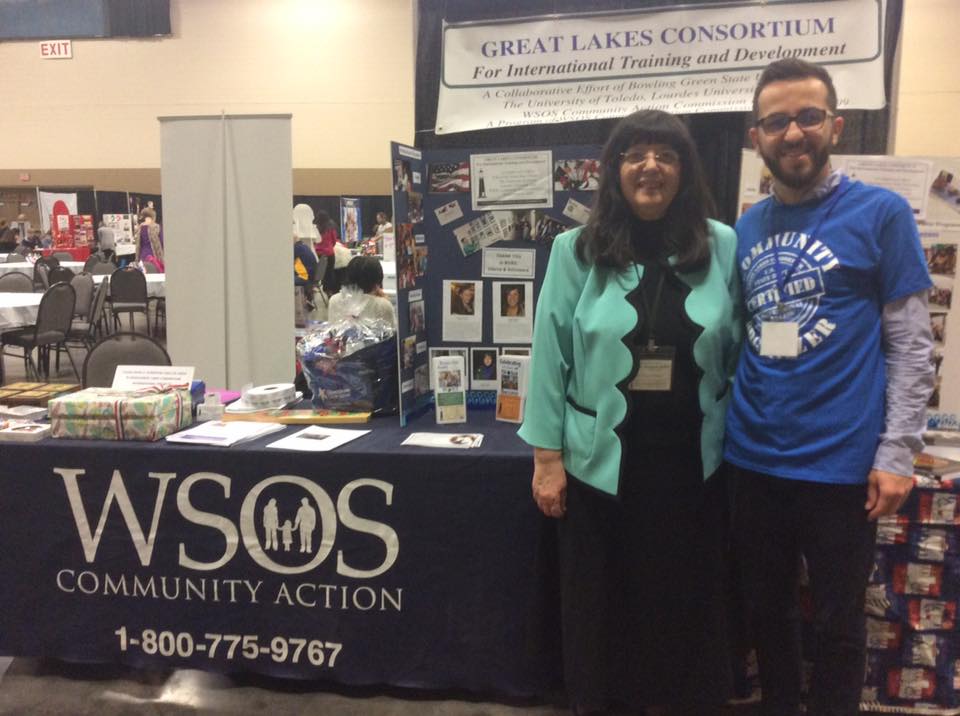
Dr. Elizabeth Balint, director of the Great Lakes Consortium. We worked
together on the Open World Project that brought people from Ukraine to Toledo.  

Toledo is a "Welcoming City," home to immigrants from many countries.  They have helped make our neighborhoods strong for generations. Some are newer, including refugees from war-torn Syria. Toledo has sister cities in Spain, China, Hungary, Poland, Japan, Tanzania, Germany, Lebanon, Pakistan and India.  It makes sense that the world's two Toledos, Toledo, Ohio and Toledo, Spain have been sister Cities since 1931, one of the oldest formally recognized sister-city relationships in the world (see www.association of two toledos.com).


I've been talking about maybe getting a sister city in Ukraine. Our US Congresswoman Marcy Kaptur is interested. She is always a strong supporter of the International Festival and international exchange programs. She is knowledgeable about and honors America's history of immigration, including her own Polish and Ukrainian heritage.  "We are all immigrants," she says, and "through food, music, art and fun we build bridges toward a stronger future together."

We had to sample some food, of course, so Philip and I got Asian food and Bubble Tea, and Chase got tacos, and we sat down to eat and watch a Karate performance. Chase is a yellow belt! We introduced ourselves to an elderly man sitting alone at the table. Turns out he was a retired Professor of German Language and Culture at the University of Toledo, where he had taught for many years.  It was nice to strike up a conversation. A few minutes later a  mother and her son, who was dressed in lederhousen, asked to sit at the table. I asked if he was from Germany. No, he was just dressed like a German, in Bavarian lederhousen actually. He was a Senior in high school who loved the German language and wanted to go to college in Germany. His mom was encouraging him.  "You're at the right table," I said, as I introduced them to the German professor, which delighted all of us.  They spoke a little in German, and we had a lovely chat about Germany and travel.

Serendipity! The same  kind of serendipity we encounter wherever we travel, and always to our delight, and it happened right here in Toledo, Ohio, at a table at the International Festival! 

The world is open to us. All we have to do is embrace it. I hope Philip and Chase, and all my grandchildren, will give it a try one day!


Sunday, April 8, 2018

What is "Hybrid Warfare"? Foreign interference in an American election.

Image, blazingcatfur


What is "hybrid warfare?" It's what Vladimyr Putin has been practicing without restraint or serious resistance since his interference in the 2010 Ukrainian presidential campaign, designed and implemented with help from Paul Manafort, followed by Putin's invasion of the sovereign nation of Ukraine in 2014.

That's the truth in a nutshell. The implications are enormous. And they are interconnected with our 2016 presidential election.

On his way out the door, fired by Trump because they disagreed, Gen. H.R. McMaster, a PhD historian, brilliant, forceful, gave a good definition:
"Hybrid warfare is a pernicious form of aggression that combines political, economic, informational, and cyber assaults against sovereign nations. It employs sophisticated strategies deliberately designed to achieve objectives while falling below the target state’s threshold for a military response. These tactics include infiltrating social media, spreading propaganda, weaponizing information, and using other forms of subversion and espionage.”
McMaster acknowledged that the West had "failed to impose sufficient costs" on Moscow for its aggressive behavior.  He was thinking Ukraine and Syria, and maybe our election.

He contended that we are engaged in a “fundamental contest between our free and open societies and closed and repressive systems.”  He called the nerve poisoning of the Skrypals in London  “an assault on the United Kingdom’s sovereignty, a clear violation of the Chemical Weapons Convention, and the first offensive use of nerve agent in Europe since World War II."  This last part was news to me, about the chemical weapons agreement and the contemporary use of a nerve agent.

I'm glad I learned this, because true to form, Russia has since mounted a new information cyber war, a disinformation campaign, to create confusion and cover up the truth.

I found more details about hybrid warfare in an article in Air Force Magazine (cited below), a fascinating source. This article caught my attention because it uses Russia's aggression against Ukraine as an example. Here's how the article describes it: 
"The “little green men” were one of the first signs of Russia’s strategy. Commandos wearing green uniforms stripped of insignia occupied key government institutions in Crimea during the early months of the Ukrainian crisis of 2014.
    For a time, their ambiguous identity allowed Russian leaders to deny that Moscow had launched a military offensive to seize the Crimean Peninsula and its Black Sea ports.
    But these Russian Special Forces were not the only indication Moscow had launched a complex, multifaceted operation in the region. That October, as Ukraine neared a crucial snap parliamentary election, electronic advertising billboards in the capital of Kiev suddenly began showing a video accusing Ukrainian politicians of war crimes. Then they displayed graphic images of civilians killed in the eastern part of the country.  The electronic network had been compromised by a shadowy, pro-Russian group of hackers. 
     Russia also relied on conventional forces to push for its objectives. Regular infantry units eventually took the place of the little green men in Crimea. Russian artillery and military personnel crossed into Ukraine proper to help pro-Russian insurgents seize and hold strips of territory in the Donbas region in the country’s east."
   
It's a concise description of a complex strategy, and its conclusions are clear: "Russia’s intervention in Crimea and eastern Ukraine is a textbook example of hybrid warfare, the combination of unconventional means (subversion, cyber attack) with conventional might to reach a geostrategic objective."

That Paul Manafort and his cronies had a hand in Putin's mission is indisputable. And it's becoming clear as more evidence and new connections emerge--as the dots are connected--that Manafort used the same kind of hybrid war games--social media, propaganda,"fake news"--in America's 2016 election that he had used in Ukraine to demonize Yulia Tymoshenko and elect pro-Russian billionaire Viktor Yanukovich.  

The folks at Cambridge Analytica, Robert and Rebekah Mercer, Steve Bannon of Breitbart, Republican Party operatives, alt-right fanatics who saw in a Trump presidency the chance to "deconstruct" our democracy, were impressed.  Manafort knew how to swing elections. The "Corrupt Yulia" disinformation propaganda campaign morphed into the "Corrupt Hillary"campaign.

But that Cambridge Analytica circle of propagandists are not the only ones who are experts at "weaponizing information."  The Air Force Magazine article reveals another interesting fact: Gen. James Mattis, Trump's Secretary of Defense and a marine to the core, is also an expert on hybrid warfare.  Who knew that? He has thought about it for over a decade and has written about it.  In a 2005 article he co-wrote with Lt. Col. Frank G. Hoffman, who was one of the first to use the term, he called it "an unprecedented synthesis."
“We may face remnants of the fielded army of a rogue state in future wars, and they may employ conventional weapons in very novel or nontraditional ways.”/ Hybrid war might feature attacks against US critical infrastructure or transportation networks. It could involve an electronic take down of military or financial computer networks," Hoffman and Mattis wrote.
"Hybrid war in Poland, blazingcatfur 
It was a prediction, and it came true.  Mattis must  see the connections to the 2016 election. He understands more than we know. Like his friend Gen. McMaster.  They must see the whole picture that Mueller is now putting together, like the pieces of a puzzle.

It makes me wonder how people who know so much more than Trump can hang in there. It makes me wonder how Mattis will work with the warmonger John Bolton, friend of Russia, ethically challenged, part of the Cambridge Analytica story, involved in Russian oligarchs' links to the National Rifle Association (NRA).

Whoever thought that Putin's brand of warfare would become part of an American presidential campaign between an unfit Trump and a super-qualified but cyber-targeted Hillary Clinton?

In fact, in my view, the intrusion in our election had its genesis in Putin's hatred of Clinton and his fear she would be hard on Russia if elected. The hybrid-disinformation campaign against her started when she was Secretary of State. Also, Putin believed Trump could be "persuaded" to end the sanctions imposed for his invasion and occupation of Ukraine. And Paul Manafort, still in touch with pro-Putin Ukrainian and Russian oligarchs, thought so too.

We are facing a political firestorm unprecedented in American History. Special Counsel Robert Mueller has his plate full. A political tsunami is rumbling onto shore, slowly but surely. It will take down the Trump regime and all who enabled it, obstructed justice, or colluded with a foreign power using a hybrid war to disrupt an American election. 


Some sources:
http://www.airforcemag.com/MagazineArchive/Pages/2017/March%202017/The-Perils-of-Hybrid-War.aspx
"Retired Marine Reservist Lt. Col. Frank G. Hoffman was among the first theorists to begin using the term “hybrid war” to refer to this hydra-headed concept. He referred to it as a “blurring of modes of war, the blurring of who fights, and what technologies are brought to bear.” In this definition, hybrid war involves both nations and nonstate forces. Its violence can span the spectrum from intense regular unit combat to guerrilla warfare and terrorist acts. It can slot in criminal kidnapping and theft and, increasingly, cyber warfare. It can employ state sponsorship of existing local unrest and the manipulation of currencies and other means of economic aggression. Diplomacy and propaganda play a part. /Hoffman began talking about this concept as early as 2005. He called it “unprecedented synthesis” in an article in Proceedings cowritten with Marine Corps then-Lt. Gen. James N. Mattis, now the new Secretary of Defense."

https://www.csspmspk.com/hybrid-war-and-economy/by Adeela Naureen, origininally published in The Nation and used in online courses.   An interesting world-wide view of what it means.

http://cyprus-mail.com/2016/06/05/russias-hybrid-war-ukraine-2/

http://nymag.com/daily/intelligencer/2018/04/mcmaster-rips-russia-on-his-way-out-of-the-white-house.html

http://nymag.com/daily/intelligencer/2018/04/mueller-is-asking-russian-oligarchs-about-donations-to-trump.html

http://nymag.com/daily/intelligencer/2018/04/mattis-had-an-impossible-task-now-trumps-making-it-harder.html

https://www.nytimes.com/2018/03/31/world/europe/balkans-russia-night-wolves-republika-srpska-bosnia.html?smprod=nytcore-ipad&smid=nytcore-ipad-share  About the Night Wolves, Putin's feared biker gang.

https://www.dailysignal.com/2017/11/17/russias-hybrid-war-west-began-battlefields-ukraine/

http://www.newsweek.com/poland-prepares-hybrid-war-amidst-russian-threat-316469 Interesting article on Russia's hyrid war in Poland, showing the extent of Putin's efforts in the East and the West.

Friday, March 16, 2018

Students in the Tradition of Marjorie Stoneman Douglas

Thousands of students sit in silence in DC and across the country
in memory of the students killed at Parkland, Florida's
 Marjorie Stoneman Douglas School. Photo by Saul Loeb/AFP/Getty Images
Marjory Stoneman Douglas (1890-1998), the journalist, writer, women's suffragist, fighter for civil rights, and savior of the Florida Everglades, would be weeping for the tragedy that took place at the school named after her in Parkland, Florida.  She would also rejoice that the student survivors of the tragedy, brave and articulate, have found their voice and are using it.  They are speaking out forcefully and directly about an urgent social problem, as Douglas did in her time. They are motivating a new generation.

dogo image
I went to google to remind myself of Douglas' legacy. I first learned about her when I moved from DC to Florida and worked for the NEH Florida Humanities Council. I read everything I could about Florida. I read Douglas, Marjorie Kinnan Rawlings (The Yearling), Zora Neale Hurston (My Eyes were Watching God), mystery writers and nature writers. I traveled the state from Pensacola and the Panhandle to Jacksonville and Orlando, along the Gulf coast from Tampa, across the Tamiami Trail over the Everglades from Naples to Miami, all to absorb Florida's geography, history, folklore, and culture.

yahoo image
My thoughts returned to Florida when the gruesome story of another mass murder filled the media. Images of Sandy Hook and other shootings with military weapons rose up, along with rage. How long will we tolerate these senseless, unspeakable tragedies?  
The student survivors at Douglas School have some answers. They are arising out of the ashes of this tragedy like a bright Phoenix.  They are revitalizing the gun control movement. They are already making a difference, and giving us hope.

Douglas would be proud of them. She, too, was a fierce and outspoken defender of the causes she believed in. She is best known for the book The Everglades: River of Grass (1947), which redefined the popular conception of the Everglades as a "treasured river instead of a worthless swamp."  It's impact has been compared to that of Rachel Carsen's Silent Spring. From the age of 79 until her death at the grand old age of 108, Douglas was a relentless and fearless crusader for the preservation and restoration of the Everglades. (Wikipedia)

The students at Douglas school are carrying on her tradition of speaking out and standing firm in their beliefs.  A new generation is out to change America for the better. It's our hope for the 21st century and beyond.


https://www.nytimes.com/2018/03/14/us/school-walkout.html
https://www.vox.com/2018/3/14/17114430/school-walkout-gun-control-photos


Wednesday, March 7, 2018

Hubris is taking down Trump


Trying to cover up his bald spot,
but it looks morel like the image of a man
under siege shutting himself off from reality
(if he was ever there). Yahoo image. 


I wrote this blog in March 2018.The news of the day had me thinking about Shakespeare and Greek tragedy. Ari Melber reminded me of it in his broadcast on August 8, 2023, when he talked about Greek myth and Trump's effort "to outrun his fate," like Hercules. I think it is relevant today as Trump faces one indictment after another. An American tragedy. 
            

Hubris--false pride, unmitigated arrogance, "challenging the gods," as the ancient Greeks would put it--is bringing Trump down, along with his crime family. The USA will recover in time, but the Trump family, the business, the brand, NEVER.  The Trump name, in whatever guise it appears, is going down in infamy, forever.  

What a bizarre twist of fate.  Is it a Shakespearean tragedy? No. That requires a noble character with a tragic flaw that is his or her undoing.  

This story is more like a Greek tragedy about a flawed character without virtue, whose narcissistic hubris is his nemesis. 

This story is about an impulsive, ignorant and emotionally unevolved man who decides to run for President of the United States even though he has not one iota of experience or knowledge, let alone a strong moral purpose, to fulfill the Constitutional duties of its highest office.  

It's a story about a man who doesn't know the U.S. Constitution, hasn't read the documents of the Founding Fathers, in fact doesn't read at all, and does not know the history of his own country.  He is a man who does not understand what it means to live under the Rule of Law and serve as its strongest public advocate. 

Moreover, this character is not interested in learning or taking advise from experts or professional civil servants who know more than he does. His billionaire cabinet, confirmed by Senate Republicans also lacking in ethical purpose, is dismantling our agencies piece by piece. He is facilitating the damage.  He is a pathological liar with the attention span and mindset of a four-year-old, totally lacking in leadership ability. Never have so many lies emanated from the White House.

This character
-trying-to-act-as-a-president is also alarmingly ignorant of public policy. He struts on the stage unable to defend or coherently make a case for any public policy position.  He has no substance. He is full of sound and fury, signifying nothing. He thinks public policy has to do with signing Executive Orders and photo ops. He makes impulsive decisions without knowing the facts or considering the consequences. His rants on health care, immigration, tax cuts for the super-rich, are examples. He hopes America will one day have "A President for Life."

Hillary Clinton, who was supremely qualified to serve and won the popular vote by over 3 million votes, said it best: "Trump's ideas are not just different, they are dangerously incoherent. They're not even really ideas, just a series of bizarre rants, personal feuds and outright lies.  He is not just unprepared, he is temperamentally unfit to hold an office that requires knowledge, stability and immense responsibility." 

Our democracy and Rule of Law are under siege. The election of this Pretender defying the Gods has set the stage for a full-blown Constitutional crisis. 


Monday, March 5, 2018

Mummies take Center Stage at the Toledo Museum of Art

The Mummies exhibit at TMA. Teddy admires the 1906 guide to the fledgling collection. The colorful
 background of  this collage is an abstract art work on sale at the Museum Shop, along with the beautiful glass bowls.  
As someone who loves Egypt I was happy to join my friend Teddy to see the new Mummies exhibit at the Toledo Museum of Art.

The pieces in this exhibit were collected by the founders of the Museum, Edward Drummond Libbey and Florence Scott Libbey, on a trip they made to Egypt in 1906.  They bought 239 ancient Egyptian artifacts and art works, including Mummy of an Old Man and Mummy of a Young Priest, for the new museum they had founded five years earlier.  The exhibit guide notes that the Libbey's added two rooms to the original museum on Madison and 13th Street to show their collection, which proved very popular.  It's a piece of Toledo history, among many, that I never knew and am happily just learning.
An excellent guide to the exhibit, with
thoughtful & studied commentary on
the meaning of "cultural appropriation"
and "the ethics of exhibiting mummies."
The exhibit focuses on the popularization of everything Egyptian at the turn of the century and again with the discovery of King Tut's tomb in 1922. Egyptomania!

From the 19th century to the present day, imagery from ancient Egypt has been appropriated for architecture and design, advertisement, cosmetics, plays and novels and popular culture.  As the guide thoughtfully notes "Appropriation, or the borrowing and alteration of images and cultural heritage, changes the context of what you see and what it means.  It can cause us to lose sight of the real people and rich history of a culture/civilization in favor of stereotypes and misunderstandings."  This is a caution well worth considering. I greatly appreciate its inclusion in the guide.

The two mummies the Libbey's purchased from Egypt are on display. They are the focus of the exhibition, which considers mummies in the context of Egyptomania, while also examining their original role within ancient Egyptian religious beliefs. (All information about the exhibit from the Museum guide or panel notes and descriptions accompanying the art.)

It is fascinating to read about the modern techniques used to study and identify mummies. For instance the mummy of the young priest was first thought to be a woman until Xrays and genetic testing confirmed otherwise.  Radiocarbon dating determined that the mummy was a young man, about 20 years old when he died in about 800 BCE.  He was almost certainly a priest because his head and body were completely shaved for ritual purification. Art scholars also learned that the pose of the mummy--hands crossed across the chest--is a position known only for men.

The other mummy, the old man, dated to 50-150 CE when Egypt was part of the Roman Empire.  Xrays and other studies determined he was about 45-55 years old when he died, about the average life expectancy for his time. The details of his entombment revealed a life of heavy labor and signs of bone problems and arthritis.  Imagine being able to uncover such details.

I pondered the art of the dead and the science of life.  The ancient Egyptians believed that death began a journey to the afterlife, where all the necessities of their former lives, including their bodies, would be essential to eternal survival.  The grand story of the god Osiris and his resurrection, a belief common across religions as Joseph Campbell reminded us, was the source of the ancients belief that life continued in another sphere after death. My brother Loren believed this, and since his sudden death from a  heart attack in May 2010 I want to believe it too.

These beliefs of course are sacred. They need to be taken seriously, respected. Fittingly, the Museum, on the cutting edge of museum practice, addressed the issue head on in a large interpretive panel titled "The Ethics of Exhibiting Mummies."  The panel notes that when the Libbeys purchased the items for their Egyptian collection it was common to exhibit mummies as scientific and cultural curiosities. In recent decades, however, "there has been a world-wide dialogue about respect for national cultural patrimonies and reverent treatment of the remains of the dead, whether ancient mummies or more recent burials of indigenous peoples. In addition, the display of human remains in an art museum prompts its own questions of appropriateness."

Kudos to TMA for giving viewers a context for understanding this exhibit and enriching our museum experience.

I couldn't believe I was at the Great Pyramids of Egypt,
and that I saw the moon rise and the sun set on 2011
in the Valley of the Kings and Queens
in the desert outside the amazing city of Luxor on the Nile.
The exhibit took me back to my fabulous trip to Egypt at the close of 2010 with Peace Corps friend Jud. I didn't know it then, but we were following in the adventurous footsteps of the Libbeys! Not that we could purchase any art! But like the Libbey's we were engulfed in antiquity, immersed in the art, artifacts, beautifully designed and painted "cartonnage" (linen, glue and plaster with paint) in the Egyptian Museum of Art in Cairo and wherever we went along the Nile. The colors were still brilliant, as if they had been painted yesterday and not thousands of years ago. Egypt's culture and history filled me with awe. Perhaps it was seeing the art in its own cultural context, unfiltered through the interpretation of others, up close, in person. The Pyramids! I stood at the bottom of the stairway to these enormous tombs, and stopped, transfixed. I honestly couldn't believe I was in Egypt, actually seeing them first hand. The train trip from Cairo to Luxor also filled our senses; the landscape and views along the historic Nile River were riveting, the scenes of daily life fascinating, and the archeological splendor of Luxor beyond imagination.

Ah Egypt, we wish you the glories and beauty of your antiquity as you move into an uncertain future. Thanks to TMA for its sensitive portrayal of the Mummies and for keeping the stories and the memories alive. 
In Cairo, at the Egyptian Museum of Art, at the pyramids, at the Valley of the Queens and Kings, in exquisite beautiful Luxor. The trip of a lifetime in an ancient land going back some 5000 years.  How lucky to celebrate New Years Day 2011 in the Luxor desert, upper right.


Some Egypt Blogs at www.fran-ukrainian-adventure
http://fran-ukrainian-adventure.blogspot.com/2011/01/art-and-architecture-for-dead-egypt.html
http://fran-ukrainian-adventure.blogspot.com/2011/01/eqypt-seductive-our-whimsical-hostels.html


Don't get out the popcorn yet: The Wheels of Justice Grind Slowly

"Delay, Delay, Delay: From pre-trial motions to negotiations over security, the master of legal stalling has many tactics in his arsena...