Friday, February 18, 2022

Luigi Serafini's Codex Seraphinianus


The fantastical world of Italian artist Luigi Serafini, born in 1949 and still living in Rome. 

A forest somewhere, in some place,
maybe over the rainbow

I discovered a whole new world recently when visiting my granddaughter Julia and her oldest son Philip, my great-grandson, now 15 years old. He talked about something called the Codex, an encyclopedia of some kind, and he especially liked the drawings. They are weird, these odd scribbles and things, made-up things. Like weird plants, weird animals and birds, weird machines. Hmm, really?  I had no idea what Philip was talking about.

When I got home I messaged his mom to send me more information. What is this book? She said it was called The Codex Seraphinianus. Strange name. I did some research and reading. It didn't take long to realize I had gotten lost in a very unusual, to say the least, fantasy world that was incomprehensible and fascinating at the same time. 

The Codex Seraphinianus is an encyclopedia of people, places and things that exist only in the mind of its creator, Luigi Serafini. It's nothing like the other Codex we know, the one by Renaissance artist and genius Leonardo Da Vinci, which is a collection of his scientific writings and illustrates the link between art and science.  No, this is different. Maybe its title contains some hints. It's peculiar. It's  graphic. It's a combination of the author's name and, ahem, something else. It was created to sound like Latin so it would be taken seriously, which is so amusing in itself, this parody, this play on words. 


Serafini's Codex, as it's called for short, was first published in 1981. That's a longer time ago than I thought. I learned that it became a "cult classic," has been republished several times since then, and that it continues to feed a vast underground of admirers and followers right up to Philip's generation.  

Serafini, who lives in Rome, is an artist, designer, and architect. He spent years creating a make-believe language for his encyclopedia, a sort of flowing script with lots of curly ques and flourishes that looks like a free-floating form of Sanscrit to me. Some reviewers have called it asemic: it looks like writing, but you can't read it.

So the first thing to know about Serafini's Codex is that you cannot read this book. You just look at it and enter into a fantastical place you've never been before. I went to the Library to look through it.  It was strange. It  felt like being embedded in a Salvador Dali painting, actually many Dali paintings, getting into his dripping watches out on a limb in a strange dreamscape. 
What in the world? Whose world?

The second thing is that the people, places and things described in this encyclopedia are also invented. The Codex is wildly imaginative. The made-up language describes made-up people, places and things. Yes, I see what Philip was saying. The illustrations are amazing and weird, drawn in colored pencils, detailed, amusing and sometimes even scary. These fantastical visuals resemble nothing that we would want to look up in any real encyclopedia, but you can't help but be drawn into a surreal enchantment.  Serafini credits the decorative gothic painter Carlo Crivelli and the Surrealists with informing his style. "I have many masters. I really believe in masters. Really, it's very difficult to say what master gave me more than others," he says.  The surrealist masters stand out for me. 

Taken together, the visuals you don't recognize and the language you can't read, add up to a powerful imaginative experience that transports you to another realm. Readers, especially younger readers, are inexplicably mesmerized by this encyclopedia of arcane knowledge you don't need to consult for any reason, except that it's a fun+++ art experience. 

Serafina, now 72, began creating his Codex in the mid-1970s, and I would hazard to guess, maybe under the influence of something!  According to a 2020  Insider article, Serafini spent "two and a half years drawing like a hermit" while wearing out the grooves of a vinyl copy of Mozart's "The Magic Flute."  That was "the soundtrack of the Codex," Serafini said. "I almost broke it."  

His publisher finally forced him to put his pencil down. The Codex was published in 1981, and republished several times after that.

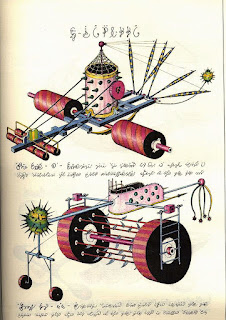
One critic calls Serafini's work  "a cross between a field guide to alien flora and fauna and an assembly manual for bizarre biomechanical devices, like something you'd find on a shelf in Dr. Strange's library – an arcane artifact that's recognizably a book, just not one from our reality."
A panel from a French exhibit of Serafini's work in October 2020

Why has this fanciful encyclopedia of Serafini's world that exists only in his mind, as creative and wonderful as it is, become a cult classic?  Maybe this psychotherapist, Douglas Hofstadter, has an answer. 
At Serafini's house in Rome. He is still writing,
still drawing, so there's no end to his Codex either. 

"On top of dreaming up a magnificently mysterious curly script in which all the articles were written (readable only by inhabitants of that world, sad to say, yet beautiful to behold by outsiders like us earthlings), he painted hundreds of fantastic, surreal scenes that would have sent chills up and down the spines of such madly possessed magicians as Hieronymus Bosch, Giuseppe Arcimboldo, Salvador Dalí, René Magritte, and M. C. Escher. Without any doubt, Luigi Serafini belongs in the ranks of those immortal geniuses, each of whom was gifted with a unique brand of deliciously demonic inventivity. Serafini matches them all at every level and in every dimension. I tip my hat with boundless admiration to this marvelous thinker, miraculous creator, and magistral artist."  Douglas Hofstadter
So, Philip.  Why do YOU like this book you can't read and that you find strange and weird?  "I don't know. It has do with the mystery of it, and the drawings." 

"Lots of people think the made-up language could be an actual language," he says. "There's lots of discussion online about it." 

Why would they think that? "Well, it might have grammatical rules or something. Also, the drawings are the coolest things ever and the art is unique. Where else can you find this information, Nana?"

Some Sources:  

1.  https://birdinflight.com/media/luigi-serafini-on-how-and-why-he-created-an-encyclopedia-of-an-imaginary-world.html

2.  https://contentcatnip.com/2018/09/21/book-review-codex-seraphinianus-by-luigi-serafini/

3.  https://newsrnd.com/life/2020-09-29-france-pays-homage-to-the--codex-seraphinianus-.rJeUvLYgUP.html   A 2020 exhibition in Southern France. 

4.  https://www.insider.com/codex-seraphinianus-luigi-serafini-interview-40th-anniversary-edition-2021-11

5.  https://www.wired.com/2013/10/codex-seraphinianus-interview/

6.  https://www.openculture.com/2017/09/an-introduction-to-the-codex-seraphinianus-the-strangest-book-ever-published.html  two pages from this weird Encyclopedia of a fantasy world

7.  https://en.wikipedia.org/wiki/Codex_Leicester

8.  https://en.wikipedia.org/wiki/Codex_Seraphinianus  "The Codex is an encyclopedia in manuscript with copious hand-drawn, colored-pencil illustrations of bizarre and fantastical flora, fauna, anatomies, fashions, and foods....The illustrations are often surreal parodies of things in the real world, such as a bleeding fruit and a plant that grows into roughly the shape of a chair....Others depict odd, apparently senseless machines, often with delicate appearances and bound by tiny filaments. Some illustrations are recognizable as maps or human faces; while others (especially in the "physics" chapter) are mostly or totally abstract. Nearly all of the illustrations are brightly coloured and highly detailed."  

Wikipedia also describes the structure of the book. "The book is in eleven chapters, in two sections. The first section appears to describe the natural world of flora, fauna and physics. The second deals with various aspects of human life, including garments, history, cuisine and architecture. Each chapter seems to address a general encyclopedic topic, as follows:

  1. Types of flora: strange flowers, trees that uproot themselves and migrate, etc.
  2. Fauna (animals), including surreal variations of the horsehippopotamusrhinoceros and birds
  3. An apparently separate kingdom of odd bipedal creatures
  4. Physics and chemistry (generally considered the most abstract, enigmatic chapter)
  5. Bizarre machines and vehicles
  6. The humanities: biology, sexuality, aboriginal peoples, including some examples with plant life and tools (e.g. pens, wrenches) grafted onto the human body
  7. History: people (some only vaguely human) of unknown significance, with their times of birth and death; scenes of historical and possibly religious significance; burial and funereal customs
  8. The Codex's writing system (which is to say, the – or probably, a – writing system of the world (if a world it is) from which the codex originates, or which it documents), including punctuation marks, the text being written, and experiments performed upon the text
  9. Food, dining practices, garments
  10. Bizarre games, including cards, board games and athletic sports
  11. Architecture." 

Monday, February 14, 2022

Russia v. Ukraine: David v. Goliath


Biden says latest intel indicates Russia will invade on Wednesday
16 February 2022.  Pray for Ukraine.

Russia has one of the most powerful militaries in the world. It ranks in the top five nations that spend the most on their military. In 2020, 
A map of Russia and Eastern and Western Europe. The
sheer size of Russia is daunting, and its military budget
even more so. 
Russian military spending amounted to $61.7bn. Ukraine’s was less than a 10th of that at $5.9bn, according to the Sto
ckholm International Peace Research Institute.  The Ukrainian military is bigger than it was in 2014, when Russia invaded and annexed Crimea and then invaded eastern Ukraine in the Donbas region where I served with the Peace Corps.  But it's still David v. Goliath when it comes to war and geopolitics.

It wasn't always the case. In fact, Ukraine used to be the third largest nuclear power in the world. It gave up nuclear weapons in 1994 in exchange for security guarantees from the US, UK and Russia.  These were promises to respect Ukraine's borders. Russia violated these agreements by invading Ukraine in 2014.  Only then did NATO station multinational forces to protect eastern Europe,  and the U.S. and allies imposed sanctions on Russian and pro-Russian oligarchs. These were the sanctions that Republicans sought to end in 2016, and in most cases did, Oleg Derispaka being the prime example.  

Although the NATO nations agreed to increase support for Ukraine, there is still no international accountability for Putin's invasion of the sovereignty and territorial integrity of Ukraine's borders, or for that matter for Russia's shooting down of MH-17 over the killing fields of Ukraine, which killed 298 innocent people, or the blatant breaking of international treaties. 

Crimean Tatars, a peaceful and long-suffering people,
mourn the 2014 Russian takeover of their homeland. 
After heroic efforts to return to Crimea & rebuild their
homes and communities, they find themselves once again
under the genocidal thumb of Russia. 
Few shed tears for the loss of Crimea, the indigenous home of the Crimean Tatars, now militarized, stalinized, and victimized by untold human rights abuses. I weep for Crimea, and for the loss of parts of Lugansk and Donetsk oblasts, where I lived for two years and where the warm and wonderful Ukrainian people took in a stranger and made me feel at home. 
. .

Putin, unchecked, will continue to grab Ukraine into his orbit. It touches the core of his revanchism. He is set on destroying Ukraine and with it NATO in one fell swope. He says this is non-negotiable. Not Ukraine, not any eastern European country, must be accepted into NATO membership. It cannot happen.  
Yesterday's protest in Kyiv. +

Shouldn't these countries be able to make their own decisions, free from the threat of war? It's not what Putin wants.  Nigel Gould-Davis, of the International Strategy Institute in the UK, argues that Putin's immediate fear is not NATO per se, "but its own currently declining influence over Ukraine, whose Western ties are growing deeper, resistance to local pro-Russian figures like Viktor Medvedchuk sterner, and national identity stronger.... Since time is not on Putin’s side, he is seeking to assert dominance over Kyiv while this is still possible.” (reported in Aljazeera, which is on top of this story). 

No one wants war with Russia. I think President Biden is making every effort to work with our allies in Europe to negotiate peace. Putin's aggression has strengthened our alliances, which as we know were severely damaged during the former administration. The president of Ukraine, Volodymyr Zelinsky, was elected by a large majority and is holding fast. He has made progress against corruption and is focusing on Ukraine's economy. I asked historian Timothy Snyder, author of The Bloodlands, if there were Nazis in the Ukrainian government. "There are no Nazis in the government," he said. Zelinsky, who is Jewish, is working on self-determination for Ukraine, and that's across the board.  That's what the vast majority of the Ukrainian people yearn for. 

In spite of the massive amounts of intel the US has, no one knows for certain what Putin will do. He's already achieved his goals of creating chaos and fear in the West. His military build up will make a decision to invade easy to carry out. And it will be devastating.

Biden warns that the latest intel suggests that Russia will attack on Wednesday. This Wednesday, February the 16th. 

Ukraine will resist, but it will not be able to hold back the mighty Russian military. I fear for arial bombings of Kyiv, an ancient and  beautiful capital city filled with extraordinary cathedrals. monuments, and neighborhoods. I fear for the destruction of the beauty of Ukraine across the country, from my town of Starobelsk in the far east to Lyiv in the far west of Ukraine; from Chernigov down to Odessa and around the Black Sea. I fear for my friends who have been in harm's way since Putin's 2014 invasion. 

If Ukraine falls, many Russia experts predict that so will other former Soviet Socialist Republics of eastern Europe. Belarus is already in alliance with Russia. Hopes for self-determination and autonomy will be gone. Western Europe will be on the Russian border, facing Putin's Ukraine strategy. The world will be a sadder place wherever Peace Corps volunteers have served in eastern Europe in their efforts to build fellowship across boundaries. 
Putin's map would look something like this, adding eastern Europe and more
territory to what is already the largest country on earth.
 Putin does not fear for his borders, he's hungry for war and revenge and international dominance over eastern Europe that will bring Russia to the boarders of the West. 
 

The drums of war are getting louder. The echoes of death and destruction are hovering. The saber rattling is morphing into boots on the ground and bombs from the air. President Biden says if Russia continues to advance into Ukraine, retaliation will be swift and forceful. What does that mean? I pray for my friends.  


Here is a powerful take by Anne Applebaum of The Atlantic, "The Reason Putin Would Risk War," February 3, 2022: "Putin is preparing to invade Ukraine again—or pretending he will invade Ukraine again—for the same reason. He wants to destabilize Ukraine, frighten Ukraine. He wants Ukrainian democracy to fail. He wants the Ukrainian economy to collapse. He wants foreign investors to flee. He wants his neighbors—in Belarus, Kazakhstan, even Poland and Hungary—to doubt whether democracy will ever be viable, in the longer term, in their countries too. Farther abroad, he wants to put so much strain on Western and democratic institutions, especially the European Union and NATO, that they break up. He wants to keep dictators in power wherever he can, in Syria, Venezuela, and Iran. He wants to undermine America, to shrink American influence, to remove the power of the democracy rhetoric that so many people in his part of the world still associate with America. He wants America itself to fail."

Sources/Notes:

1.   https://www.reuters.com/business/aerospace-defense/how-ukraines-armed-forces-shape-up-against-russias-2022-02-01/

2.  https://www.aljazeera.com/news/2022/1/25/infographic-military-capabilities-of-russia-and-ukraine-interactive,  Good on options for economic sanctions, which sound severe. 

3.  https://www.aljazeera.com/news/2022/1/27/ukraine-faces-enormous-military-odds-against-russia

“Ukrainian politics is quite a fractious sport because it’s undergoing a period of protracted reform from an oligarchical system. Russia is ruled under the iron grip of the regime and there wouldn’t be any vacillation on the Russian side,” he said, calling any Russian-Ukrainian war “an unfair fight”.

4.. https://www.nato.int/cps/en/natohq/topics_111767.htm

5. https://www.nybooks.com/daily/2022/02/04/an-open-letter-to-the-russian-leadership/

6,  https://francurrocaryblog.blogs+pot.com/2016/02/de-occupy-crimea-end-russian-occupation.html

7.  https://www.trtworld.com/magazine/how-russia-is-slowly-encircling-europe-32596

Friday, January 28, 2022

"Overcoming the Powers of Darkness:" The Fritz Ascher Society for Persecuted, Ostracized and Banned Art

Fritz Ascher was born on Oct. 17, 1893 in Berlin and died on Mar. 26,1970 in Berlin
A Holocaust survivor, his work was discovered by Rachel Cohen in the mid-80s and inspired her founding of The Fritz Asher Society in 2014. Ascher, an Expressionist and symbolism artist, is just now being rediscovered, so we are in on the ground floor..


Alice Cahana

  I discovered the Fritz Ascher Society by accident, when I was researching a blog on the artist Alice Cahana. Cahana (1929-2017) was a Hungarian Jew from Sarvar who survived four different concentration camps in the last year of WWII, losing every member of her extended family except her father and her beloved older sister Edith. Edith survived only to perish from illness immediately after liberation. She entered a hospital and Alice never saw her again. Cahana married and came to the US, where she became known for her art of the Holocaust and left a remarkable legacy. Loss is an enduring pain, Nazi terror knew no bounds, and it informed Alice's life and her art. How could it not?


In learning about Alice Cahana, I became interested in the art and the artists who survived the inhuman violence of  Nazi Germany and the Holocaust.  


So did Rachel Cohen, who some years ago discovered the art of Fritz Ascher, whose career, like Cahana's and so many other artists, was motivated, interrupted or destroyed by the Nazi regime. Cohen felt, rightly, that these artists had not received the recognition they deserved.  She writes:
"The strength and artistry of Fritz Ascher's work has driven me to try change that. In 2014 I founded the Fritz Ascher Society for Persecuted, Ostracized  Banned Art, which researches, discusses, publishes and exhibits artists whose life and work were affected by the German Nazi regime between 1933 and 1945. With our work we commemorate their artistic achievements, introduce work that may have been forgotten to a broad audience, and initiate an active dialogue about individuality and artistic integrity in response to conditions of extreme duress and political tyranny."   

This is God's work for sure. 

Fritz Ascher studied art in Berlin and began a brilliant career only to confront the fearful rise of Hitler's Nazi Germany. Moving from place to place to avoid capture, he, along with millions of others, could not escape the Gestapo's ruthless hunting rampages.  He was found and sent to Sachsenhauser concentration camp and then to Potsdam  Gestapo prison.

"Art interrupted," as art historians remark with sadness about the Jewish artists of these times.

When released Ascher lived in a bombed out shelter with the help of Martha Graftsmann until the war ended.  He resumed his painting, but his oeuvre came to embody the darkness and emotional terror that overcome his life and that of so many other artists then. 
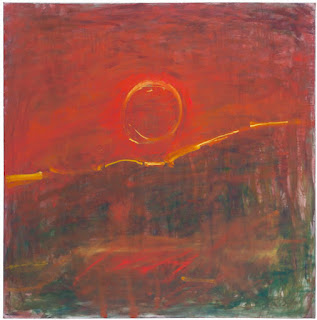
Ascher's Sunset, at Grey's Gallery, in 2019,NYU's fine
arts gallery in Washington Sq.in Greenwich Village.  

His work lay hidden from public view until Rachel Cohen discovered his paintings and vowed to bring them to light. 
“The intensity, the strong energy, the colors, the forms,” she said, recalling the first time she saw his work in the mid-80s. "It was love at first sight."  After years of study and research, Cohen is finally bringing Ascher's work to the public, and galleries, art auctions, social media sites, public exhibits, and some media exposure is amplifying the Ascher Society's efforts. Cohen's labor of love is expanding our art universe.

The Ascher Society recognizes as well that while the Nazi terror regime "is certainly the blueprint for authoritarian terror," there are other dictatorial regimes that have suppressed individual and artistic freedom during the 20th century. They deserve recognition too. There was the Stalinist terror of the late 1920s through the 1950s; China's long march terror under Mao ZeDong; Pol Pot in Cambodia; Salazar in Portugal; Franco in Spain, authoritarian takeovers in the Middle East, and in fact up to this 2022 International Holocaust Remembrance Day. 

The Ascher Society commemorates those who withstood these powers. I believe with the Ascher Society that by showing their work "we can inspire reflection, creativity and resilience in the face of adversity today...and provide today's audiences and society at large with valuable examples of how humanity can overcome the powers of darkness." 

Sources:

1.  https://fritzaschersociety.org/  "Comparing Ascher’s self-portraits from before and after the War equally proves instructive and offers insight into how Ascher’s psyche and his self-conception evolved as a consequence of his persecution. For an artist, the self remains a compositional subject infinitely in play as something to explore, avoid, grapple with, or deny. In this regard, Ascher’s multi-medium and multi-faceted study of himself and the representation of the inner life prove to be a consistent thread throughout his career."

2.  https://en.wikipedia.org/wiki/Fritz_Ascher 

3.  https://francurrocaryblog.blogspot.com/2020/12/alice-lok-cahana-holocaust-survivor.html

4.  https://borislurieart.org/about-boris-lurie  

5.  https://www.artforum.com/spotlight/boris-lurie-art-foundation-83595 

6.  https://300magazine.com/nightmare-art-inspired-by-war-first-us-exhibition-of-fritz-ascher-works/.  

7.  https://www.timesofisrael.com/if-not-for-the-nazis-he-may-have-been-the-next-leonardo/  


Monday, January 17, 2022

SPLC's Civil Rights Museum: Honoring MLK and the Monumental Struggle for Civil Rights and Justice


The newly redesigned Civil Rights Memorial Center in Montgomery, Alabama, remembers the past and challenges visitors to continue the struggle. The center provides another pillar to support the struggle for freedom and justice in this country. Southern Poverty Law Center (SPLC)


The Civil Rights Memorial Center (CRMC) in Montgomery, located new the church where MLK preached during the Montgomery Bus boycott, was created in 2005, designed by Maya Lin, famous for the Vietnam Memorial in Washington. The Southern Poverty Law Center (SPLC) created the museum as part of its long-time commitment to social justice.


The SPLC has been looked to as a pioneer in Civil Rights advocacy since its founding in 1972. Its had landmark cases against vicious White Supremacy, the KKK, and all forms of  racial injustice since then. SPLC has had its own struggles and some painful inner turmoil, but it is back to the SPCL we idealist liberals have known and loved since Julian Bond served as president. It's  why I continue to support its work. It's new president, Margaret Huang, formerly head of Amnesty International, is committed to its mission and its legal, advocacy, and educational goals.    

The renovated Civil Rights Memorial Center (CRMC), given added weight as the Black Lives Matter movement ricocheted across the country, embodies this mission. It embodies the passion and commitment of Martin Luther King. It emphasizes the civil rights movement "as a continuum, weaving together the US's history of racism with the ongoing activism in pursuit of equity. Like the work of the SPLC itself, the museum challenges visitors to be catalysts for justice." Its new exhibits, videos and hands-on materials sound fascinating and moving, its educational mission as important as SPLC's legal advocacy. 
“The reopening of the CRMC comes precisely at the right moment as our country grapples with efforts to prevent the teaching of an honest history about race and racism in our schools,” said Margaret Huang. "The CRMC and museums across the country can help fill those gaps. I’m thrilled that the CRMC is reopening to once again help visitors understand the truth about the history of civil rights advocacy in this country.”
Martyrs of Civil Rights movement engraved on black granite wheel.


Photo Haraz Ghanbari/AP

The SPLC's recognition of and commitment to lifting up the work of activist and community organizers on the front lines of the fight for racial justice resonates especially with historians of the movement. People like Fannie Lou  Hamer, who fought for voting rights from the ground up in Mississippi when the KKK rode roughshod over the lives of African Americans and lynching darkened the Southern landscape with violent deaths 

The Museum honors them all, and all those who fought and died for the monumental struggle. The names of civil-rights martyrs from 1954 to 1968 are engraved on the Memorial's circular black granite table. It honors those killed, terrorized, and buried in the darkness of tragic loss. It reminds us that the work for equality and justice never stops.  

Tragically, the fight for voting rights, the basic rights in a democracy,  is with us again. It is shattering. That no elected Republicans in Congress will vote for the current voting rights bills passed by the House is criminal; it's treasonous. That's why we need the continuing educational and legal advocacy of the SPLC and its Civil Rights museum, as well as other museums and memorials in Montgomery, and in several other Southern cities.

Martin Luther King's dream remains unfulfilled. It's up to us to make it a reality, to continue the monumental struggle for civil rights for all Americans, "until justice rolls down like waters and righteousness like a mighty stream." . 

A story of one victim of White Supremacy, Johnnie Mae Chappell.
https://www.splcenter.org/news/2021/02/12/remembering-johnnie-mae-chappell-jim-crow-era-injustice-resonates-period-black-lives-matter

Some Sources:

1.  https://www.splcenter.org/news/2022/01/14/redesigned-crmc-encourages-fight-social-justice?

2.  https://en.wikipedia.org/wiki/Southern_Poverty_Law_Center good descriptive article, with a good list of the cases SPLC has litigated.

3.  https://www.latimes.com/travel/la-tr-alabama-mississippi-museums-20180722-story.html

4.  https://www.goworldtravel.com/tragedy-triumph-civil-rights-sites-alabama/. There are several Civil Rights museums in the US. I'd like to take a tour of all of them. It would be good to take high schoolers on a tour especially now. 

5.  https://www.cleveland.com/travel/2021/04/montgomery-alabama-confronting-americas-painful-past-at-the-legacy-museum-along-the-us-civil-rights-trail.html

6.  https://www.nytimes.com/2020/03/11/arts/civil-rights-trail.html 

7.  https://heathercoxrichardson.substack.com/p/january-16-2022 A brief and important history: 

"Republicans say they oppose the Freedom to Vote: John R. Lewis Act because it is an attempt on the part of Democrats to win elections in the future by “nationalizing” them, taking away the right of states to arrange their laws as they wish. Voting rights legislation is a “partisan power grab,” Representative Jim Jordan (R-OH) insists. / In fact, there is no constitutional ground for opposing the idea of Congress weighing in on federal elections. The U.S. Constitution establishes that “[t]he Times, Places and Manner of holding Elections for Senators and Representatives, shall be prescribed in each State by the Legislature thereof; but the Congress may at any time by Law make or alter such Regulations.”

There is no historical reason to oppose the idea of voting rights legislation, either. Indeed, Congress weighed in on voting pretty dramatically in 1870, when it amended the Constitution itself for the fifteenth time to guarantee that “[t]he right of citizens of the United States to vote shall not be denied or abridged by the United States or by any State on account of race, color, or previous condition of servitude.” In that same amendment, it provided that “[t]he Congress shall have the power to enforce this article by appropriate legislation.” /   It did so, in 1965, with “an act to enforce the fifteenth amendment to the Constitution,” otherwise known as the Voting Rights Act of 1965, a law designed to protect the right of every American adult to have a say in their government, that is, to vote. The Supreme Court gutted that law in 2013; the Freedom to Vote: John R. Lewis Act is designed to bring it back to life."

Thursday, January 6, 2022

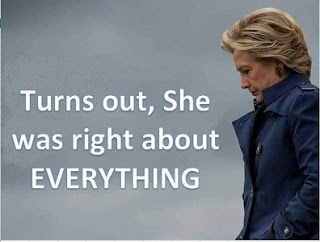
Favorite Memes of 2021 & Doing my Bit


A picture says a thousand words. A meme gives a message in as few words as possible. It's like folk art. Words and text with a message from the heart.

Another year comes to an end, and lots of great meme's tell the story of how it went. Issues captured in one little message that carries a lot of meaning.

For fellow Democrats, a meme actually makes our ranting less noisy, . In a few words it can save a thousand words.  


No gun shops in Sylvania

Used this one a lot. Historian
Chris Browning on the "gravedigger
of democracy." 
There are lots of memes on the other side, sure, on the dark side, lots of propaganda in my view, in support of sedition, lies, gaslighting. But I spot the ones that mean the most to the millions who voted for Biden and want to save our democracy in these unhinged, twisted time.

What the memes on the progressive side of the political spectrum tell us is that the resistance to tyranny, betrayal of rule of law, dereliction of duty, and sedition is alive and well.  
Toledo's Resist Portman Indivisible group meets on Zoom 
on Tuesdays. The R Senator, who voted tRUmp all the way, every time,
 is not running. Hope to turn his seat Blue with Rep.Tim Ryan (OH,D). 


The Sisters of St. Francis
hold BLM protests every
week. I'm happy to join.
them
.          

 
Thanks to Indivisibles across the land, local and state action groups, progressive media organizations, and voter rights advocates everywhere who have been on the front lines since the Women's March on Washington in January 2017. It's been over 6+ years. We've been marching and protesting ever since. I've done my bit, and whenever I'm on the streets with my signs, I feel better. I'm considered an old warrior, which is fine by me. 

Thanks also to the Southern Poverty Law Center, CREW and like-minded organizations for exposing corruption and going after the dark $ unleashed by Citizens United against our politics and our culture. I was with the resistance 100%, and did my bit for saving our democracy.

Here are some of my favorite memes that tell a larger story in a few words and images. 

We know the state of our Judiciary branch from SCOTUS on down is precarious. With millions of dollars from Koch networks and  dark money funders, the Judiciary branch has been loaded with far-right wing zealots from top to bottom. SCOTUS stands on the precipice of irrelevance. We have lost confidence in the highest court in the land. Chief Justice Roberts has joined Justice Sonia Sotomayer in sounding the alarm.  
"Gravedigger" of democracy

Mitch McConnell has played a major role in corrupting the Judicial branch, cramming over 260 far-right, unqualified, unapproved by the Bar, without judicial experience  on the courts. It is rank dereliction of duty to obstruct Senate legislative activity, deliberately rig Senate "juries"  to vote against impeachments, to pack the courts. Liar Kavanaugh? Dancing on Ruth Bader Ginsburg's grave?  Senator Sheldon Whitehouse is on it. I'd like to assume the FBI is on it too. A real investigation this time around.


Voting Rights protest with
friend Janice.
While I'm on McConnell, it is still a question how one person, plus one (Manchin) since 2020, can get away with obstructing action on the VOTING RIGHTS BILLS that have been passed by the House.  How is it that Mr. Filibuster McConnell gets away with no action on bills piling up his desk?  Doesn't the Senate have a constitutional duty to act on them?  Isn't it dereliction of duty? 

And what about accountability for all those involved in the insurrection against the US government and all those Republicans who voted the Big Lie on the presidential election, with tRUmp watching it on TV with glee?  Extreme dereliction of duty again, and again, since the former guy lied about crowd size and committed over 92,000 lies thereafter.  

If the January 6 committee keeps working full steam ahead, as it is doing now, I predict that there might very well be some 100 Republican seats open in 2022 and 2024. Public hearings are planned, evidence is piling up, cases are being made. It looks like tons of information will be revealed. Liz Cheney has made that clear.  A sea change could be upon us.  "The times they are a changing,"  as Dylan sang. Liz Cheney might very well get the GOP back on track, and maybe run for president too.  
It would help a lot if we could get money out of politics by legislating transparency and safeguards, putting limits on corporate lobbying, making it illegal for Congress members to own stock, ending Citizens United. Senator Elizabeth Warren has drafted some excellent legislation to address these issues. Lots of good memes advocate for change. Get money and greed out of politics. 

And while we're getting money out of politics, we need to tax the rich, too.  Robert Reich, public economist #1, is on these issues. His memes are the best. Reich can pack a message better than just about anyone! He kept them coming in 2021.
This is what Reich preaches. Wisdom
from a great President. When will this
message sink in to all voters?


I also like the progressive memes on getting Putin out of Ukraine.  Ukraine has been in the center of the Cabal's corruption at least since Paul Manafort became head of the fool's campaign. Putin is threatening again, amassing some 90,000 troops on the border, saber-rattling. He gets off on it. But it's exactly where I served, in Starobilsk, Lugansk oblast, far-eastern Ukraine close to the Russian border.  It's complicated, but my friends are in harm's way, and I care what happens.  


Other issues that matter include Voting Rights, gun violence, and Black Lives Matter (BLM ). There are tons of them but these remind us that White Supremacy is alive and well, and poisoning our social fabric the same way it's done since the beginning of time.  I've never been so aware of White privilege.  

And finally there's a lot of unfinished business on the 2022 political agenda. These memes point the way.


America awaits real action on climate change, addressing the ongoing Covid 19 pandemic to reduce incidents and deaths, and bringing final accountability for those who planned, organized, and funded a coup to overturn a presidential election in gross violation of Rule of Law, the worst case of treason and dereliction of duty this country has ever seen. . 

 "There’s is no Law and Order without Justice. There is no Justice without accountability." 

Lots of unfinished business. This is tip
of the iceburg in the foreign relations department.
There's Ukraine, Iran, Saudi Arabia, what Kushner did in 
Israel, secret deals with Russia, North Korea, enemies of the US.   the role of transnational networks, and extreme dereliction of duty to protect and preserve the USA. 

A new year's wish. 


Interesting Guardian article on memes: 


Don't get out the popcorn yet: The Wheels of Justice Grind Slowly

"Delay, Delay, Delay: From pre-trial motions to negotiations over security, the master of legal stalling has many tactics in his arsena...