Monday, May 28, 2018

Discovering Poet Yosef Komunyakaa on Memorial Day 2018

I discovered a poet I should have known about many years ago. Yosef Komunyakaa. He won the Pulitzer Prize for Poetry in 1994 for his book, "Neon Vernacular."  I'm ordering it on Amazon, along with a few others of his works. I've spent most of the day, between doing some gardening, reading his poems online, enrapt in metaphors, allusions and fanciful reflections.

My friend Alice Twombly brought Komunyakaa to my attention on this Memorial Day, May 28, 2018, when we have a self-absorbed lying traitor in the White House who cannot commemorate the day without making it about himself. 

Alice and I noted the offense. She suggested I look up Komunyakaa's poem "Facing it."  And I did.   It's how a real warrior, a Vietnam Vet from Louisiana, a poet soldier, would remember the day. Alice, the master teacher, is teaching the poem to her class tomorrow, so it's fresh on her mind. I wish I could be there.

Vietnam War Memorial, Washington, DC
The poem is about  Komunyakaa's visit to the Vietnam Veterans Memorial and, yes, facing it: facing the war. Facing the horror, the pain, the loss.  The poet becomes absorbed in the glossy black granite of the wall, a mirror, etched "like  smoke" with the names of those who died. His name's not there, but he finds the name of a friend. He cannot hide what he sees, "I see the booby trap's white flash." He's inside the horror, inside that shiny black granite, absorbed in images and memories that he doesn't want to remember. "Metaphor meets monument," Robin Ekess put it in a Poetry's Foundation's interpretation of the poem.  Komunyakaa the poet meeting Maya Lin, the architect.

Komunyakaa's poem, like Lin's wall, is a powerful metaphor for this Memorial Day 2018, facing the reality of what war means, facing the truth.

Facing It, by Yosef Komunyakaa
My black face fades,
hiding inside the black granite.
I said I wouldn't
dammit: No tears.
I'm stone. I'm flesh.
My clouded reflection eyes me
like a bird of prey, the profile of night
slanted against morning. I turn
this way—the stone lets me go.
I turn that way—I'm inside
the Vietnam Veterans Memorial
again, depending on the light
to make a difference.
I go down the 58,022 names,
half-expecting to find
my own in letters like smoke.
I touch the name Andrew Johnson;
I see the booby trap's white flash.
Names shimmer on a woman's blouse
but when she walks away
the names stay on the wall.
Brushstrokes flash, a red bird's
wings cutting across my stare.
The sky. A plane in the sky.
A white vet's image floats
closer to me, then his pale eyes
look through mine. I'm a window.
He's lost his right arm
inside the stone. In the black mirror
a woman’s trying to erase names:
No, she's brushing a boy's hair.

President Obama tweeted what many of us feel about this day.  "We can never truly repay the debt we owe our fallen heroes. But we can remember them, honor their sacrifice, and affirm in our own lives those enduring ideals of justice, equality, and opportunity for which generations of Americans have given that last full measure of devotion,” he  tweeted.  This is what we needed to hear on this Memorial Day 2018, and the dirge for fallen soldiers. .

Source:
Yusef Komunyakaa, “Facing It” from Pleasure Dome: New and Collected Poems. Copyright © 2001 by Yusef Komunyakaa. Reprinted with the permission of Wesleyan University Press.
Dodgepoetry.org.

Brief  biography: Internet Poetry Archive.
Komunyakaa was born on 29 April 1947 in Bogalusa, Louisanna, the oldest of five children. His  childhood experiences inform many of his works: his family relationships, growing up in a rural Southern community, being close to the jazz and blues environment of  New Orleans.  He was born James William Brown. He legally changed his name to Komunyakaa in memory of his grandfather, who was from the West Indies and, as family legend went, had arrived in America as a stowaway on a ship. After  high school he joined the Army and served in Vietnam (1969-70), working as a war correspondent and specialist for the military paper Southern Cross, covering actions and stories of fellow soldiers. After his tour of duty, he went to the University of Colorado and discovered his love of poetry. He spent time with the Provincetown Fine Arts Work Center after getting an MFA from the U. of California at Irvine, a transformative experience. "A sort of unearthing has to take place," he wrote," Sometimes one has to remove layers of facades and superficialities.  The writer has to get down to the guts of things and rediscover the basic timbre of his or her existence."  He's a prolific writer, with dozens of books to his name, among them Pleasure Dome, Taboo, Talking Dirty to the Gods, Thieves of Paradise, Neon Vernacular, and Magic City.  He teaches creative writing at NYU.


Friday, May 25, 2018

The New Fake GOP


From Kevin Baker, New Republic article, May, 17, 2018.
Illustrations by Christine Cornell.
"The right lies pervasively, and it lies well. Its lies have become deadly, living fantasies—as lies will, given enough political muscle." Kevin Baker, "Nothing is Hidden," New Republic, May 17, 2018

"If a political party does not have its foundation in the determination to advance a cause that is right and that is moral, then it is not a political party; it is merely a conspiracy to seize power."  
President Dwight D. Eisenhower, speech, March 6, 1956

"This is not your father's Republican Party. They are not who we are. They are not who America is. What they are doing is sending a vision of America around the world that is distorted. That is damaging. That is hurting us...this phony populism, this fake nationalism.... It's time to say 'no more.'" 
Joe Biden at NY convention renominating Cuomo for NY Governor, AP, May 24, 2018

America needs a new, wholly reconstituted Republican party.  It could be a revival of Abraham Lincoln's party that fought for freedom and a united America through a brutal Civil War, or the Eisenhower Republican Party that put country over party and honored the Rule of Law above all else. I can even see a return to George W. Bush's "compassionate conservatism." 

I never thought I'd be writing these words. It's an indication of how the present revises  history over time. 

But America needs a two-party system afterall, maybe even more parties, and the corrupt, traitorous tRump regime, which thinks it's above the Rule of Law, forces some rethinking. 

We have a president who cannot tell the truth, assails the free press, rants about conspiracy theories and a "deep state," and lies to the American people every day.  We have a corrupt Cabinet that is dismantling the government agency by agency. We have a right wing extremist judge on the Supreme Court who favors eliminating every law that protects workers and ordinary Americans from the greed of corporate overkill. We have a Congress that is not fulfilling its Constitutional duty to provide oversight of the Executive Branch. In fact, the three branches of government, absolutely central to how our democracy works, have become frightfully unbalanced. 


The modern Republican Party has let the fox into the hen house.  "Alt-right extremists, a fundamentally anti-democratic  cabal funded by billionaires and "dark money" sources to enrich themselves, has taken over the GOP to the point that it no longer exists as a real party. McConnell and Ryan have encouraged and allowed it to happen.  

Eisenhower was right: The GOP today "is merely a conspiracy to seize power."   

Kevin Baker, in an important New Republic article, cited below, noted the dire consequences for America: 
"In less than a year and a half in office, Donald J. Trump and the squalling far-right movement he has dragged into the White House like a mischievous dog have already changed the parameters of the American presidency and the nation’s politics beyond recognition."
An alt-right extremist vision of America has swept across the land. Kevin Baker has a good handle on what this alt-right vision is, which he calls "a sort of anarcho-corporate state."  What is an "anarcho-corporate state"?  Baker's description is worth noting and remembering. 
"[It's a state] in which pretty much everyone will be armed and able to threaten each other into nonviolence; miraculously reconstituted extended families will eradicate the need for Social Security and Medicare; poor children will work as janitors to pay for their schooling; tax cuts will generate enough income to offset the need for subsidized health care; public property will be largely eliminated; and no regulations of any kind will apparently be required to keep our food, water, air, money, or medicine safe or to determine how the public will shape its own towns and cities."
"In everything from Education Secretary Betsy DeVos’s desire to turn the public school system over to the church, to House Speaker Paul Ryan’s tax plan with its backdoor assault on Medicaid, Medicare, and Social Security, the modern-day GOP moves determinedly toward turning these fantasies, no matter how putrid or dangerous or unpopular, into a reality."
I think that in time--maybe at the conclusion of the Mueller investigation or after the mid-term elections--these fake Republicans will be charged with dereliction of duty, abuse of power and obstruction of justice. This will include a failure to  protect and preserve the balance of powers and the institutions which ensure America's safety and domestic tranquility.  


“The GOP we knew pre-Trump began its death march the day Trump secured the nomination," said Tara Setmayer, a former communications director for Rep. Dana Rohrabacher (R, CA), now a CNN commentator.  "It has accelerated down the slippery slope ever since with party leaders who used to be the vanguards of basic Republican principles and decency now becoming enablers of the party’s own demise."

Sources
1) https://newrepublic.com/article/148270/nothing-creation-hiddenFrom the article: Eisenhower to his brother, when the GOP was an honest party in touch with reality."Should any political party attempt to abolish social security, unemployment insurance, and eliminate labor laws and farm programs, you would not hear of that party again in our political history. There is a tiny splinter group, of course, that believes you can do these things ... an occasional politician or business man from other areas. Their number is negligible and they are stupid." Interesting. Too bad the GOP didn't nip this "negligible" and "stupid" extremist group in the bud.  Today it now dominates and has destroyed the legitimate Republican party.

2)  https://www.washingtonpost.com/news/politics/wp/2018/01/23/what-does-the-republican-party-look-like-after-trump/?utm_term=.386f09e8e70e by Philip Bump.  "...the Trump era will end, and a Republican Party that has been subsumed to the president’s personality, temper and raucous base will need to figure out a path forward."  Quote from Tara Setmayaer:  “The GOP we knew pre-Trump began its death march the day Trump secured the nomination,” said Tara Setmayer, former communications director for Rep. Dana Rohrabacher (R,CA), now a CNN commentator. “It has accelerated down the slippery slope ever since with party leaders who used to be the vanguards of basic Republican principles and decency now becoming enablers of the party’s own long-term demise./....Trump’s brand of rabid economic populism fueled fear and isolationism rather than optimism and inclusion and is the antithesis of Reagan’s ‘shining city on a hill’ or Bush’s brand of ‘compassionate conservatism....Could the party of those eras be resurrected? “I’m not sure.”

3) Joe Biden at NY Democratic convention endorsing Cuomo for governor for a 3rd term, AP, May 24, 2018.

Tuesday, May 22, 2018

Loren's Spirit Keeps us Going


Remembering Loren.
Raining on Irina's flowers
  in Starobelsk, Ukraine. 
It's been eight years since my brother Loren's last hike, on May 23, 2010. He died on the trails of northern Florida along the Aucilla River.  His hiking friends from the Tallahassee Trails Association found him and ran for help.  It was too late. Loren's spirit flew up and away, into the great beyond. I like to think an Eagle flew overhead at that very moment, like the one he spotted at St. Marks Preserve the day our Mom died at the end of March 2003. 

I was in Ukraine when that eagle flew over the Aucilla River, so far away. A very early morning call, connected through Peace Corps headquarters in Kyiv. My sister's voice, crying.  The sad messenger of the saddest news. So sudden, so unexpected. Our sister Andy, living in Tallahassee, felt her heart skip a beat when two police officers, in solemn faces, appeared at her door. "I knew something was wrong the minute I saw them," she said. The shock still lingers, for both of us.   

We were adults, retired, getting up there in age, but we weren't ready for our little brother's death at 63 years old.  Too young. Same age that our dad died.  Loren wasn't ready either. His autobiography about growing up with Asperger's Syndrome was about to come out. He had poured his heart and soul into it. He had all his environmental and political work awaiting him.  He had so much reading to do. Loren always surrounded by books, an enduring image. He wanted to travel, too, return to his beloved upstate New York, to the Rochester area where we grew up, to the Finger Lakes, the Adirondacks, maybe a trip to Mexico with his sisters. Instead, Loren was taken on a different trip, one we were powerless to redirect.   

Whenever Andy and I rant about the news of the day, which is a lot now, we miss Loren's voice. "If only Loren were here," we say.  We want to hear his take on things, learn new ways of looking at them from his vast knowledge about everything on Earth. 

But Loren is somewhere else. I'm not sure where. I hope he is hiking in the cosmic hologram of another dimension, beyond global warming and the desecration of the Earth he fought so hard to protect. I hope he's in a place without hate, guns, war and violence, his Aspie self aglow in the warm embrace of the goddess. 

When I think I hear his voice, because I want to so badly, he is calm. Like a serene Buddha. He seems to have a  kind of lofty perspective on humans doing their thing on earth. He seems to know that our ideals will survive and save us, as they always have. That the arc of history is toward justice, as MLK taught us.  It's not a raging voice; it's a quiet voice of compassion and empathy. I see the light from a lovely soul at peace with himself and the world. “I've done my part," he seems to say. "You guys have work to do. Don't stop now, until we meet again.”

A POEM FOR LOREN. 
The Dead, by the wonderful poet Billy Collins, former US Poet Laureate

The dead are always looking down on us they say,
while we are putting on our shoes or making a sandwich,
they are looking down through the glass-bottom boats
of heaven as they row through eternity.

They watch the top of our heads moving on earth,
and when we lie down in a field or on a couch,
drugged perhaps by the hum of a warm afternoon,
they think we are looking back at them.

Which makes them lift their oars and fall silent
and wait like parents for us to close our eyes.


Thursday, May 17, 2018

Moses Fleetwood Walker and his Times

. 
The Thaddeus Walinsky History Group (named after a devoted Toledo historian) meets on the first Monday of every month.  The last meeting, which my friend Teddy and I attended, focused on a talk by David Wise and Bill Romp about Moses Fleetwood Walker. Walker was an Ohio native son, African-American baseball player with a stint in the Major Leagues before Jackie Robinson, and entrepreneur.  His name suited him, emblematic of Biblical naming patterns adopted by freed slaves and their descendants on the long road to freedom.  But actually it seems he was called "Flint," and that suited him too!

The History group meets at the Beirut Restaurant, an homage to Toledo's large and long-established Lebanese-American community, from which have come prominent lawyers, judges, teachers, and  civic and business leaders. It takes me back in time to the 1970s-80s, when I worked with Judge Charlie Abood on a pioneering Lucas County family violence prevention project chaired by the Bishop of the Toledo Diocese, James Hoffman.  I will always remember these two civic leaders, the Judge and the Bishop, for their commitment to promoting a compassionate Toledo.

The History group is a wonderful opportunity to learn about local and state history, as well as American and World history of interest to particular members. Members take turns giving presentations, with time for questions and answers. It's fun and intellectually stimulating to have a chance to talk history over a wonderful Lebanese meal.

Moses Fleetwood Walker,
Wikipedia. 
So we learned about Moses Fleetwood Walker (1856-1924), with Bill Romp presenting an interesting biography.  Walker was born in Mount Pleasant, Ohio, a working class town in eastern Ohio with a large Quaker community that had served as a sanctuary for runaway slaves since 1815 (fascinating information). When Moses was a child the family moved to Steubenville, where his father became one of the first black physicians in Ohio and later a minister of the African Methodist Episcopal (AME) Church. The AME church was among the first denominations founded on racial grounds rather than theological differences, and always advocated for civil rights through social improvement and political action. (Wikipedia).

Walker's family and the Steubenville Black community where he grew up influenced the direction of Moses' life. He became a star athlete at Oberlin College, where his baseball career as a catcher started, and later at the University of Michigan. These colleges were ahead of their time in accepting women (such as women's rights advocate Lucy Stone) and Black students, and Walker took advantage of it. He was a good student, favored philosophy and art, but his first love was baseball.

Logos of these great  organizations.
"Discover Greatness!" a perfect motto
.
He played for semi-professional and minor league teams before joining the Toledo Blue Stockings of the MLB's American Association (AA) for the 1884 season.  Moses was apparently the last African American to participate in a major league before Jackie Robinson broke baseball's color line in 1947. Like Robinson, Walker bore his share of  racial taunts and jeers.  I recalled that it was the virulent racism in America that infused our "favorite past-time" and led to the formation of the Negro Baseball Leagues, where some of the best players in the country, like pitcher Satchel Paige, played in segregated games to the thrill and pride of huge Black audiences. Robinson's achievement in "integrating" the Majors led to the end of the Negro Leagues (documented in several studies and in Ken Burn's "Baseball" series).  It remains debatable to this day whether the end of segregation hurt more than helped the once-thriving black communities of America. 

Moses was proud of his African-American heritage, Bill Romp noted, and he had an entrepreneurial spirit. Besides his love of baseball, he engaged in various business ventures; edited a newspaper, the Equator, with his brother Weldy (also a baseball player); and wrote a book, Our Home Colony (1908), exploring ideas about emigrating back "home" to Africa. He floundered a bit when his baseball career ended and he had his rough times as well as good times. Moses died in 1924 at the age of 67.

Considering the historical context in which Moses Walker lived--the Era of Apartheid and White Supremacy, as vicious here as anywhere in the world--his achievements and those of other African Americans at the time are remarkable.

Human bondage did not end with the Civil War.  No. Another form of bondage emerged during Reconstruction and well into the 20th century, and in the most vicious forms imaginable.

It was human bondage embedded in stifling Jim Crow Laws and the southern Black codes; the passage of laws forbidding former slaves from hunting, fishing and foraging (major means of survival); the resulting creation of a new "criminal" class of  young black men who worked like slaves on chain gangs as cruel as any South African prison or Russian Gulag; relentless oppression and injustice without civil rights, without any rights at all; and the terrorism of the KKK, which dominated the American landscape.  Lynchings were at an all-time high, a sickening spectacle of emboldened White Supremacy. These gruesome murders led to the courageous anti-lynching efforts of journalist Ida B. Wells (the history of  black women pioneers too often hidden) and then to the NAACP's Anti-Lynching Campaign. (I worked in the NAACP records, at the Library of Congress; they are the most graphic, unnerving, and saddest documents I have ever worked in as an historian).

A parallel reality also existed at this time. It is, indeed, a major theme of the African-American experience: the persistence and strength of Black communities across the South and into the North, surviving against the odds; the grassroots struggle for civil rights, including the right to vote, like the efforts of Fannie Lou Hammer and sharecroppers in Mississippi; the emergence of Black educational, religious, businesses, and social and cultural institutions that sustained these communities; and the training and rise of brave men and women leaders who put Black civil rights on the national agenda.

In Walker's time, hundreds of African-American women, working to the bone to keep their families
together and sick and tired of the oppression, rose up to mobilize the masses of Black folks across the South and North. Among them were women pioneers like Ida B. Wells and Mary McLeod Bethune, educated activists way ahead of their time. In their footsteps, three prominent African-American men also stepped onto the national stage. They were Booker T. Washington, W.E.B. DuBois, and Marcus Garvey. They shared the same goals--equality, justice, equal opportunity--but they had different strategies for getting there, strategies that are debated to this day.


Booker T. Washington (1856-1915) was probably the most well-known of the three, and certainly the least feared by the white community because he did not focus on integration or civil rights. Born into slavery, Washington called for black progress through education and entrepreneurship.  He promulgated this strategy in his famous "Atlanta Compromise," which called for building the black community's economic strength and pride through self-help. His base was Tuskegee Institute, a historically black college in Alabama. It could well be that Walker the entrepreneur learned a lot from Booker T, and in many ways embodied his self-help strategies.

W.E.B. DuBois (1868-1963), a Harvard PhD, sociologist and historian, author of the epic "Reconstruction in America" and "The Souls of Black Folks," moved beyond Booker T's "Atlanta Compromise" approach.  DuBois focused on working for political change, integration, and equal  rights. He was a co-founder of the NAACP in 1909, but in time moved beyond this organization as well to call for more revolutionary actions against American racism. There are plenty of hints that Moses knew of DuBois, shared the goals of the NAACP, and was familiar with its remarkable lawyers, including Walter White, who headed the Anti-Lynching campaign, Professor Charles Houston of Howard University in DC, and perhaps even Houston's student, the young Thurgood Marshall, who later become the first African American Supreme Court Justice.

Marcus Garvey  (1887-1940) was a proponent of Black nationalism and leader of  a mass movement called Pan-Africanism.  Moses Walker certainly knew of Garvey's ideas, and incorporated them into his own book, "Our  Home Colony." Garvey founded the Universal Negro Improvement Association, the African Communities League, and the Black Star Line, a shipping and passenger line that promoted the return of the African diaspora to their ancestral lands.

Moses Fleetwood Walker's life is part of this larger story of  the African American experience and the struggle for freedom. It's truly an American story of Achievement against the Odds.  Incredible odds.  There was a mountain of  oppression, hatred and despair to overcome, Martin Luther King, Jr. reminded us. America is still a work in progress, still struggling to live up to it's ideals, time after time, generation after generation.

Some sources:  Talk by history group members David Wise and Bill Romp; Wikipedia and blackpast.com.  Pat and Frederick McKissack, Jr., Black Diamond: The Story of the Negro Baseball Leagues (New York: Scholastic, 1994) and "Baseball," Ken Burns' documentary. Wikipedia bios on Booker T. Washington, W.E.B. DuBois, Marcus Garvey.

Dr, Martin Luther King, Jr.,  I've Been to the Mountaintop, April 3, 1968
Like anybody, I would like to live a long life.
Longevity has its place.
But I'm not concerned about that now.
I just want to do God's will.
And He's allowed me to go up to the mountain.
And I've looked over.
And I've seen the promised land.
I may not get there with you.
But I want you to know tonight,
that we, as a people will get to the promised land.


From interesting article by Kevin Baker, "Does America need truth and reconciliation after Trump," New Republic, May 2018, discussing another period when America did:
"African Americans were ... moved from slavery to serfdom. The new Southern constitutions contained horrific “Black Codes” so close to the same states’ old “slave codes” that in places they simply lifted entire blocks of text from the antebellum statutes and substituted “Negro” for the word “slave.”
The Black Codes of 1865–1866 restricted every form of African American activity as closely as any totalitarian state has ever controlled its population. They legally tied the former slaves to the lands of their once-and-future masters and began the long tradition of convict labor that still plagues America to this day, creating incentives for local police forces to arrest people of color on the flimsiest of pretexts and force them into what Douglas Blackmon called, in his book of the same title, “slavery by another name.”"


Tuesday, April 17, 2018

Fr. Jim Bacik: Opening the Catholic Church to the World

image by tsahaylu


I haven't been to a Fr. Jim Bacik lecture in a while, but I'm glad I went last week. I met friend Teddy and we planned to go to dinner afterwards. Fr. Bacik, ever the scholarly theologian,  talked about the "new tribalism," the tendency to gather with like-minded people, as a response to globalization. He emphasized the dangers of turning inward and ignoring or demonizing those who are different. He pointed to the growing number of hate crimes in the US, the renewed anti-semetism, angry racism, white nationalism, the prejudice against Muslims, and the rise of an extreme political partisanship pulling people apart and destabilizing the world.

Before talking about Vatican II (1962-1965) and Pope John XXIII, Fr. Bacik recalled the Council of Jerusalem in the year 62 AD, where debates between Paul and Peter and different factions led to more openness in the church, a kind of first step to a more tolerant mission.

Pope John XXIII. Pope Francis continues his
tradition of a church open to the world,
 and I think he looks like him too. 
 
Vatican II revived the spirit of the Council of Jerusalem to renew calls for a Church that was relevant to peoples around the world. It's the spirit that Pope Francis, coming as he did from serving in Argentina and among the poor, embodies and carries on today.

John XXIII wanted Aggioramento, a rural church, a humble and loving Church that welcomed all people everywhere. This is  how the Catholic church reached out to South America and Asia and Africa.  Of course there was the inevitable resistance to change. The Curia leaders and the Bishops rose up to defend tradition, like Cardinal Ottaviani, whose motto was Semper Idem (Always the same).  I like that Latin phrase, and often have need of it!

What were the key issues?
*The liturgy: use of the vernacular instead of Latin so that parishioners went from being passive spectators to active conscious participants in the service
*Spirituality: from holiness for priests and nuns to a universal call to holiness
*Religious liberty: from Catholic privilege to freedom for all
*From a ghetto mentality to ecumenical dialogue
*From opposition to other religions to interfaith dialogue and cooperation
*From withdrawal from the world to active engagement.

Lovely statue of John XXIII in front
of St. Anthony's Church in Istanbul,
 where he preached for 10 years
 before becoming Pope.
Pope John XXIII prevailed.  Vatican II marked a new era in which the Catholic church "would understand itself for the first time as a World Church." As Karl Rahner, Fr. Bacik's mentor and a brilliant theologian noted, Vatican II was the most important change in the church after the Council of Jerusalem. It offered salvation and freedom of conscience, and energized ecumenical dialogue. Fr. Bacik called Vatican II "a great salvation optimism" for the whole human family with all its joys and sorrows.

I am not Catholic, but my daughter Elissa is; she calls me a Pope Francis Catholic. She's right. I knew when the new Pope took the name Francis that he would be a wonderful Pope, that he would be another John XXIII."Who are we to judge?" Pope Francis reminds us, a phrase I use a lot.
St. Antoine of Padua Church, Istanbul. Photo taken at night
on Christmas eve 2009 in the heart of  the city.  We walked 
along bustling streets, shops and cafes crowded with revelers 
and decorated in blue lights with joy in our hearts..

Fr. Bacik's lecture took me back to a Christmas in Istanbul in 2009 with my Peace Corps friends Jud and Jason. We decided to attend St. Anthony (Antoine) of Padua church, where John XXIII preached for ten years before becoming Pope. It was the kind of incredible travel experience that moves you, transforms your view of the world.

St. Anthony's is an international congregation, befitting the memory of Pope John XXIII. The church overflowed with people from all over the world in a spirit of  inclusiveness and acceptance. The service was ecumenical, the priests, the choir, the music and traditions from around the world.

I sat next to a lovely young woman who said her name was Fatima, which I recalled as the name of the town in Portugal where three shepherd children claimed to have seen visions of Mary, the mother of Jesus. I assumed Fatima was celebrating the Christian holiday.  We chatted as the choir practiced songs from South America, Africa, and around  the globe. I explained that we were Peace Corps Volunteers from America working in Ukraine. "I thought you were American!" she said with a big smile.

I asked about her. She was born in Turkey, and lived in Munich, Germany, with her family." She went on to talk about being a college student majoring in international organizational development. She spoke many languages and loved Munich.

"Why are you here tonight?" I asked.
"I'm visiting family. And Istanbul is my birthplace, Muslim is my religion, and the cultures of the world my greatest interest," she replied. "I like this church because it is diverse and tolerant. I remember it as a child, and I feel welcomed here."

It was the best Christmas message we could have gotten from any church in the world, and here we were in Istanbul, three Amerikankas celebrating with Fatima, the devout Muslim. What a conjunction of the human spirit.   The "Open Arms Tribalism" Fr. Bacik champions.  It enveloped each of us in gratitude.


http://fran-ukrainian-adventure.blogspot.com/2009/12/christmas-in-istanbul.html


Saturday, April 14, 2018

Philip and Chase at the Toledo Sister Cities International Festival


I try to introduce my grandchildren to the wider world whenever I have a chance. I give them maps, photos, talk about my travels, take them to meet people from somewhere else. They met my conversation partner Fenghua. They have met friends from Europe, Ukraine, the Middle East, and Africa, and they have classmates from other countries in school. So today, my daughter Elissa and I took our grandboys, Chase and Philip, to the Toledo Sister Cities International Festival at the Seagate Convention Center in downtown Toledo.

We roamed around looking at displays, talked about different countries, listened to music and performances by various ethnic groups. Chase and Philip enjoyed getting their names signed in Chinese, at the Chinese display table, and in Arabic, at a lovely exhibit of Lebanese art and  cultural  items.   I showed them the countries on the map.

"You guys already know about these two countries," I told them.
"No, we don't, Nana," Philip chimed in.
"Well, have you ever been to a Chinese restaurant or eaten Chinese food? And how about the Lebanese food at the Beirut and the Grape Leaf?"
"Oh right," Philip smiled. "Good food."
 We agreed food was a good way to get to know another country!


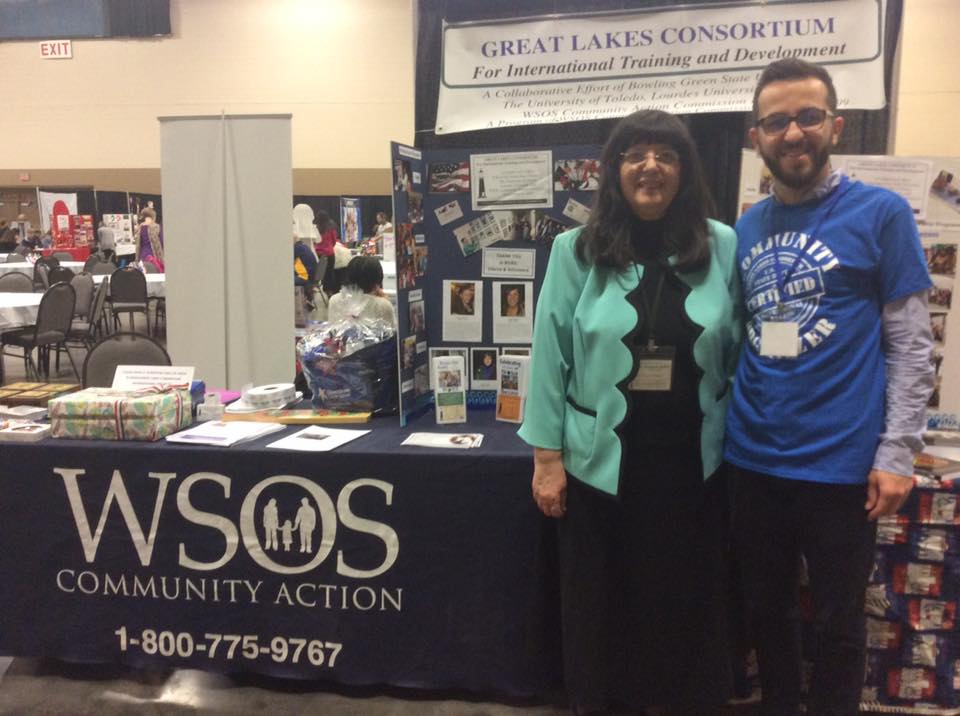
Dr. Elizabeth Balint, director of the Great Lakes Consortium. We worked
together on the Open World Project that brought people from Ukraine to Toledo.  

Toledo is a "Welcoming City," home to immigrants from many countries.  They have helped make our neighborhoods strong for generations. Some are newer, including refugees from war-torn Syria. Toledo has sister cities in Spain, China, Hungary, Poland, Japan, Tanzania, Germany, Lebanon, Pakistan and India.  It makes sense that the world's two Toledos, Toledo, Ohio and Toledo, Spain have been sister Cities since 1931, one of the oldest formally recognized sister-city relationships in the world (see www.association of two toledos.com).


I've been talking about maybe getting a sister city in Ukraine. Our US Congresswoman Marcy Kaptur is interested. She is always a strong supporter of the International Festival and international exchange programs. She is knowledgeable about and honors America's history of immigration, including her own Polish and Ukrainian heritage.  "We are all immigrants," she says, and "through food, music, art and fun we build bridges toward a stronger future together."

We had to sample some food, of course, so Philip and I got Asian food and Bubble Tea, and Chase got tacos, and we sat down to eat and watch a Karate performance. Chase is a yellow belt! We introduced ourselves to an elderly man sitting alone at the table. Turns out he was a retired Professor of German Language and Culture at the University of Toledo, where he had taught for many years.  It was nice to strike up a conversation. A few minutes later a  mother and her son, who was dressed in lederhousen, asked to sit at the table. I asked if he was from Germany. No, he was just dressed like a German, in Bavarian lederhousen actually. He was a Senior in high school who loved the German language and wanted to go to college in Germany. His mom was encouraging him.  "You're at the right table," I said, as I introduced them to the German professor, which delighted all of us.  They spoke a little in German, and we had a lovely chat about Germany and travel.

Serendipity! The same  kind of serendipity we encounter wherever we travel, and always to our delight, and it happened right here in Toledo, Ohio, at a table at the International Festival! 

The world is open to us. All we have to do is embrace it. I hope Philip and Chase, and all my grandchildren, will give it a try one day!


Sunday, April 8, 2018

What is "Hybrid Warfare"? Foreign interference in an American election.

Image, blazingcatfur


What is "hybrid warfare?" It's what Vladimyr Putin has been practicing without restraint or serious resistance since his interference in the 2010 Ukrainian presidential campaign, designed and implemented with help from Paul Manafort, followed by Putin's invasion of the sovereign nation of Ukraine in 2014.

That's the truth in a nutshell. The implications are enormous. And they are interconnected with our 2016 presidential election.

On his way out the door, fired by Trump because they disagreed, Gen. H.R. McMaster, a PhD historian, brilliant, forceful, gave a good definition:
"Hybrid warfare is a pernicious form of aggression that combines political, economic, informational, and cyber assaults against sovereign nations. It employs sophisticated strategies deliberately designed to achieve objectives while falling below the target state’s threshold for a military response. These tactics include infiltrating social media, spreading propaganda, weaponizing information, and using other forms of subversion and espionage.”
McMaster acknowledged that the West had "failed to impose sufficient costs" on Moscow for its aggressive behavior.  He was thinking Ukraine and Syria, and maybe our election.

He contended that we are engaged in a “fundamental contest between our free and open societies and closed and repressive systems.”  He called the nerve poisoning of the Skrypals in London  “an assault on the United Kingdom’s sovereignty, a clear violation of the Chemical Weapons Convention, and the first offensive use of nerve agent in Europe since World War II."  This last part was news to me, about the chemical weapons agreement and the contemporary use of a nerve agent.

I'm glad I learned this, because true to form, Russia has since mounted a new information cyber war, a disinformation campaign, to create confusion and cover up the truth.

I found more details about hybrid warfare in an article in Air Force Magazine (cited below), a fascinating source. This article caught my attention because it uses Russia's aggression against Ukraine as an example. Here's how the article describes it: 
"The “little green men” were one of the first signs of Russia’s strategy. Commandos wearing green uniforms stripped of insignia occupied key government institutions in Crimea during the early months of the Ukrainian crisis of 2014.
    For a time, their ambiguous identity allowed Russian leaders to deny that Moscow had launched a military offensive to seize the Crimean Peninsula and its Black Sea ports.
    But these Russian Special Forces were not the only indication Moscow had launched a complex, multifaceted operation in the region. That October, as Ukraine neared a crucial snap parliamentary election, electronic advertising billboards in the capital of Kiev suddenly began showing a video accusing Ukrainian politicians of war crimes. Then they displayed graphic images of civilians killed in the eastern part of the country.  The electronic network had been compromised by a shadowy, pro-Russian group of hackers. 
     Russia also relied on conventional forces to push for its objectives. Regular infantry units eventually took the place of the little green men in Crimea. Russian artillery and military personnel crossed into Ukraine proper to help pro-Russian insurgents seize and hold strips of territory in the Donbas region in the country’s east."
   
It's a concise description of a complex strategy, and its conclusions are clear: "Russia’s intervention in Crimea and eastern Ukraine is a textbook example of hybrid warfare, the combination of unconventional means (subversion, cyber attack) with conventional might to reach a geostrategic objective."

That Paul Manafort and his cronies had a hand in Putin's mission is indisputable. And it's becoming clear as more evidence and new connections emerge--as the dots are connected--that Manafort used the same kind of hybrid war games--social media, propaganda,"fake news"--in America's 2016 election that he had used in Ukraine to demonize Yulia Tymoshenko and elect pro-Russian billionaire Viktor Yanukovich.  

The folks at Cambridge Analytica, Robert and Rebekah Mercer, Steve Bannon of Breitbart, Republican Party operatives, alt-right fanatics who saw in a Trump presidency the chance to "deconstruct" our democracy, were impressed.  Manafort knew how to swing elections. The "Corrupt Yulia" disinformation propaganda campaign morphed into the "Corrupt Hillary"campaign.

But that Cambridge Analytica circle of propagandists are not the only ones who are experts at "weaponizing information."  The Air Force Magazine article reveals another interesting fact: Gen. James Mattis, Trump's Secretary of Defense and a marine to the core, is also an expert on hybrid warfare.  Who knew that? He has thought about it for over a decade and has written about it.  In a 2005 article he co-wrote with Lt. Col. Frank G. Hoffman, who was one of the first to use the term, he called it "an unprecedented synthesis."
“We may face remnants of the fielded army of a rogue state in future wars, and they may employ conventional weapons in very novel or nontraditional ways.”/ Hybrid war might feature attacks against US critical infrastructure or transportation networks. It could involve an electronic take down of military or financial computer networks," Hoffman and Mattis wrote.
"Hybrid war in Poland, blazingcatfur 
It was a prediction, and it came true.  Mattis must  see the connections to the 2016 election. He understands more than we know. Like his friend Gen. McMaster.  They must see the whole picture that Mueller is now putting together, like the pieces of a puzzle.

It makes me wonder how people who know so much more than Trump can hang in there. It makes me wonder how Mattis will work with the warmonger John Bolton, friend of Russia, ethically challenged, part of the Cambridge Analytica story, involved in Russian oligarchs' links to the National Rifle Association (NRA).

Whoever thought that Putin's brand of warfare would become part of an American presidential campaign between an unfit Trump and a super-qualified but cyber-targeted Hillary Clinton?

In fact, in my view, the intrusion in our election had its genesis in Putin's hatred of Clinton and his fear she would be hard on Russia if elected. The hybrid-disinformation campaign against her started when she was Secretary of State. Also, Putin believed Trump could be "persuaded" to end the sanctions imposed for his invasion and occupation of Ukraine. And Paul Manafort, still in touch with pro-Putin Ukrainian and Russian oligarchs, thought so too.

We are facing a political firestorm unprecedented in American History. Special Counsel Robert Mueller has his plate full. A political tsunami is rumbling onto shore, slowly but surely. It will take down the Trump regime and all who enabled it, obstructed justice, or colluded with a foreign power using a hybrid war to disrupt an American election. 


Some sources:
http://www.airforcemag.com/MagazineArchive/Pages/2017/March%202017/The-Perils-of-Hybrid-War.aspx
"Retired Marine Reservist Lt. Col. Frank G. Hoffman was among the first theorists to begin using the term “hybrid war” to refer to this hydra-headed concept. He referred to it as a “blurring of modes of war, the blurring of who fights, and what technologies are brought to bear.” In this definition, hybrid war involves both nations and nonstate forces. Its violence can span the spectrum from intense regular unit combat to guerrilla warfare and terrorist acts. It can slot in criminal kidnapping and theft and, increasingly, cyber warfare. It can employ state sponsorship of existing local unrest and the manipulation of currencies and other means of economic aggression. Diplomacy and propaganda play a part. /Hoffman began talking about this concept as early as 2005. He called it “unprecedented synthesis” in an article in Proceedings cowritten with Marine Corps then-Lt. Gen. James N. Mattis, now the new Secretary of Defense."

https://www.csspmspk.com/hybrid-war-and-economy/by Adeela Naureen, origininally published in The Nation and used in online courses.   An interesting world-wide view of what it means.

http://cyprus-mail.com/2016/06/05/russias-hybrid-war-ukraine-2/

http://nymag.com/daily/intelligencer/2018/04/mcmaster-rips-russia-on-his-way-out-of-the-white-house.html

http://nymag.com/daily/intelligencer/2018/04/mueller-is-asking-russian-oligarchs-about-donations-to-trump.html

http://nymag.com/daily/intelligencer/2018/04/mattis-had-an-impossible-task-now-trumps-making-it-harder.html

https://www.nytimes.com/2018/03/31/world/europe/balkans-russia-night-wolves-republika-srpska-bosnia.html?smprod=nytcore-ipad&smid=nytcore-ipad-share  About the Night Wolves, Putin's feared biker gang.

https://www.dailysignal.com/2017/11/17/russias-hybrid-war-west-began-battlefields-ukraine/

http://www.newsweek.com/poland-prepares-hybrid-war-amidst-russian-threat-316469 Interesting article on Russia's hyrid war in Poland, showing the extent of Putin's efforts in the East and the West.

Don't get out the popcorn yet: The Wheels of Justice Grind Slowly

"Delay, Delay, Delay: From pre-trial motions to negotiations over security, the master of legal stalling has many tactics in his arsena...