Friday, October 29, 2021

Keep Ruth Bader Ginsburg's Hopes Alive


“We need women who are so strong they can be gentle, so educated they can be humble, so fierce they can be compassionate, so passionate they can be rational, and so disciplined they can be free.” Kavita Ramdas

"When the Supreme Court hears arguments on the Texas and Mississippi abortion bans, remember that these cases didn’t spring up on their own. Right-wing donor interests spent decades and massive amounts of dark money to make it happen." Senator Sheldon Whitehouse, October 26, 2021

Ruth Bader Ginsburg will always be a role model and inspiration for women all over the world.  Her struggles are our struggles, her triumphs our triumphs. We must continue to keep her hopes and dreams alive.

Ginsburg struggled to become a lawyer when she was a young wife and mother. At Harvard she tackled the challenges of motherhood and a male-dominated school where she was one of nine women in a class of 500. Still, she became the first female member of the Harvard Law Review. 

She faced gender-based discrimination when she graduated from Columbia, having moved to New York City when her husband took on a job there. She graduated first in her Law School class at Columbia, but had a hard time getting a job because of her sex.

I don't even have to imagine it, because like many women I shared her experiences. Even her exceptional academic record did not shield her from the discrimination women faced in universities and the workplace in the 1960s and 1970s.  Ginsburg had trouble finding a job until one of her Law professors refused to recommend any other graduates before U.S. District Judge Edmund J. Palmiri, who then  hired Ginsburg as a clerk.  I know that experience well.  

And so Ruth Bader Ginsburg took flight, soared like an eagle, followed a self-made career path that eventually took her to the Supreme Court. She committed herself to ensuring equality, equity and justice for all people. She dedicated her life to defying and dismantling institutionalized gender discrimination, both on her own behalf and ours.  


We stand on her shoulders. That's why we are committed to continue the struggle for which she fought until her dying breath, when she told her loved ones that her "fervent wish" was that a new president choose her successor. 

That did not happen.  Mitch McConnell, the gravedigger of democracy, made sure of it. He, Leonard Leo's Federalist Society, the Koch dark money networks danced on her grave with glee that they could steal another Supreme Court seat. 

Senator Sheldon Whitehouse is, thankfully, fully aware of the extent of the damage, and how it happened. We now have  a Court so devalued, a  Judiciary branch so corrupted by Mitch McConnell and his Republicans, that the majority of Americans in this pluralistic nation have lost trust in its impartiality and integrity.  Changes have to happen. Mitch McConnell's tactics and dark money funders should be investigated. The whole Judiciary branch needs to be cleaned up.

It's hard not to get discouraged. It's hard to keep fighting the same battles that Susan B. Anthony and Elizabeth Cady Stanton began in the early 19th century, and that the Grimke sisters, Lucretia Mott, Sojourner Truth, Lucy Stone, and hundreds of other pioneers, silent warriors, took up along with their wish to end slavery. It's hard to carry RBG's mantel into the future for our grandchildren and their children. But what choice do we have? We have to fight for the things we care about. We have to keep hope alive.

When Great Trees Fall by Maya Angelou
When great trees fall,
rocks on distant hills shudder,
lions hunker down
in tall grasses,
and even elephants
lumber after safety.
When great trees fall
in forests,
small things recoil into silence,
their senses
eroded beyond fear.
When great souls die,
the air around us becomes
light, rare, sterile. . . .
And when great souls die,
after a period peace blooms,
slowly, irregularly.....
Our senses, restored, never
to be the same, whisper to us.
They existed. They existed.
We can be. Be and be
better. For they existed.


Some sources
* Wikipedia for RBG biography; NYT and Washington Post obituaries.
http://www.oyez.org/justices/ruth_bader_ginsburg
* https://www.scotusblog.com/2021/03/senate-judiciary-holds-hearing-on-dark-money-and-supreme-court/
Here's an option under consideration. I think it's time. 

Tuesday, October 26, 2021

Our National Parks, Our Sacred Treasures

Dismantling our democracy means dismantling everything we hold dear. That includes our environment and natural resources. Under the last criminal administration, nothing was sacred, including our National Parks and Monuments. Fortunately, a new administration is working to overturn the brutal attacks on our environment, values and way of life.
Our national parks,  our national treasures. 
Our National Parks and monuments encompass the glorious natural beauty of our country, from sea to shining sea. Ken Burns in his documentary calls them "America's Best Idea." Pioneer naturalist John Muir called them "our national cathedrals," counterpoints to the built environment and monuments of old Europe.
There are 63 National Parks. Here are a dozen of them.
 (NPS under the Dept.of the Interior)

America's rich, diverse and awesome natural environment is part of our shared history and cultural heritage. It unites us. Destroying our National parks and monuments means erasing some of the most significant chapters of the American story. Fortunately, Deb Haaland, the new Secretary of the Department of Interior, appointed by President Biden, is returning priority to saving and preserving them for future generations. She is the first Native American to serve in this post, and it seems more than appropriate, and incredibly overdue. 

Zion National Park, which I visited with
my brother Loren. Incredible beauty.
Before Haaland there was Zinke, enemy of our national parks and federal lands. Lots of voices rose up in fear and loathing to defend them. Among them were the Jarvis brothers, Jonathan, former director of the National Parks Service (NPS), and Destry, a long-time Parks advocate for various nonprofits, They were concerned with the efforts of TFG and his billionaire minions to open the parks up to corporate drilling and exploitation. (Jarvis and Jarvis, "Our National Parks are being Dismantled," The Guardian, January 10, 2020.)  The parks were on a slippery slope, like our democracy itself. 

Chief Seattle now has a voice in the Biden Cabinet.  
  The election of Biden in 2020 reversed this course. For one thing, his Cabinet includes Deb Haaland as Secretary of the Department of the Interior (DOI), and he  recently restored the previous cuts to the parks. The Jarvis brothers noted that  "professional management of our national parks has been respected under both Democratic and Republican administrations for over 100 years." Sure, they've had different priorities, "the Democrats often expanding the system and the Republicans historically focused on building facilities in the parks for expanding visitation." But the career public servants of the National Park Service (NPS), charged with stewarding America’s most important places, were left to do their jobs. They protected the parks and our natural heritage. Under Secretary Deb Haaland, they will continue to do so. 
At the Grand Canyon, cold but awestruck
by its vastness, ancient geology, layered beauty.

Some sources:
1. Jonathan B. Jarvis and Destry Jarvis, The Guardian, January 10,2020, https://news.yahoo.com/great-dismantling-americas-national-parks-110036985.html.

2. http://www.pbs.org/nationalparks/, Ken Burns, "Our National Parks: America's Best Idea.

3. https://www.doi.gov/secretary-deb-haaland, Secretary Deb Haaland made history when she became the first Native American to serve as a cabinet secretary. She is a member of the Pueblo of Laguna and a 35th generation New Mexican. 35th generation! Haaland will work on reversing the damage of the former president and the criminal Zinke, who allowed drilling and logging on federal lands, worked to destroy national parks and monuments, showed total disregard for America's heritage and values. 

4. https://www.doi.gov/pressreleases/administration-leaders-applaud-president-bidens-restoration-national-monuments


The Grand Staircase-Escalante National Monument boasts stunning features such as the Escalante Canyons, seen here in an undated photo. Together with Bears Ears, the Trump administration approved big changes for the monuments (Jerry Sintz/AP). Thank goodness the Biden administration is reversing the damage done. 

5. https://www.cnn.com/2021/10/08/politics/joe-biden-national-monuments-expansion/index.html

6.  https://www.doi.gov/blog/10-public-lands-powerful-native-american-connections  

Thursday, October 7, 2021

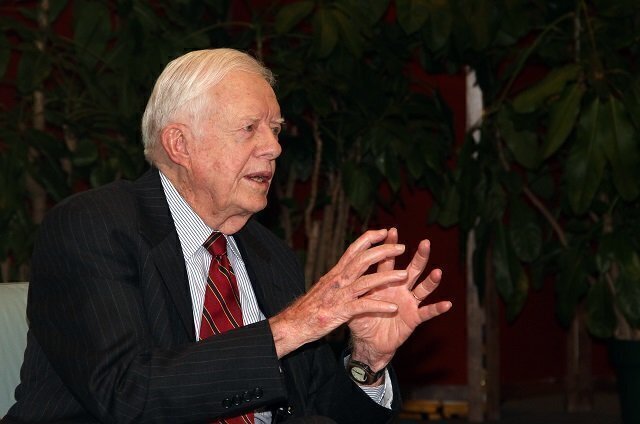
Jimmy Carter Shines as America's Most Compassionate President

 https://constitutioncenter.org/blog/10-fascinating-facts-about-former-president-jimmy-carter 

I copied this article here, because I want to remember.  Jimmy Carter is my favorite president, a caring and compassionate activist for peace and justice in the world.  Also, I want to highlight the work of the Constitution Center. It has outstanding programs and courses about the history and evolution of the US Constitution and Rule of Law, needed now more than ever.  I wish every social studies and civics teacher would use their resources. I think the National Constitution Center would be a great partner with the National Endowment for the Humanities (NEH), too, which could reach every state and territory through the  state programs. 

Today we celebrate the birthday of former President Jimmy Carter. The Plains, Georgia native is certainly unique in comparison with other Presidents.

Jimmy_Carter_at_the_LBJ_Library02"Carter, the only United States Naval Academy graduate to be elected to the White House, endured a roller-coaster four years in office. But much of his public career began after leaving Washington, D.C. in 1981.

Here’s a quick look at some fascinating facts about the 39th President:

1. Born on October 1, 1924, in Plains, Georgia, young James Earl Carter Jr. was the first person on his father’s side of his family to graduate from high school.

2.  Carter entered Annapolis during World War II. The future President graduated in the top 10 percent of his class in 1946, and he and his new wife, Rosalynn, moved frequently as his Navy assignments changed.

3. Carter gave up his military career to save the family peanut farm. And as a parent, Carter became involved in local politics when he served on an education board.

4. He supported civil rights, which hurt his early political career in Georgia. After a poor showing the 1966 governor’s race, Carter adopted a more centrist image, and he won the election in 1970. He became known as a budget cutter while in office.

5. Carter was a “dark horse” presidential candidate in 1976. The future President was tied for 12th in early polling, well behind former Alabama Governor George Wallace and former nominee Hubert Humphrey. He used his image as a Washington outsider to defeat Gerald Ford in the general election.

6.  The Carter presidency was a study in contradictions. President Carter played a key role in the Camp David peace accords, but he also struggled with Congress and the media. The Iranian Hostage crisis proved to be a significant factor in his 1980 loss to Ronald Reagan.

7. Carter’s legacy grew after the 1980 loss. F. Scott Fitzgerald wrote there are no second acts in American lives, but Carter’s public career after the White House is an exception.

8. In 1982, he founded the Carter Center, which has played an active role in human rights and disease prevention issues globally. The Carters helped publicize Habitat for Humanity, also.

9. Carter received his Nobel Prize in 2002. He received the award "for his decades of untiring effort to find peaceful solutions to international conflicts, to advance democracy and human rights, and to promote economic and social development."

10. Harry Truman was Carter’s favorite President. Carter told The Guardian in 2011 that he admired Truman for not trying to profit off his presidency."

I think about Jimmy Carter a lot, because I'm so aware he won't be with us for much longer. Why not celebrate his life and achievements while he's still alive! 


Wednesday, September 29, 2021

Canna Lilies Celebrate the Joy of Living


My sister Andy posted a favorite flower in her garden, her Red-Orange Canna Lily. "Honestly, my greatest pleasure this year!" It looks a lot like an Iris, but it sits atop that tall stalk with those tropical red-veined dark leaves, and it's really stunning. "First thing I see when I open my porch door." 

I've sat on that porch many times, and I know what she means. I love my sister's garden in Tallahassee as much as I love mine in Sylvania, Ohio. Our gardens bring us closer, connect us, keep the love flowing. 

That Canna is a perennial beauty. It has some great symbolism, too, that goes back to Greek, Roman and Egyptian legends.  I love that. The Red Canna especially symbolizes courage and determination, and trust in a higher power. They are good to share with a loved one for inspiration during tough times. We can all use those Red Cannas.  Manna from heaven.  

Red Cannas also attract hummingbirds, those birds of paradise that symbolize enjoyment of life and lightness of being. Even though they are very small, they can travel great distances, so they can follow you across the ocean and stay with you until you land in, say, Greece.  And having to cancel that trip this year due to COVID, I plan to do that next year, a Red Canna and a hummingbird beside me.             

Red Canna, 1919
   My sister's Canna brings to  mind Georgia O'Keeffe's sensuous flowers. Here's one of her Red Cannas, painted in  1919. She was still in New York, finding her way. Art historians think she fell in love with Canna Lilies when she visited  Lake George, New York, with Alfred Stieglitz the photographer in 1918.    

 O'Keeffe loved to garden, lucky for us, because her flower paintings are among her most popular paintings of all. Like my sister, I imagine O'Keeffe looked out at her garden and received the  greatest pleasure. And when she gave them to us in the form of a painting, so did we.

Red Canna, 1924

Sources: 

https://www.culturetype.com/2021/07/28/on-occasion-of-new-exhibition-alma-thomas-everything-is-beautiful-curators-and-scholars-reflect-on-lesser-known-aspects-of-artists-life-and-work/

wikipedia on Georgia O'keeffe


Saturday, September 18, 2021

The Incredible Alice Twombly


A Teaneck Reunion

Teaneck, 2018

Dear Alice, 
      Can you believe it's been almost 6 decades since our paths crossed in Madison, Wisconsin? We were so young, thirsting for knowledge, eager, idealistic, innocent. The anti-Vietnam War teach-ins and protests, Civil Rights marches, Beatlemania swept the UW campus and touched us all. I was a grad student in the History Department and you were a teacher. I left with a degree and you left a legacy for the students you taught, with many of whom you're still in touch. How fortunate they are! 

Our dreams were still in the bud when we left Madison, but you blossomed ever after through hard times and good times. A master teacher and poet, you've touched so many lives. You have a wonderful family, great sisters, two wonderful sons, beautiful grandkids. 

You make literature and poetry come alive. I think of all the poets you've introduced me to, like the war poet Brian Turner and your sister Veranda, and those poetry readings you have on Thursdays, which I was blessed to have attended on a memorable visit to Englewood a few years ago. I treasure our visits together, here and there. I treasure our intellectual musings and our rants. You are my brilliant, beautiful soulmate, Alice, a treasure of the heart. Love you forever, Fran  

Some Memories:
We re-unioned in Union, NJ after many years on our different paths, when I was visiting Ukrainian friends, 2016 I think. You drove from Teaneck, and got in a traffic jam on the way home. You remembered your dad's business and your family. You knew the streets. We could see the new World Trade Center across the river. We picked up where we had left off, and I felt a sense of peace and joy. I knew we would meet again. 

On a visit to your home in Teaneck, NJ, in 2018, you took me on a tour of the ancient Palisades. We went to a poetry reading by Don Zirilli at the Classic Quiche Cafe, reading from "Heaven's Not for You."  You started this poetry series with your friend Zev many years ago and it's still going strong. We shared dinner together at an Indian restaurant before the readings. We spent an evening at a Shabbat service and dinner at the home of friends. 

We marched in Leonia for women's rights and against the unfit White House occupant, where I met some remarkable resisters, like Anne and Joe Cassidy. Remember? We sang "This Land is Your Land!" 1960s redux. We wove in and around Dutch Colonial brick homes, so full of stories, down Main Streets and side streets. You  reminded me of  NJ American Colonial and Revolutionary War history, with a stop at the Historic New Bridge Landing where George Washington retreated across the Hackensack River with his ragtag Continental army after a great loss at Fort Lee. It moved Patrick Henry to write those famous words, you reminded me: "These are the times that try men's souls."  Applies today, I thought, but kept silent. I was seeing NJ through the eyes of a native daughter. Unforgettable. As was our visit to Brooklyn where I met an old family friend, Jon Kay, and we had dinner with your son Jonathan, his lovely wife Kaori, and their two daughters. 
I hope you remember your visits to Sylvania, touring Main Street America, as fondly as I do. We walked the town, visited the Sylvania Historical Village, went to the Toledo Museum of Art (they had a Greek vases exhibit), shared wine at  Element 112. You were on your way to Madison. A year or so later you visited again. You shared time with my daughters and my friends and we went to the University of Toledo campus to watch the solar eclipse.  That was thrilling. 

Then there was our last visit, which I still feel bad about. November 2019. I had just returned from Morocco about a week before a long planned  to NYC with friends. I got to your house from the Port Authority bus station with the worst cold and cough, a precursor of the coronavirus, I swear. You kindly took me in anyway, and sadly, I left you with the damn cold, which went on for weeks.  Even so we shared some good times, meals at nearby restaurants, long talks. You were waiting for a new sofa. Little did we know then that we would be plagued with the coronavirus and COVID 19 in a few months. It's changed lots of things. Don't know about travel, lots of uncertainties. But your friendship will always remain a constant, Alice, and for that I am grateful. 

At the Toledo Museum of Art for the "Berlin Painter" exhibit


In Brooklyn, a historic tour with old family friend Jon Kay,
and a dinner with Alice's son Jonathan and family.


Friday, September 17, 2021

There's More to Frida than Meets the Eye


"Frida in Flames" (Self-portrait inside a Sunflower), 1953-54,  a powerful late painting (Credit: Private Collection, USA. Photo courtesy of Mary-Anne Martin Fine Art New York, printed by Taschen publishing.


There's a new book out about Frida Kahlo's hidden, less well-known works, 152 of them, seldom exhibited, seldom seen. "Frida Kahlo: The Complete Paintings," by art historian Luis-Harlan Lozano, with Andrea Kettermann and Maria Vazquez Ramos, offers "the first ever survey of her entire oeuvre." 

I was excited to come across an article by art historian Holly Williams, cited below, that reviews the book. I went to order it on Amazon but it costs $200, and I hesitated. Still, how fascinating to catch glimpses of those 152 paintings. They are not the large dazzling self-portraits that we know and love, inspired by the artifacts, landscapes, folklife, clothing, adornments and decorative arts of  Mexico. They are not surrealism or magical realism. 

The cover of the new book on Kahlo, 
published by Taschen. It's surprising that
it's one of the self-portraits that we
 know her by, but then, it will sell books. 
 
They are portraits of people she knew from here in the US and in Mexico. They are in style, composition, and format different from those we are used to seeing in a Frida Kahlo. They show her range of seeing, her attention to art trends, and some different aspects of her life. They seem to have been  painted early in her life, or toward the end of her life. She died in 1954. She was only 47 years old. These works present interesting facets of her short but often flamboyant and emotionally charged life, her thinking, political passions, range of interests. 

Holly Williams presents an interesting analysis of the painting that begins this blog, "Frida in Flames."

"It's very interesting in terms of aesthetics – when your body is not working anymore, when your brain is not enough to portray what you want to paint, the only source she's left with is to deconstruct the image. This is a very contemporary, conceptual position about art: that the painting exists not only in its craft, but also what I think the painting stands for./  We are left with a painting that is imperfect, certainly a world away from the fine, smooth surfaces and attention to detail of Kahlo's more famous self-portraits – but it nonetheless is an astonishingly powerful work that deserves to be known. There is something tremendously poignant in an artist so well-known for crafting their own image using their final creative act to deliberately destroy that image. Even in obliterating herself, Kahlo made her work speak loudly to us."

Spoken like a true art historian, insightful, penetrating, in cultural and historical context for understanding what this self-portrait might mean. Most of us art appreciators can't claim this kind of expertise, but we are energized just looking at these varied paintings. Some of them are re-printed in Holly Williams' BBC Culture article, and they are fascinating. 

Here's a style, roses in a small blue vase, 1935, that reminds
me, or makes me think of, many other women artists who painted flowers. It's lovely.
It has not been exhibited since 1954 and, according to art historian Holly Williams, 
it shows the influence of the artist's father. I didn't know he was also an artist, a well-known photographer. This painting is not "ethnic," not magic realism, not those large Calla lilies. More traditional it seems, in the western art tradition that her father apparently embraced.    
(Private collection. Courtesy Sotheby's, New York)


Si Adelita (Los Cachuchas), c1927, is another of the lost works.
 "It's sharp Modernist lines are striking."
This one depicts an experience Kahlo no doubt had in NYC,
at a gathering around a game (?) table, artists, poets, surely jazz musicians,
in formal black and white, strong angles and poses.
I think I see Langston Hughes or WEB DuBois or somewhat-familiar jazz musicians.
There's the invitation, a domino, a music score, a woman peering out with a frightened or confused look on her face, maybe Frida feeling like an outsider.  All the subjects look very serious. It's a slice of Frida's life, attentive to detail, emotions, the times.  


Pancho Villa and Adelita (unfinished), warriors for an independent Mexico,
reflecting Frida's strong political interest, painted in 1927.
Holly Williams notes its "avant-garde" style:
 "It indicates Kahlo's interest in Mexican art trends
 before she met Diego Rivera." (Credit: akg-images)


   A still life with white dove, which Holly Williams wrote appeared often
in her late life paintings, this one from 1953/1954, just before Kahlo's death.
I was surprised to learn that she didn't have her first exhibit in Mexico until 1953,
and her art then was hidden in anonymity and neglect until the late 1970s and into the 1990s.    
"Kahlo included the Mexican flag and the dove as motifs in her later work,'
such as this colorful still life, "Long Live Life."
 (Credit: Rafael Doniz/ Banco de Mexico/ VG Bild-Kunst)


Sources:

*https://www.bbc.com/culture/article/20210719-the-unseen-masterpieces-of-frida-kahlo? review article by Holly Williams. "Lost or little-known works by the Mexican artist provide fresh insights on her life and work. Holly Williams explores the rarely seen art included in a new book of the complete paintings."

https://news.artnet.com/art-world/frida-kahlo-complete-paintings-taschen-1993532

** https://www.artsy.net/article/artsy-editorial-frida-kahlo-georgia-okeeffes-formative-friendship, interesting article, and great juxtaposition of Frida paintings and O'Keeffe paintings. 


Friday, September 10, 2021

Yarema Kosak, Ukrainian-American Artist Shines Light on his Cultural Heritage

Yarema Kozak, "October," 1980s


There are Cossacks living and working in and around Detroit, those Ukrainian warriors whose history is as complicated as any Eastern European country, as conflicted and torn between East and West for centuries. The Yarema Kosak family descends from a long line of Cossacks, but they are not fighters. They are cultural warriors who have made great art across several generations. The Detroit area has been a recipient of their talent. 

An exhibit of Yarema Kosak's work at the Ukrainian-American Museum in Hapensack, MI, is bringing these Ukrainian-American Cossacks to light. His brother Yurko was also an artist and some of his paintings are included. Yurko was a designer for Buicks at General Motors for many years, thanks to the wisdom of GM managers who recognized the value of his versatile talent. Yarema embraced his life as an artist. 

Yarema's Roses
Yarema was born in 1941 on the border between Ukraine and Poland. That's part of the region of eastern Europe that Yale historian Timothy Snyder calls "the Bloodlands," caught for ages between the vicious rivalries of Western and Eastern Europe and the Russian empire. Snyder writes: "Between 1939 and 1945, Joseph Stalin's Soviet Union and Adolf Hitler's Nazi Germany committed mass killings of an estimated 14 million unarmed non-combatants, the majority outside the death camps of the Holocaust." Snyder's thesis is that the "Bloodlands," a region which comprises what is modern-day Poland, Ukraine, Belarus, Russia and the Baltic states, is the area where "the totalitarian regimes of Stalin and Hitler interacted to increase suffering and bloodshed many times worse than any seen in western history."

After the war, Cossacks were "repatriated" back to the Soviet Union, where they were sent to the Gulags and murdered. The same fate befell millions of Ukrainian children who were kidnapped and sent to concentration camps to build bombs for Hitler.  (https://francurrocaryblog.blogspot.com/2018/02/the-book-philip-gave-me-making-bombs.html)

Is it any wonder that after the war, Ukrainians sought refuge anywhere in the world that would have them. Many settled in Canada, many in various countries in western Europe. The Kozaks moved to the US and settled in Detroit in 1949.  And so Detroit became "the seat of the entire American Kozak enclave, which embraced various professions and a host of civil and cultural initiatives. Most of all, the Kozaks influenced the artistic and intellectual life of the Ukrainian diasporan community beyond Ukraine." 
(Ukrainian-American Archives and Museum)

Yarema Kozak, Hutsul Woman. 
 The Hutsuls are a Ukrainian ethnic group
spanning western Ukraine and Romania.
The Kozak family is from this region.
While Yuri worked designing Buicks, Yarema devoted himself to his art. Between 1968 and 1975 he headed an art school for youth at the local Cultural Community Club. At the same time he acquired his individual traits as a graphic artist and painter. His first exhibit was held at the public library in Hamtramck, Michigan, in 1969.

Yarema was a university-trained artists. He followed the most recent trends in American and world art and showed interest in abstract art, "exploring ways to synthesize modernism with his ethnic Ukrainian background."   I found his paintings, the few I've seen, to show different styles depicting a range of subjects, from beautiful roses to Orthodox icons to abstract landscapes and profiles.

I was pleasantly surprised to learn that the Kozak family was involved in creating the large decorative memorial wall honoring Ukrainian heritage at Wayne State University in 1976.  I first saw it in 2013, after participating in friend Laura Kline's Russian language and culture class in Manoogan Hall, talking about what I learned about Ukrainian history and traditions as a Peace Corps Volunteer. After the class, we had a tour of "The Ukraine Room," where a huge map of Ukraine with motifs from Ukrainian history and national culture filled the walls; it was colorful, upbeat, patriotic. The project was completed by another Ukrainian-American artist, Volodymyr Mayorchak, who added a full-wall mural, hutsul-style wooden benches, and a variety of lovely carvings. The Ukraine Room, which served as a classroom for the study of Ukrainian language and literature, was updated and restored in 2003, reflecting the ongoing devotion of Detroit's large and active Ukrainian community. My Ukrainian friends from Starobilsk visited them when they were in the US for an Open World project. I'll always remember that time.  Я никогда не забуду время, проведенное в Украине.

Sadly, Laura informed me, the language classes, always a struggle to sustain, are now taught only sporadically, victims of the declining support of humanities study on colleges campuses across the country.  America is paying dearly right now for this decline in the study of history, literature, philosophy, and the entire liberal arts curriculum that makes for "informed citizens."   . 

The Yarema Kozak and Kozak family heritage, however, lives on, gaining in public and scholarly recognition. Their artistic efforts to preserve Ukrainian culture, along with organizations like the Ukrainian-American Museum and Archives, represent the extent and depth of America's multi-cultural heritage. In this chaotic time, we really do need reminders that this is what America is all about. 


Parts of the mural in The Ukraine Room at Wayne State University.
 I love the quote from Ukrainian poet Taras Shevchenko, below, who longed for Ukrainian
independence. There are Shevchenko statues all over Ukraine,
including in Lenin Park in Starobilsk, where I served with the Peace Corps.


Sources

http://www.thehamtramckreview.com/ukrainian-museum-features-works-by-local-ukrainian-artists/ by Roman Yatsiv.

https://day.kyiv.ua/en/article/close/american-kozaks-mission-and-individuality  Good the Kozaks work was recognized in Ukraine, mainly through various exhibits in various cities.

https://en.wikipedia.org/wiki/Cossacks, for a complicated article on a complicated subject, the Cossacks of Russia, Ukraine, eastern Europe.

https://en.wikipedia.org/wiki/Repatriation_of_Cossacks_after_World_War_II, "repatriated" to the Soviet Union, which sent them to gulags and murdered them outright. A few managed to escape, among them the Kosak family of  Detroit. Not surprising to learn that this story was hidden from history until 1974, with the publication of "The Last Secret" by Lord Bethell. It was made into a documentary that year.  That same year, Aleksander Solzhenitsyn's "The Gulag Archipelago" was published. 

 https://francurrocaryblog.blogspot.com/2013/04/teaching-about-ukraine.html At Wayne State, April 2013.

Talking about my experience in Ukraine for Laura Kline's
Russian Class at WSU, along with a presentation about
Chernobyl.

This artwork is by Yuri Kozak, Yarema's older brother.
St. Trinity Church in Kyiv, 1980s. It takes me back to Ukraine.


Don't get out the popcorn yet: The Wheels of Justice Grind Slowly

"Delay, Delay, Delay: From pre-trial motions to negotiations over security, the master of legal stalling has many tactics in his arsena...