Thursday, August 19, 2021

Remembering African-American Artist Beauford Delaney: Restoring the Delaney Family Home in Knoxville, TN

Beauford Delaney, exhibit honoring the friendship of
"Delaney and James Baldwin," at
 Knoxville Museum of Arts, February-May 2020

Beauford Delaney, "Gathering Light," at Knoxville Museum of Art.


The restoration of the Delaney Home is underway in Knoxville. Organized by the Beck Cultural Exchange Center, the primary repository for the history and culture of East Tennessee, the restoration of the Delaney Home (above) will be undertaken by BarberMcMurry Architects of Knoxville. Yellow is an appropriate color for Beauford, his "signature color" it has been called. He used yellow for so many of his paintings, his portraits and in his more abstract art in the late 1950s to 60s. I found it fascinating.

It's always wonderful when the ancestral homes of talented people who have been hidden from history are restored. It's happening in Knoxville, Tennessee, with the restoration of the Delaney Family home, paying homage to Beauford Delaney, African-American painter and mentor to James Baldwin whose legacy was neglected for a long time after his death in Paris in 1979. Beauford's brother Joseph was also an internationally known artist. East Tennessee I learned, during my dissertation research, had more anti-slavery sentiment than Memphis and West Tennessee, where slavery and plantation life flourished. It is honoring its past. 

Beauford Delaney was born in Knoxville, his father a Methodist minister and his mother a former slave determined to educate her children in freedom, an education she never had. Beauford's early talent was recognized by a local white artist, Lloyd Branson, who encouraged him to go to Boston to pursue his education and to take art lessons. 

After a solid education in the arts, Beauford  moved to New York during the heyday of the Harlem Renaissance. He established a solid reputation as a young painter, but he struggled to survive financially. In 1953 he moved to Paris, settling in the Montparnasse district in the Left Bank, an artist colony of international renown that enveloped African-American artists. There he became a close friend and mentor to writer James Baldwin, a friendship that lasted until his death.  Delaney, like Baldwin "relished a sense of freedom as a gay Black man that he did not have in the United States."  Richard Wright, the writer, described Paris as "a place where one could claim one's soul."  

Delaney, James Baldwin,
one of many portraits.
In Paris, Delaney moved toward abstraction. He also painted many portraits of James Baldwin, whose wonderful friendship overtime is a story in itself. The Studio Museum in Harlem had a major retrospective of his work in 1978. A year later the Knoxville Museum of Art acquired several Beauford Delaney paintings for an exhibition, and it is now the major repository of his work. 


Composition 16, at MOMA

"While Paris had in some sense liberated Delaney, there were sorrows he could not escape," a MOMA curator noted. “There always seems to be the shadow,” Delaney wrote to a benefactor, “which follows the light.” Although he was referring to the financial difficulties that plagued him throughout his career, the artist could also have been talking about his struggles with depression and mental illness, which eventually led to his living in a mental hospital at the end of his life. MOMA noted that while Delaney was a mentor to Baldwin during the author’s early years, "Baldwin later became Delaney’s protector, assisting him financially and emotionally."

For an introduction to an exhibition in Paris in 1964 Baldwin wrote, “Perhaps I am so struck by the light in Beauford’s paintings because he comes from darkness—as I do, as, in fact, we all do.” 

 "The vibrant luminosity of Composition 16 is but one example of Delaney’s lifelong quest to find light in that darkness." (MOMA.org on Delaney). 

It is wonderful that Beauford Delaney, a neglected artist for so long, is coming into the light of public awareness and appreciation, reborn in his hometown of Knoxville with the restoration of his childhood home.  Among art patrons and collectors, he is becoming  highly praised and his works highly valued.  

Most of all,  I was taken by Beauford's talent and by James Baldwin's compassion for his friend, his loyalty to an artist who "came from darkness." I was enamoured with Beauford's use of yellow, too, a contrast to the turmoil of his inner life, a color to lighten his burdens and doubts, illuminating his striving to find hope in spite of himself.  A yellow house that inhabits Beauford's soul is a perfect tribute.

Beauford Delaney, "Jazz Quartet." Could that be Ella Fitzgerald at the piano?
It was the Harlem Renaissance and then the post-war New York energy 
when Harlem remained the center of Black cultural life


Delaney, "Oh Freedom," a paeon to the Harlem Renaissance.  I love
his paintings from this period.  


Quess what? This is a portrait of
Beauford Delaney by Georgia
O'Keeffe, in New York, 1943. Yes, it's
an O'Keeffe. I didn't know she
did portraits. Loved discovering this!


Sources: 

1. https://www.culturetype.com/2018/02/10/knoxville-museum-of-art-acquires-of-12-beauford-delaney-works-plans-major-exhibition-in-2019/

2. https://lesamisdebeauforddelaney.blogspot.com/2021/08/the-delaney-museum-at-beck.html?

3. https://www.youtube.com/watch?v=mz2cU5gVfY8

4. https://knoxvillehistoryproject.org/2020/02/26/beauford-delaney-in-knoxville

5. Beauford Delaney, wikipedia 

6. https://www.moma.org/artists/40994, "Beauford Delaney, American, 1901-1979." I like this description of Composition 16:  

Have been working and living with the many people who make up Beauford,” Beauford Delaney wrote to his great friend James Baldwin in September 1954, “and trying to merge them into some sense of composition and a workable form of painting.” Composition 16, a modestly sized work on canvas composed of swirling...strokes of yellow, red, orange, ocher, pale green, and blue paint, some squeezed directly from the tube, is a vivid example of Delaney’s quest to unite disparate aspects of his interior life and artistic practice while keeping a promise to continue “doing all that is possible with paint.” With its suggestion of ground, sun, sky...Composition 16 fuses landscape and abstraction, depicting light and color as ecstatic matter. The color yellow, scumbled liberally over the surface of the painting as a unifying element and predominating in many of Delaney’s abstract and figurative works from the period, seems to have held a particular fascination for the artist. Philosopher Rudolf Steiner wrote, “If yellow is to be painted—do not only apply yellow, but live in the colour itself,” and canvases such as Composition 16, like a yellow-hued Self-Portrait from 1962 and the yellow-walled interiors in St. Paul de Vence from 1972, show the artist embracing a Steiner-like dictate."

Beauford Delaney, Ella Fitzgerald, "Isn't she beautiful."
Basking in yellow paint, like "Composition 16." 

More on Beauford's use of Yellow:
"Delaney’s most celebrated paintings date to the late 1950s and 1960s. Characterized by fluid brush strokes, these fully abstracted works are explorations of saturated color and strong texture. His signature use of yellow—which he described as “the color of his sacred light” and representational of a “higher power”—reveals a joy that seems to contradict his deteriorating personal circumstances while illuminating a resolve to resist an inner darkness. In 1963, he wrote these hopeful lines to his friend, the author Henry Miller: “I pray for the courage to keep struggling to express in color the substance of what life is directing. The need in the world for beauty, harmony, good confidence, brotherhood, sunlight, music, humanity...was never so urgent. The creative life is holy.”  https://thejohnsoncollection.org/beauford-delaney/  This site also has a brief bio of Beauford's brother Joseph. 


Thursday, July 8, 2021

Barbara Fox: Watercolor Magic

"I crave beauty, peace, and order, and paint subjects and settings that reflect this idyllic view of the world."  Barbara Fox

"

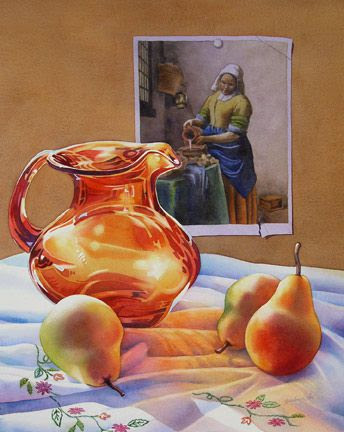
Barbara Fox, American contemporary artist, loves painting marbles! She is mesmerized by their subtle variety of design, fabulous color, and heavenly reflection of light. In this way she reminds me of the late Massachusetts artist Janet Fish and Canadian Mary Pratt, painters of glass and light.
 
  
Here's another example of allusions to Fish and Pratt, at least in my mind:
Barbara Fox delighting in luscious green apples on a lovely glass plate. 


While Barbara Fox's paintings of glass drew me into her art, I discovered that this highly regarded American artist has her own delicious style, methods, and vision that surprise and amaze. 
 
Barbara Fox paints still lifes and floral subjects in watercolor and oil. Her "meticulously crafted" paintings are exhibited and collected internationally, have received numerous awards, and have been selected for publication in fine art books and magazines.

I find it fascinating that she is also an illustrator and designer for the United States Mint. So far, 21 of her designs have been minted as coins and medals, including one commemorating Ellis Island, special to me because it's where my grandparents entered America along with millions of other immigrants. 

Barbara Fox received her BFA in studio art from the University of California, Davis. She is a founding member of the National Watercolor Society and leads watercolor workshops around the country, teaching her method of layering washes and painting details. 
 She currently resides, paints, teaches and exhibits in Little Valley, New York, in far western NY state, not too far south from Rochester where I grew up. She's on facebook and has a lovely website.  

The captivating details and background images of her still lifes also drew me in. It appeared at first as if they had been tacked on, kind of casually, like we tack a poem or image to our refrigerators. But these decorative additions, it turns out, are not after-thoughts. They are intrinsic to her vision and how she sees the world. Where most other artists avoid such artifact and allusions, Fox embraces them. "Her work explores the nature of artifice itself, a fact to which she alludes by the frequent inclusion of paintings and objet d'art in the background of her work. "The art of Barbara Fox is an art that continually examines itself."  https://rehs.com/eng/default-artist-bio-page/    She explains it this way:
"My working method pays homage to the Dutch masters and the tradition of academic painting. I work from life and photographs. Watercolor and oil paintings begin as detailed drawings to which a number of glazes are applied, building deep values and rich colors. The process of completing these works may take many weeks, so I usually have several paintings in process at once. Creating artwork is both a meditation and an adventure that opens my eyes to our beautiful world."   https://art.state.gov/personnel/barbara_fox/  
"Tulip Dance," with Degas dancers
behind the glass vase. 


I was also drawn to Fox's art because she loves flowers, growing them, photographing them, painting them. Her peonies and roses are among the most beautiful of all. I especially love her hydrangea, the exquisite detail and luscious colors. She paints her flowers in lovely vases, like this round cut-glass vase, or in various still-life poses. In "Tulips Dancing," above, the image of a classic Degas captivates, suggesting, perhaps, "in the now" as in the past.  It is signature Barbara Fox. I love it. 

Her paintings have been featured in solo and group exhibitions in museums and galleries throughout the United States and abroad.  For us Midwesterners, they can be viewed at the Phillips Museum of Art in Lancaster PA and the Neville Museum in Green Bay, WI, as well as at her studio in Little Valley, and for international travelers at the MEAM in Barcelona. Wish I had known that when I was there admiring Gaudi in all his glory. For easier access, her works have been published in three editions of the watercolor publication Splash: The Best of Watercolor Painting, and featured in leading national art magazines like American Artist and Watercolor Magic. I hope I can visit her studio in Little Valley, NY, one day, maybe when I'm visiting my Rochester, NY, cousins. 
Hydrangea, "In the Light of Morning."


Shimmering in layers of paint and light. Love the glass pitcher
reflecting the multi colors of the hydrangea.

Barbara Fox seems like a delightful person, accessible, friendly, and she is a meticulous and prolific artist, an American treasure.  Women artists of the present stand on the shoulders of women artists of the past. No one is more aware of this than Barbara Fox. She is "in the tradition," which she illuminates, augments and honors in her own unique and brilliant style.   
"The Pleasure of Randomness."  
"My newest work features glass, origami, historic documents,
and artwork conveying a sense of calm beauty with
 captivating detail. "


Some Sources:

https://www.artistsnetwork.com/art-ediums/watercolor/wc-fox-gallery/    Fox loves flowers(www.bfoxfineart.com) "but she’s not content to stick with what she knows and loves. She’s constantly challenging herself to try new techniques in watercolor and...[new subjects]...In this creative endeavor, Fox has tried her hand at trompe l’oeil effects and experimented with still life settings..."  


    on her designs for the US Mint."

https://rehs.com/eng/default-artist-bio-page/? A gallery that promotes and sells her art

https://www.barbarafoxartstudio.com/ 
My newest work, features glass, origami, historic documents, and artwork conveying a sense of calm beauty with captivating detail. / My work pays homage to the working methods of the Dutch masters and the tradition of academic painting which involves balanced and graceful composition as well as precise execution. These paintings begin as detailed drawings to which a number of glazes are applied, building deep values and rich colors. The process of completing these works may take many weeks, becoming an extended meditation on patience and artistic craft."

Hydrangea in progress, on the easel,
 next to a pallet of paint,
in her studio.  


"Possibilities." 
Glistening clear marbles on a historic Latin manuscript. 
What a wonderful juxtaposition of images. 


A Barbara Fox for my brother Loren


Wednesday, June 2, 2021

Mary Pratt, 1938-2018, Canadian artist: Illuminating Everyday Life

Mary Pratt, Canadian, Jelly Shelf, 1990s
"I think, with my work, even the things that are ordinary are not ordinary, because I don’t believe that anything is ordinary. I think everything is complex and worthy of conjecture, and worthy of a look — worthy of a close look."

Doesn't the painting above, of jars of jelly, look like an Alice Fish painting? I thought so too when I first saw it and seized upon it.  It felt good to recognize a piece of art by its style, composition, subject, color. But I was wrong. It's not an Alice Fish. It's a Mary Pratt. Off to google I went.

Raspberries Reflecting Summer. Shimmering!
Their are several interesting Mary Pratts, I discovered. T
here's a Mary Pratt baseball player from Ohio, a real pioneer. Fascinating story. And a Mary Pratt contemporary artist, based in Atlanta, Georgia, whose paintings are fabulous. I got distracted for a good while, which is how I spend a lot of time.

The Mary Pratt whom I thought was Alice Fish is a Canadian artist, born in 1935. Same year as Alice Fish, same generation. Was that a particular way that some talented women of that time saw life and added meaning to their everyday experiences? Is that how some women painters who came of age during the post-World War II generation added value to the ordinary domestic life to which they were socially assigned?  Interpreters of the Feminine Mystique from women artists' points of view?

Green Grapes, Wedding Presents &
Half a Cantaloupe
Mary West married artist Christopher Pratt in 1957 and had four children. While he painted and became a well-known artist in Canada, Mary's life was filled with domestic chores. She lived in rural St. Johns, Newfoundland, took care of her children and her husband. It was hard to find time to paint.

Still, when some item or other moved her, she felt an "erotic charge," as she put it, that propelled her to pick up her brush. She had taken art lessons as a young girl, studied Fine Art in College, took lots of photos which she later returned to and found images that impelled her to paint them. That's how she found her voice, her medium, her own signature style. She put her painting career this way: “It was a love affair with vision. A real love affair with vision.”   

I don't know whether or not Fish and Pratt knew each other, or knew of each other's work, but they shared a vision. Look at those jars of jelly. Uncanny, the way a golden light runs through them like light runs through Alice Fish's glassware and red cups, jars of salad dressing and cellophane covered peaches. Both infused everyday objects with prisms of light and color. Both transformed the ordinary into the extraordinary.

Pratt like Alice Fish loved red, too.   

"There’s a painting of raspberries that I did, where there were all kinds of little glass blobs, and every blob is different than every other glass blob, and every one of them has to be given its full due. You can’t just say, “Oh well, yes, there’s glass: light on one side and red on the other; now that’ll be enough,” because that’s not the way it is. It’s very intricate. And I just love these intricacies, because they all lend to the truth of the object, or the truth of the vision, and I just think they’re worth doing."

Pitcher with Lemons
Mary Pratt created personal, translucent realistic still lifes. If, as critics said of  Alice Fish "she transformed the still life," well so did Pratt. Both took objects from domestic life and added meaning to them, illuminated them. 

I was fascinated that Pratt painted mostly from things around her at home or from photographs. She preferred being inside rather than outside. After a divorce, as her children grew, many of her paintings became both more translucent and more opaque, with shades of moodiness, some sadness in the darker tones. She also felt a sense of freedom in being alone, relished it. And her art flourished. 


Silver Fish on Foil


Mary Pratt, Red Currant Jelly

"There is a colour between blue and red that is a sort of a “bridger”—allowing the heat of red to melt into the cool of blue. I love it. It has no name."

Her husband Christopher joked with her about that "bridger" color. "Mary, it's called purple!"  But not to Mary Pratt. It went beyond purple. We can see that in these paintings, above, and the way the colors fuse together and rise from that shimmering aluminum foil.  

Her biographer and art critic Mireille Eagan, curator of contemporary art at The Rooms Provincial Gallery in St. Johns, gives us a good look at Pratt's life. She was well known and loved in Canada, her art exhibited in galleries and museums across the country, her art celebrated. She painted until her death in August 2018.

Here we have another fabulous woman artist whose works could be in the permanent collection of the Toledo Museum of Art, and museums around the world, and hung prominently among the male artists of the traditional Western canon. 

"It may be that future texts will position Mary as a footnote, placed alongside artists whose works are perceived to have more gravity. This would underestimate her impact. Good art transforms the walk home from the gallery; it fundamentally changes how one sees the world. Mary’s art did just that. She drew our attention to the margins, to the enveloping space that exists between and around official texts. She showed us the sadness and beauty in the meals we make, the light through glass at a certain time of day, the blood of a fish on tinfoil, the washing of a baby. She showed us how to hold, to cherish, a moment before we must inevitably turn to resume the day." Mireille Eagan, Canadian Art, August 15, 2018.


If Pratt's work were marginalized, as Eagan feared, it would more than "underestimate her impact." It would underestimate the works of thousands of women whose talent has been hidden from public view. Women's art documents women's lives, their perspectives, their experiences. Sure, often you can't tell by looking at a painting if it were done by a man or a woman. Impressionists paintings or Abstract Expressionists, for example. But the talent is there, the skill, the palate and brush strokes, the glories of creation beautifully rendered. How tragic to lose the art, to lose the stories painted by women from across geography and time. In showing us her world, Pratt, like women artists everywhere, illuminates our lives and e
nriches us all. 

Some Sources:
https://en.wikipedia.org/wiki/Mary_Pratt_(painter)

https://www.gallery.ca/magazine/exhibitions/mary-pratt-a-love-affair-with-vision

https://canadianart.ca/features/mary-pratt-1935-2018/  Mireille Eagan on her life and work. 

https://www.facebook.com/groups/864751373634163/? for fabulous  postings of women artists whose art deserves broader public recognition. See also Christa Zaat and Carek Ronk's  https://www.facebook.com/female.artists.in.history/,  pioneers in discovering and posting women artists overtime online. Christa Zaat has put these artists in fabulous albums for art lovers, researchers and scholars, for curators, galleries and museums.  On of my biggest arguments is that museums all over the world need to buy and add women artists to their permanent collections. Sure it's nice to have a special exhibit now and them, but at least 50% of a Museum's walls should display  the art of women in all ages, all genres. 

https://globalnews.ca/news/4388778/mary-pratt-dead/ Obituary

https://www.thestar.com/entertainment/visualarts/2018/08/26/canadian-artist-mary-pratt-remembered-by-friends-family-and-fans.html

"Pratt’s unmatched talent for depicting the mysterious beauty in the detail of everyday things — her hyper-real paintings of jelly jars on the window sill, a bloody fish in the sink, salmon on crinkled tinfoil — captured the hearts and minds of art lovers across the country and around the world." The Toronto Star, August 2018


Saturday, May 22, 2021

Janet Fish, Playing with Light


Janet Fish

Janet Fish, born in May 1938 in Boston, MA, is a contemporary realist artist who explores the interaction of light with everyday objects, through oil painting, lithography, and screen printing.  Art critics note with delight that she has revitalized the still life genre, updated and changed it in remarkable and distinctive ways (Wikipedia).  She attributes her fascination with light to growing up in Bermuda, a place of bright light and intense color.  I think she might have had this fascination had she stayed in Boston, it seems so natural and intrinsic to her vision in art. 

Janet Fish makes windex beautiful! 

We are contemporaries. We grew up at the same time, in the same era.  Not that I ever knew about or heard about her.   That's how it was growing up in the 1950s and '60s.  Here was this fabulous artist, who embraced change and believed in the interconnectedness of all things, as I do, kindred spirits, but I never saw her art, not even through those glamourous women magazines of the time.  But then I wasn't looking for them with any clarity, either.  I was immersed in Van Gogh and Monet and the art of the male Western canon.  My love of  women's art grew with my love of learning into adulthood.


Light inhabits Fish's paintings, and so does change. This is what draws us in. "The objects that serve as armatures for color and light in her work are exuberant in their state of flux," writes David Moore Gallery, which represents her and has a beautiful  collection of her work.  I love that phrase, "Exuberant in their state of flux."

Sequins, 2003.
Right from my grandparents', and my mom's, table.
That gorgeous, shimmering Depression glass.

Glasses, 1974
After college at Smith and getting her MFA at Yale, where she resisted the Abstract Expressionism of the time, Fish moved to New York City.  She followed her own muse.
"Her paintings from the late 60s and early 70s, studies of transparent objects, began a life-long preoccupation with the nature and substance of light. From the beginning, Fish focused on commonplace objects, insisting that her subject matter, glasses, fruits covered in supermarket cellophane, or liquid filled containers, was unimportant. For Fish, meaning is determined by tone, gesture, color, light, and scale." (David Moore Gallery)
I must say, I also love the subject matter, and how it moves, and how she makes it come alive.  Still lifes in flux, ever changing light, studies in creative contradiction.  

At 83 years of age, Janet Fish still resides and paints in her loft in Soho or at her Vermont farmhouse.  She is exhibited and sold at David Moore Gallery and many others, as well as online, in sites like Artsy and Pinterest. Her works are popular and sell well at auction; many of them are now in private collections. You can view her work in several museums, from the Art Institute of Chicago and the Cleveland Museum of Art to the Dallas Museum of Fine Arts, Metropolitan Museum of Art in NYC, Museum of Fine Arts in Boston, and the Whitney Museum of American Art.  I'll be sure to look for them next time I'm in any one of those cities.  And hope, as I always do, that the Toledo Museum of Art might buy and exhibit her art.

Wrapped in cellophane.
From her "Panoply" exhibition, 2014
 

Some Sources

https://www.facebook.com/groups/864751373634163/? for fabulous  postings of women artists whose art deserves broader public recognition. See also Christa Zaat and Carel Ronk's  https://www.facebook.com/female.artists.in.history/,  pioneers in discovering and posting women artists overtime online. 

https://www.dcmooregallery.com/artists/janet-fish for a good collection of her art over time.

https://www.newyorkartworld.com/reviews/fish.html Good description of  how she paints, her style, her vision.

https://wsimag.com/art/7158-janet-fish-panoply An exhibition. 

https://en.wikipedia.org/wiki/Janet_Fish for a basic biography. 


Sunday, May 16, 2021

Grace Carpenter Hudson: Painter of the Pomo Indians of California

I saw this beautiful painting posted by Celebrating Female Artists in History and immediately wanted to know more about the artist, Grace Carpenter Hudson (1865-1937). She was a native Californian, born in Potter Valley, some 130 miles north of San Francisco in rural Mendocino County. Her interest in painting began as a young child, leading her to study art at the new San Francisco School of Design in the early1880s. She painted mostly portraits and landscapes.

It was an exciting time for women culturally. Hundreds of exceptional women artists, whose works were acknowledged and admired, emerged in the public sphere, along with the first generation of college-educated women, the emergence of a revitalized suffrage movement, and the rise of women reform leaders, philosophers, writers.  It was a time when women organized and gathered together to support one another. The "Bonds of Womanhood" propelled women into a myriad of  associations and clubs, women artists among them, rising up like sunflowers in fields across the land. 

These artists, like some of the first women scholars and their work, disappeared from public awareness and public view after their deaths. As men rose to claim the field, and the canon, they often intentionally, often aggressively, pushed women aside. The women artists didn't stop painting, didn't stop creating art,  of course. How could they? It's just that their work wasn't encouraged or exhibited. It wasn't celebrated. It was not shown in galleries. It was not bought by Museums for their collections.  Galleries and auction houses didn't display and sell them. 

Now this is changing. The art is being shown and the talent cannot be ignored.  It cannot be ignored.   

Grace Carpenter advanced her art as pioneer California grew and advanced its status in the United States. After she  married Dr. John Hudson, who migrated from Tennessee to take a job as the physician for the San Francisco and Northern Pacific Railroad, she began painting the local Pomo people, whom she had known since childhood.  John Hudson, also interested  in Native cultures, encouraged her interest. 

Given the atrocities being committed against the native people of America at the time, it's a wonder that this couple seemed to have an interest in documenting and preserving their culture. The painting to the right is of a basket weaver, and the baskets are beautiful.  


Hudson's portrait of a sleeping Pomo child in 1881, entitled "National Thorn," turned out to be the first in a numbered series of paintings she did of the Pomo people. I'm not sure what the title means. Is it sarcastic, that a lovely sleeping child could be a thorn in America's side? The popularity of this painting at the time motivated so many copy-cats that Hudson took care to protect its progeny, and her future paintings as well. 
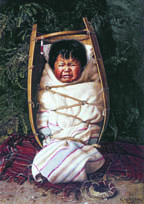
Little Mendocino, Hudson's most
 popular painting. This is a photo of the original.
The series grew to over 680 paintings by the time of
her death.

It does seem odd to me that there was this kind of interest in the paintings of  native Americans when at the same time they were being rounded up, thrown on "reservations," killed by US poachers and US soldiers, and forced to "Americanize" their ways in a concerted effort to wipe out their heritage. The Trail of Tears, the Sioux Wars, Little Big Horn where Crazy Horse was killed, Wounded Knee are just a few of the close to one hundred wars and conflicts aimed at exterminating the indigenous people of America.   


While Grace painted the basket weavers,
 her husband John collected them. They
are beautiful baskets.
.
And still these paintings by Grace Hudson became so popular they were copied many times over. When her husband gave up his medical practice to study the Pomo people and follow his deep interests in archeology and ethnography,a famous duo was born. She kept painting, he researched, studied, and collected. In fact it's his collection of California Indian baskets and other Native American artifacts that you can see in the Smithsonian, the Field Museum of Natural History in Chicago, the Brooklyn Museum, noted for its commitment to diversifying its collection, and the Grace Hudson Museum in Ukiah. 

A Grace Hudson Museum? How wonderful. I didn't know about it until doing some research for this blog. I hope I can visit on my next trip to California. The museum houses the manuscripts, artifacts and some paintings of Grace Hudson. A "Sun House," designed and built by the Hudsons, a California bungalow built of redwood, is part of the museum complex.  Here the Hudsons lived in retirement, researched, painted, collected, relaxed, entertained. They adopted the Hopi sun symbol as their family symbol, displayed prominently over the doorway.  The museum is operated by the city of Ukiah. It's designated a California Historical Landmark and listed in the National Register of Historic Places. 

Today, Grace Hudson's work enjoys renewed interest and recognition for its fine and sympathetic portrayals of native peoples. Her paintings sell well through Sothebys and other auction houses. It's a good omen for other women artists, and it pays homage to the persistence of native American culture against great odd that has enriched and continues to enrich our nation. 
Sun House entry door with Hopi sun symbol. Photo by User Binksternet

https://static1.squarespace.com/static/577fcdeab3db2bbb8519136a/t/58ae3f2a1e5b6c4889a00f19/1487814572232/little-mendocino-mad.pdf

https://en.wikipedia.org/wiki/Grace_Hudson a different version, said to be her first of her Pomo Indian paintings, called "National Thorn,." 1891  

https://www.gracehudsonmuseum.org/grace-hudson  LEARN ABOUT GRACE CARPENTER HUDSON'S EARLY CAREER, AND HER MOST FAMOUS PAINTINGS
Little Mendocino  Grace Carpenter Hudson 1892, oil on canvas 36" x 26"   In the collections of the California Historical Society

Little Mendocino
Grace Carpenter Hudson
1892, oil on canvas
36" x 26"
In the collections of the
California Historical Society

The August 2013 issue of Maine Antique Digest features a lengthy article on Grace Hudson and her early career by Karen Holmes, Grace Hudson Museum Registrar and Carpenter Family Historian. "The Sincerest Form of Flattery: Grace Hudson's Little Mendocino and Its Many Copies," traces the history of Hudson's 1892 portrait of a crying Pomo Indian baby that became the artist's best known work. Both the provenance of the original painting and the many copies it mysteriously inspired are thoroughly discussed in this copiously illustrated article. It provides the clearest picture yet of both the first years of Hudson's career, and her working methods as one of America’s earliest commercially successful female artists.


https://en.wikipedia.org/wiki/American_Indian_Wars  for information on the American Indian wars, pushing indigenous people of their land and onto reservations. It's a very sad  story. 

https://www.history.com/topics/native-american-history/american-indian-wars. For the vicious 19th- century wars, the era Grace Hudson painted the Pomo Indians.

https://www.gracehudsonmuseum.org/the-sun-house


Don't get out the popcorn yet: The Wheels of Justice Grind Slowly

"Delay, Delay, Delay: From pre-trial motions to negotiations over security, the master of legal stalling has many tactics in his arsena...