Saturday, May 22, 2021

Janet Fish, Playing with Light


Janet Fish

Janet Fish, born in May 1938 in Boston, MA, is a contemporary realist artist who explores the interaction of light with everyday objects, through oil painting, lithography, and screen printing.  Art critics note with delight that she has revitalized the still life genre, updated and changed it in remarkable and distinctive ways (Wikipedia).  She attributes her fascination with light to growing up in Bermuda, a place of bright light and intense color.  I think she might have had this fascination had she stayed in Boston, it seems so natural and intrinsic to her vision in art. 

Janet Fish makes windex beautiful! 

We are contemporaries. We grew up at the same time, in the same era.  Not that I ever knew about or heard about her.   That's how it was growing up in the 1950s and '60s.  Here was this fabulous artist, who embraced change and believed in the interconnectedness of all things, as I do, kindred spirits, but I never saw her art, not even through those glamourous women magazines of the time.  But then I wasn't looking for them with any clarity, either.  I was immersed in Van Gogh and Monet and the art of the male Western canon.  My love of  women's art grew with my love of learning into adulthood.


Light inhabits Fish's paintings, and so does change. This is what draws us in. "The objects that serve as armatures for color and light in her work are exuberant in their state of flux," writes David Moore Gallery, which represents her and has a beautiful  collection of her work.  I love that phrase, "Exuberant in their state of flux."

Sequins, 2003.
Right from my grandparents', and my mom's, table.
That gorgeous, shimmering Depression glass.

Glasses, 1974
After college at Smith and getting her MFA at Yale, where she resisted the Abstract Expressionism of the time, Fish moved to New York City.  She followed her own muse.
"Her paintings from the late 60s and early 70s, studies of transparent objects, began a life-long preoccupation with the nature and substance of light. From the beginning, Fish focused on commonplace objects, insisting that her subject matter, glasses, fruits covered in supermarket cellophane, or liquid filled containers, was unimportant. For Fish, meaning is determined by tone, gesture, color, light, and scale." (David Moore Gallery)
I must say, I also love the subject matter, and how it moves, and how she makes it come alive.  Still lifes in flux, ever changing light, studies in creative contradiction.  

At 83 years of age, Janet Fish still resides and paints in her loft in Soho or at her Vermont farmhouse.  She is exhibited and sold at David Moore Gallery and many others, as well as online, in sites like Artsy and Pinterest. Her works are popular and sell well at auction; many of them are now in private collections. You can view her work in several museums, from the Art Institute of Chicago and the Cleveland Museum of Art to the Dallas Museum of Fine Arts, Metropolitan Museum of Art in NYC, Museum of Fine Arts in Boston, and the Whitney Museum of American Art.  I'll be sure to look for them next time I'm in any one of those cities.  And hope, as I always do, that the Toledo Museum of Art might buy and exhibit her art.

Wrapped in cellophane.
From her "Panoply" exhibition, 2014
 

Some Sources

https://www.facebook.com/groups/864751373634163/? for fabulous  postings of women artists whose art deserves broader public recognition. See also Christa Zaat and Carel Ronk's  https://www.facebook.com/female.artists.in.history/,  pioneers in discovering and posting women artists overtime online. 

https://www.dcmooregallery.com/artists/janet-fish for a good collection of her art over time.

https://www.newyorkartworld.com/reviews/fish.html Good description of  how she paints, her style, her vision.

https://wsimag.com/art/7158-janet-fish-panoply An exhibition. 

https://en.wikipedia.org/wiki/Janet_Fish for a basic biography. 


Sunday, May 16, 2021

Grace Carpenter Hudson: Painter of the Pomo Indians of California

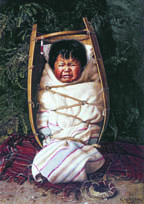
I saw this beautiful painting posted by Celebrating Female Artists in History and immediately wanted to know more about the artist, Grace Carpenter Hudson (1865-1937). She was a native Californian, born in Potter Valley, some 130 miles north of San Francisco in rural Mendocino County. Her interest in painting began as a young child, leading her to study art at the new San Francisco School of Design in the early1880s. She painted mostly portraits and landscapes.

It was an exciting time for women culturally. Hundreds of exceptional women artists, whose works were acknowledged and admired, emerged in the public sphere, along with the first generation of college-educated women, the emergence of a revitalized suffrage movement, and the rise of women reform leaders, philosophers, writers.  It was a time when women organized and gathered together to support one another. The "Bonds of Womanhood" propelled women into a myriad of  associations and clubs, women artists among them, rising up like sunflowers in fields across the land. 

These artists, like some of the first women scholars and their work, disappeared from public awareness and public view after their deaths. As men rose to claim the field, and the canon, they often intentionally, often aggressively, pushed women aside. The women artists didn't stop painting, didn't stop creating art,  of course. How could they? It's just that their work wasn't encouraged or exhibited. It wasn't celebrated. It was not shown in galleries. It was not bought by Museums for their collections.  Galleries and auction houses didn't display and sell them. 

Now this is changing. The art is being shown and the talent cannot be ignored.  It cannot be ignored.   

Grace Carpenter advanced her art as pioneer California grew and advanced its status in the United States. After she  married Dr. John Hudson, who migrated from Tennessee to take a job as the physician for the San Francisco and Northern Pacific Railroad, she began painting the local Pomo people, whom she had known since childhood.  John Hudson, also interested  in Native cultures, encouraged her interest. 

Given the atrocities being committed against the native people of America at the time, it's a wonder that this couple seemed to have an interest in documenting and preserving their culture. The painting to the right is of a basket weaver, and the baskets are beautiful.  


Hudson's portrait of a sleeping Pomo child in 1881, entitled "National Thorn," turned out to be the first in a numbered series of paintings she did of the Pomo people. I'm not sure what the title means. Is it sarcastic, that a lovely sleeping child could be a thorn in America's side? The popularity of this painting at the time motivated so many copy-cats that Hudson took care to protect its progeny, and her future paintings as well. 
Little Mendocino, Hudson's most
 popular painting. This is a photo of the original.
The series grew to over 680 paintings by the time of
her death.

It does seem odd to me that there was this kind of interest in the paintings of  native Americans when at the same time they were being rounded up, thrown on "reservations," killed by US poachers and US soldiers, and forced to "Americanize" their ways in a concerted effort to wipe out their heritage. The Trail of Tears, the Sioux Wars, Little Big Horn where Crazy Horse was killed, Wounded Knee are just a few of the close to one hundred wars and conflicts aimed at exterminating the indigenous people of America.   


While Grace painted the basket weavers,
 her husband John collected them. They
are beautiful baskets.
.
And still these paintings by Grace Hudson became so popular they were copied many times over. When her husband gave up his medical practice to study the Pomo people and follow his deep interests in archeology and ethnography,a famous duo was born. She kept painting, he researched, studied, and collected. In fact it's his collection of California Indian baskets and other Native American artifacts that you can see in the Smithsonian, the Field Museum of Natural History in Chicago, the Brooklyn Museum, noted for its commitment to diversifying its collection, and the Grace Hudson Museum in Ukiah. 

A Grace Hudson Museum? How wonderful. I didn't know about it until doing some research for this blog. I hope I can visit on my next trip to California. The museum houses the manuscripts, artifacts and some paintings of Grace Hudson. A "Sun House," designed and built by the Hudsons, a California bungalow built of redwood, is part of the museum complex.  Here the Hudsons lived in retirement, researched, painted, collected, relaxed, entertained. They adopted the Hopi sun symbol as their family symbol, displayed prominently over the doorway.  The museum is operated by the city of Ukiah. It's designated a California Historical Landmark and listed in the National Register of Historic Places. 

Today, Grace Hudson's work enjoys renewed interest and recognition for its fine and sympathetic portrayals of native peoples. Her paintings sell well through Sothebys and other auction houses. It's a good omen for other women artists, and it pays homage to the persistence of native American culture against great odd that has enriched and continues to enrich our nation. 
Sun House entry door with Hopi sun symbol. Photo by User Binksternet

https://static1.squarespace.com/static/577fcdeab3db2bbb8519136a/t/58ae3f2a1e5b6c4889a00f19/1487814572232/little-mendocino-mad.pdf

https://en.wikipedia.org/wiki/Grace_Hudson a different version, said to be her first of her Pomo Indian paintings, called "National Thorn,." 1891  

https://www.gracehudsonmuseum.org/grace-hudson  LEARN ABOUT GRACE CARPENTER HUDSON'S EARLY CAREER, AND HER MOST FAMOUS PAINTINGS
Little Mendocino  Grace Carpenter Hudson 1892, oil on canvas 36" x 26"   In the collections of the California Historical Society

Little Mendocino
Grace Carpenter Hudson
1892, oil on canvas
36" x 26"
In the collections of the
California Historical Society

The August 2013 issue of Maine Antique Digest features a lengthy article on Grace Hudson and her early career by Karen Holmes, Grace Hudson Museum Registrar and Carpenter Family Historian. "The Sincerest Form of Flattery: Grace Hudson's Little Mendocino and Its Many Copies," traces the history of Hudson's 1892 portrait of a crying Pomo Indian baby that became the artist's best known work. Both the provenance of the original painting and the many copies it mysteriously inspired are thoroughly discussed in this copiously illustrated article. It provides the clearest picture yet of both the first years of Hudson's career, and her working methods as one of America’s earliest commercially successful female artists.


https://en.wikipedia.org/wiki/American_Indian_Wars  for information on the American Indian wars, pushing indigenous people of their land and onto reservations. It's a very sad  story. 

https://www.history.com/topics/native-american-history/american-indian-wars. For the vicious 19th- century wars, the era Grace Hudson painted the Pomo Indians.

https://www.gracehudsonmuseum.org/the-sun-house


Thursday, April 29, 2021

On the Cusp of Now or Never: Going to Greece

A romantic view of the city of Athens. In my dreams. photo, greeking.me

Santorini. photo by greeka.com
I just booked a tour to Greece with Gate 1 Travel.  Going with my daughter Elissa, in mid-October. We are so excited. Elissa will be looking for gluten-free baklava, like the gluten-free fish and chips she found in Dublin! I'll be looking for antiquities and rainbows. 

"But, Fran, what about COVID and all the issues around travelling?" 

Yes, I know. It's a bit  risky. Lots of uncertainties.  We might have to cancel, and reschedule.  

"Can you even fly into Greece? It'll be like going to India, which I can't even watch on television. It's being called an "apocrolypic explosion," that's how bad it is. Fareed Zakaria's 85-year-old mom died of it."

Yes, sad. The explosion of COVID in India is tragic. Greece has had a rough time of it, for sure, but it's not India, thank goodness. The Greek government has been on it with mask and distancing mandates, I think even before we were, and  people are now being vaccinated. Greece relies on tourism. And just this month, it opened to foreign travelers. You need proof you're fully vaccinated.  

Also, this is a tour with a wonderful professional company that I've traveled with before, to Sicily, Barcelona, the coasts of France and Italy, Cinque Terra, and Ireland. They take care of all the details. 

"Why not wait a little longer, to be on the safe side?" 

Athens. Photo, tripadvisor.com


That's something to think about. You know the saying about adding life to your years? Greece has long been a dream, since college days, when we read Plato and Aristotle and learned the history of democracy.  Also, after a trip to Sicily with my sister Andy, the birthplace of our maternal grandmother, I wanted to learn more about what I think could be a Greek heritage as well. 

And I can't resist saying it, but I feel as if  I am on the cusp of now or never, as I told Andy. If not now, when?  It's kind of the same feeling I had joining the Peace Corps at age 69 and turning 70 in Ukraine. The unknowns were enormous. Same with deciding to leave Florida in 2011 and return to Toledo. The unknowns of traveling during the Time of COVID are too. 

"What do you think, Mom?" Elissa asked. We'll just wait and see, I replied. She agrees.

Gate I Greece tour plus we're adding extension to Santorini.


https://gr.usembassy.gov/covid-19-information/

https://www.ontheluce.com/ancient-city-akrotiri-santorini/

https://www.google.com/search?q=Athens,+Greece&rlz=_

Sunday, April 25, 2021

Women love Flowers


Addendum: I am adding some more flowers by women artists below, at the end of this blog, because they are so skillfully rendered and lovely in every way--form, shape, color, perspective, composition, distinctiveness.

Anna Blackburne, British
naturalist artist, 1726-1793 

Francoise de Felice, Italian-French, born in Paris in 1952. She studied art at the Sorbonne. At 20 she moved to Sicily, where the Sicilian Baroque style inspired her work. Women and flowers, forever in bloom.

What delights us most, even during this time of COVID? What brings unmitigated joy? What makes us smile? 

Flowers. Yes, all kinds of flowers. Women love flowers. We see in flowers, in every single flower actually, a whole world of energy and beauty.  It's like returning to the  Garden of Eden and traveling from there on a flowery path to our very own gardens.  

The flowers painted by women skilled in the art of still life are like a perpetual garden in every season. They are forever young, forever blooming, in every age, across time and space.  Old age does not diminish them. Old age becomes them. 

And they are as diverse and unique as the artists who created them and bring them to still life and our lives. Their flowers bloom not only in Spring but year-round, in profusion, for eternity.  That's why these women artists who painted in the shadows of better known male artists are becoming well known themselves, and increasingly popular, from grand auction houses and myriad galleries, to internet sites such as Pinterest, Etsy and Artnet.  Whether its an original or a print, we can surround ourselves with the exquisite talent of women artists from any historic period. 

Here are a few of the thousands of flowers in the aesthetic gardens of women artists from around the world and mostly in chronological order of the historical period in which they worked.  

Anna Blackburne, British, 1726-1793, was a British naturalist, an interest she inherited from her father, a natural historian and collector. She learned Latin in order to improve her knowledge, and started her own collection as well. The power of curious woman who lived in every era of human history! She was in contact with famous naturalist like Linnaeus and Johan Foster, both of whom named several species in her honor. Who knew! Also her brother, who lived in the US, sent her many specimens, especially of birds, which she also painted. Although her art was rather ingloriously dispersed and sold off to god knows where, it's wonderful that Sothebys has rounded up a wonderful collection that it sells at auction. So glad to know this.


Jessica Hayllar, c.1858-1940, was born in London, the youngest of 9 children. The 5 sisters in this large family were given art lessons by their father, James, a well-known painter at the time. Jessica became the most prolific artist among the Hayllar offspring, although her sister Edith also achieved some recognition. Jessica exhibited at the Royal Academy in London regularly between 1879 and 1915 and also had works shown at the Society of British Artists and other venues. She painted domestic scenes, local villagers, and family gatherings. 
The family lived at Castle Priory, Wallingford, on the banks of the Thames, and many of her works depict the happy, settled life they enjoyed there. In her later years she mostly concentrated on painting flowers, as shown here, in a kind of Pre-Raphaelite realism she apparently inherited from her father. Her works sell very well through Christie's, whose collection includes art from Jessica's other sisters, always nice to learn.


Jane Peterson, American, 1876-1965, was born in Elgin, Illinois, and was a graduate of Pratt Institute in Brooklyn.  She is known for her richly painted sill lifes and beach scenes along the Massachusset's coast. 
Fishing Boats, Gloucester, MA,
at the Brooklyn Museum.

She travelled widely and studied as she did so, including under some well-known European artists. She also taught art in the US and abroad. Around 1912 she became associated with a group of American artists that included John Singer Sargent, Childe Hassam, and Maurice Prendergast.  Her works are held at the Metropolitan in NY. the National Museum of Women in the Arts and the Hirschorn in Washington, DC. I'll have to look for them next time I'm in those cities. I love this bright bouquet of zinnias, which may well have been influenced by her work and travels with the Spanish  artist Joaquin Sorolla (another new name for me). 


Laura Wheeler Waring, 1887-1948, African-American, was born in Hartford, Connecticut, became a painter and educator. She went to the highly regarded Pennsylvania School of the Arts, travelled and painted in France, and returned to the States to teach and continue her art.  This young girl is surrounded by flowers, lifting her up with hope at a time when White Supremacy raged in America. 


Dod Procter, born Doris Margaret Shaw, a British artist, 1890-1972
, attended art schools in England and in Paris along with her husband Ernest, where they were both influenced by Impressionism and Post-impressionism. Her husband joined a French Ambulance Unit during World War I, a powerful impact on their lives and work. Dod Procter was an active artist after the untimely death of her husband in 1935. That's when she also travelled to the United States, Canada, Jamaica and Africa. She died in 1972. Her work was exhibited at the Royal Academy on many occasions, considered a triumph for women artists. She painted more portraits then still lifes, but I like this painting. Also this turn of the century period was one of the most prolific for women artists around the world. 


Amy Katherine Browning 1881-1978, was born in Bedfordshire, UK. She entered the Royal College of Art in 1899, and spent several years off and on studying and teaching there until 1906. I was delighted to learn that she was a friend of the  English suffragist Sylvia Pankhurst and that they worked together on an art exhibition for the Women's Social and Political Union in 1909. This was a time when American Suffragists were learning from their active English counterparts and began holding parades and public protests for suffrage. Browning continued to paint after painful years of World War I, supporting herself by teaching. She exhibited at the Paris Salon and won several awards for her work.  She also took commissions, including one for a portrait of Winston Churchill.  She died in 1978, her legacy preserved in several museums and galleries in the UK.  I like these flowers, kind of askew, thrown in a vase without much ado, but endearing. 

Bibi Zogbe, Lebanese, 1885-1973, Thistles. 

Bibi Zogbe, Cherry Trees in Flower
Bibi Zogbe was born in the Lebanese seaside village of Sahel Alma. She emigrated to Argentina at the age of sixteen. Her professional artistic career began in the 1930's with a number of exhibitions in Buenos Aires and Rio de Janeiro, in Chile and Uruguay, in Paris and elsewhere. At the end of the Second World War, she lived in Paris and Dakar and from there she went to Lebanon in 1947, a long-awaited dream. She had a one-woman exhibition which soon gained her fame. Her flower paintings are one of a kind, exquisite, special. Some call them a "microcosm of Lebanon, «Paradise of Eden» a garden endlessly in blossom, symbol of the birth of  life. The profusion of flowers in her work evokes an eternal spring, delicate and colorful. Art historian Charles Corms said of Bibi: “All the flowers of the world smile on us a day and then are gone, but her flowers will never perish away for she has put into them the clear immortal fire of her heart."  I have fallen in love with Bibi Zogbe. Maybe I should buy one of her works? 


Faith Ringgold, born in Harlem in 1936, Surrounded by Flowers. 

Sunflower Quilting Group

Faith Ringgold was one of the most talented artist of  the Harlem Renaissance, a painter, quilter, mixed media sculptor, performance artist, writer, teacher. She went to the City College of New York (CCNY), travelled in Europe in the 1960s, a time of  raging Civil Rights and anti-Vietnam war protests, creating her first political paintings there.  Returning to the States, she moved toward sculptor and mixed media, establishing her voice and her legacy in the 1970s and 80s until today. She wrote several books, including art books for children, and an autobiography, "We Flew Over the Bridge" (1995). She is professor emeritus at the U of California, San Diego, where she taught from 1987-2002. She now lives and works in Englewood, NJ.  An extraordinary talent, and a favorite of art collectors.


Gwendolyn Knight, Barbados-American,  1913-2005. She moved to the US as a foster child and rose against the odds to become a bright light among the artists and writers of the Harlem Renaissance. She was, I only now discovered, the wife of the famed artist Jacob Lawrence, whose Migration series remains a monumental work of art. I remember seeing the exhibit at the Phillips Collection in DC. Knight was able to find her own voice and to begin painting in mid-life into her later years. "When your spouse is Jacob Lawrence," wrote journalist Herb Boyd in an article in the Amsterdam, NewYork News in 2019, "getting out of his impressive shadow can be daunting. But Gwendolyn managed to step from his glow and shine her own artistic light and legacy, while retaining her birth surname." 


Georgia O'Keefe, Purple Petunias, 1924. These bold petunias accidently (by some click) got wedded to Beneke-Molenaar's roses, below, so here it is. 


Yvette Beneke-Molenaar, contemporary, lives and paints in Cape Town, South Africa, Roses in a Vase. Her prints are popular on Pinterest, Etsy,Artnet, etc. And they are pretty, and some intriquing.
https://www.facebook.com/yvetteart/


Georgia O'Keeffe, (1887-1986), Red Canna, 1915. I thought her purple petunias were here, but we got this lovely watercolor.  Always O'Keeffe.


Fiona Craig, Australian, contemporary, grew up in the Blue Mountains outside of Sydney, and currently resides in the US. She attended art groups and schools, both academic and non-academic, which gave her a broad arts and crafts experience. Her works are in private, corporate, institutional and public collections in Australia, the US and other countries. She specializes in floral, landscape and portrait painting in oils, pastels and watercolors. "I am constantly inspired by the contrasts between Australian flora and landscapes and those of North America. I like to compose dramatic displays that bring the art audience closer to appreciating nature."   Aren't these the most gorgeous Iris!


Charlotte Sabbagh, Danish, lives in US, contemporary, Spring
Danish artist Charlotte Sabbagh currently lives in Rowayton, CT. She studied in New York at Parsons Fine Arts program, NYC Studio School and Silvermine, CT. She gets her inspiration from her native country, where she spends each summer. She is drawn to the contrast of light and dark in the water, sky horizons, atmosphere and the natural beauty of the world we live in. These images are expressed in the colors, textures and mixed media used in each painting. Her catalog of work consists of abstract paintings using oils, acrylics and mixed media and she shows widely. “Art is public by nature, yet a complex echo of the inner self” — Charlotte Sabbagh


Some sources, for more information and images:

https://www.google.com/search?q=anna+blackburne+artist+sotheby%27s%27&tbm=isch&ved=2ahUKEwiyyb6865 
 Click on this link for a whole series from its Sotheby's Blackburne collection that it sells at auction.

https://en.wikipedia.org/wiki/Anna_Blackburne 

https://en.wikipedia.org/wiki/Jessica_Hayllar 

https://en.wikipedia.org/wiki/Jane_Peterson 

https://en.wikipedia.org/wiki/Dod_Procter 

https://www.invaluable.com/artist/zogbe-bibi-i9wq5ns4xe/sold-at-auction-prices/ Bibi Zogbe, 1890 -1973.  Click on this link to see some of Zogbe's lovely art at BP Parity auction house. I love seeing women artists selling at places like Christie's, some priced out of most of our ranges, but a few less dear. Her work is fabulous,distinctive, in museums and lots of private collections.  So glad I discovered her. 

https://www.onefineart.com/artists/painters/Bibi-Zogbe, good bio information.  

https://www.facebook.com/yvetteart/

https://www.fionacraig.com/contemporary Australian artists 


On right: Gwendolyn Knight painted more traditional works for friends, such as this bouquet of flowers. Lovely and dreamy. I have the feeling, reading about this wonderful woman, that if I had asked her for a painting, she would have done one, and I would have treasured it. 
On left, Suzanne Valadon got wedded to Knight, and can't fix it! See Addendum below.

https://www.gearygallery.com/?artists=charlotte-sabbagh, contemporary, Danish, lives in Connecticut.

http://brillyance.blogspot.com/2017/10/laura-wheeler-waring-1887-1948.html

https://www.faithringgold.com/


http://amsterdamnews.com/news/2019/nov/27/gwendolyn-knight-she-cast-her-own-artistic-light/ on Gwendolyn Knight.


Addendum: I am adding some more flowers by women artists from time to time, as they are posted on Female Artists in History and Celebration of Female Artists, because they are so skilled and lovely in every way--form, shape, color, perspective, distinctiveness. And we need to know about these great artists. Many are now collectibles, and popular, but I think more Museums should be adding them to their permanent collections and on their gallery walls. 


Suzanne Valadon
, French, 1865-1938, Flowers in Vase.. A great period for women artists.


Grace Hartigan by Gordan Parks, which is why I love this! 

Grace Hartigan, American, 1922-2008,Abstract/Expressionist painter, Flowers in Red Vase.
She is fantastic. WOW. https://en.wikipedia.org/wiki/Grace_Hartigan. Well known, highly collectible, popular on Pinterest and lie sites, her paintings are held by numerous major art institutions. Friend of Pollack and all the famed men who painted in NYC in the1940s and 1950s. She held her own. 


Mary Cassett, Lilacs in a Window, 1880 
I can smell these lush purple lilacs.  Viva Mary Cassett!


Sarah Blumenschein, Engineer and Artist, American, lives in Albuquerque, NM, contemporary, pastels and still lifes.

“I find myself primarily drawn to painting 'still life' because of the variety of colors, shapes, textures, and reflective surfaces possible. One of my favorite subjects is glass because of the way it both transmits and reflects the light. With each painting, I enjoy the challenge of capturing a strong sense of light and creating the illusion of 3-dimensions on a 2-dimensional surface.”

Thursday, April 22, 2021

Women love Roses


Sarah Blumenschein, American, contemporary, "Three Roses."

In memory of my mom, Rose Lynn Luchetti Curro, July 1915-March 2003, from whom her children inherited a love of flowers and gardening and a habit of looking for beauty in everything, everywhere. 

Women love roses, and women painters have given us the gift of beautiful roses in abundance since time immemorial. We know the flowers of Van Gogh, Matisse, Monet, Renoir, but there are so many more women still life artists emerging from their shadows into the light of day. Since I've been looking deeper, I have found that female artists paint the most roses of all, and they are exquisite, in diverse genres and styles, in delightful palettes and complex detail, and in hundreds of different arrangements. Here are a few women artists overtime who have given us a world of roses without end.  

Inessa Morozova, Ukraine.
 

Inessa Morozova (Инесса Морозова), was born in Kherson, a city in southern Ukraine, in 1981. I've written about her in previous blogs, enamoured because she is contemporary and from Ukraine. She graduated from the Solntsevo Art school and the Humanitarian  Applied Institute.  I didn't know of her when I lived there, but I'm sure if I returned to Kiev, I'd find her painting on the descent of Andreevsky Street near Maiden Square. She paints flowers and children, much like her predecessors. I love the lushness of her roses in this work. Though she is a modern-day artist, some of her works remind me of early 20th-century women artists on whose shoulders she stands, including that of Irene Klestova (see below).   

Catharina Klein, Germany 1861-1929, was born in Eylau in what was then East Prussia, which became a Russian province called Kallinigrad. She moved to Berlin to study art and begin painting in earnest. She "rode the crest of chromo lithography" at the end of the 19th and into the 20th Century. She was also known as Catherine Klein, "anglicized outside of Germany during WWI to avoid any disinclination to buy her work." I found this an interesting fact that echoes what many German-Americans did during the war, which unleashed an ugly anti-German hysteria. Her signature, "C.Klein,"  usually accompanies her work, especially in the hundreds of postcards and prints she did of her original paintings, which were in oil or gouache, an opaque watercolor paint.  Artists like Klein have found new audiences through Pinterest and other online sites. I can see why.


Suzanne Valadon
, French, 1865-1938, born in poverty in Montmartre, worked all her life to earn her keep, including  with a circus for a time, and also modeling for artists like Renoir. She was mostly self-taught but learned from the many artists who lived in Montmartre, an artist colony to this day. According to Wikipedia she was the first woman artist admitted to the Societe National Beaux Arts. I like this simple red rose. 

Here she is (left), depicted in Renoir's 1883 painting Dance at Bougival, Lovely, isn't she? 

Ethel Elizabeth Foster, American, 1873-1928, "Mixed Bouquet."

Ethel Elizabeth Foster was born in Pennsylvania,  and raised and lived in Washington, DC until her death. Her father was employed for many years as a clerk for the Department of Justice. She attended Columbia University in NY and was awarded a Fine Arts Diploma in 1901. She is listed as a public school teacher in the 1990 census, supervisor of drawing and artist in the 1910 census. Washington was home to lots of wonderful women artists at this time, and  I like to think they knew each other and supported each others' work. Many were public school teachers like Ethel Foster. 


Irene Klestova, Polish-Russian, 1908-1989, is probably the #1 painter of roses! Google her name and up will come beautiful rose after beautiful rose. She was well known in Leningrad, moved to Italy where she lived for 20 years, and then to Paris in the 1950s. She exhibited regularly at the Salon d'Hiver and the Salon des Artistes Independents. Known for her roses then as now, her works sell well in galleries and at auction today. 


Nan Greacen

, French-American, 1909-1999, Roses in a Glass Bowl, was born in Giverny, France, where her father Edmund Greacen was an impressionist painter actively following Claude Monet. Nan Greacen became a noted oil painter and watercolorist in her own right. She began earning awards from 1936, when she received the Hallgarten Prize at the National Academy of Design. She studied at a school created by her father in NYC in 1921, the Grand Central Art School. First I've heard of it. She taught drawing and still life at the school and wrote and illustrated two books on painting technique: Still Life is Exciting (1965) and The Magic of Flower Painting (1971).


Rachel Ruysch, Netherlands, 1664-1750, Still Life Of Flowers with a Nosegay of Roses, Marigolds, Larkspur,  a Bumblebee and Other Insects. She specialized in painting flowers, inventing her own style, popular in the heyday of the Dutch Golden Age. Her talent is being revived in these times of unearthing the power of women's painting.  I'm beginning to be able to identify Dutch paintings in this style from this period. They are so distinctive. Although Van Gogh and the male painters seem to dominate art galleries in Amsterdam, and I love seeing them, it's good to know that museums and galleries seem to be diversifying and broadening their collections. 


Alida Withoos, c. 1659 to 1730, was born in the Netherlands as well, to a family of artists headed by her father Matthias, a well-known artist at the time. Maybe she knew Rachel Ruysch. Alida  set off on her own and apparently thrived as a still life painter and botanical illustrator during the late seventeenth century.  She became part of a significant network of artists and botanical experts and amateurs. Although today we know little about her life, Alida Withoos contributed to some of the most important botanical artistic projects of her time. Catherine Powell, art historian at the University of Texas, noted that she "displayed enormous skill in illustrating highly detailed, life-like specimens of flowers and plants. Her illustrations were scientifically accurate and could be used for identification. They were also aesthetically pleasing and exceptional works of art in their own right." Powell  righty said "There are many Withoos, but only one Alida." She traveled widely, loved Rome, and lived much of her adult life in Amsterdam. Some of her works hang in the Rjiksmuseum, I'll look for them next time I'm there. 


We all recognize by now this stunning White Rose (1930) by 
Georgia O'Keeffe, the popular and highly esteemed artist from the prairies of Wisconsin, who studied art in Chicago and NYC, and fell in love and embraced the American Southwest from her Taos studio in New Mexico's high desert.  I love her flowers: large, bold, sensuous

Some sources:

https://www.widewalls.ch/magazine/famous-female-renaissance-artists

https://galleries.brenau.edu/2020/09/24/person-place-thing-paintings-by-women-artists-in-brenaus-collection/.  A lovely collection at Brenau University in  Gainesville, Georgia, which might have begun as a women's college in Augusta. The gallery and collection were begun under President John S. Burd in 1985, and it has grown and expanded.                                                     

https://gardencollage.com/inspire/art-design/women-artists-legacy-floral-paintings/

https://en.wikipedia.org/wiki/Rachel_Ruysch . It's amazing to me the story of so many women artists who achieved recognition in their own time, like Rachel Ruysch, but were then sidelined, marginalized and forgotten, only to be re-discovered in modern times. It's a story of how the Western Art Canon  was shaped by men with intention to obscure the works of women artists. 

https://www.averygallery.com/nan-greacen

https://artherstory.net/alida-withoos-creator-of-beauty-and-of-visual-knowledge/ by Catherine Powell, University of Texas. 

https://artliveandbeauty.blogspot.com/2020/08/artist-inessa-morozova-ukrainian-artist.html

https://www.askart.com/artist/Ethel_Elizabeth_Foster/10018349/Ethel_Elizabeth_Foster.aspx,   This painting is also in the Brenau collection, interestingly enough. 

http://www.artnet.com/artists/irene-klestova/

https://www.theguardian.com/artanddesign/2016/jul/01/georgia-okeeffe-tate-modern-exhibition-wild-beauty


Don't get out the popcorn yet: The Wheels of Justice Grind Slowly

"Delay, Delay, Delay: From pre-trial motions to negotiations over security, the master of legal stalling has many tactics in his arsena...