Monday, April 11, 2022

Odessa: In Putin's Sights with his new General Dvornikov, the Butcher of Syria


Odessa is preparing for RU attacks. Intel says it's coming as Putin's eastern front ramps up. 

I think Odessa holds a special place in Putin's twisted mind.  And it is now in imminent danger of his brutality. A massive naval squadron sits in the Black Sea blockading the beautiful port city, awaiting Putin's word to unload their lethal weapons.  

The apocalyptic scenes uncovered in Bucha, in Chernigov, Kherson, Mariupol, war crimes that have horrified the world, will play out in Odessa in time, unless the Western allies help Ukraine repel them.  

Putin's paved the way to Odessa with his earlier assaults on southern Ukrainian cities. Today, the world awaits his campaign to annihilate the Donbas.  His new general, Alexander Dvornikov, known as the Butcher of Syria for his unspeakable war crimes there, for his "utter disregard for the laws of war," is more than ready to carry out Putin's orders. An 8-mile holocaust convoy loaded with weapons is headed to Sloviansk, the platform for Putin's eastern and southern campaign. Train stations filled with terrified refugees will be easy targets everywhere, as will all evacuation routes, apartment buildings and other civilian targets. Zelenskyi warns this offensive will be worse than World War II. This has to be a red line for NATO and the western alliance. 

Odessa is the Ukrainian city created by Catherine the Great in the 1790s, with a lustful eye for dominion over all of Ukraine, then the bread basket of Europe.  She also ordered the creation of Dnipro, Kherson, Mykolaiv, and Sevastopol on Crimea. 

Putin has invaded all of them, destroyed most of them, all front lines to the Black Sea and to the critical seaport of Odessa.  

April 4, 2022, multiple artillery attacks on Kherson & Mykolaiv, the southern towns around the Black Sea, along the front to Odessa, as you can see on this map. Mariupol has been totally 
destroyed. Its Mayor says it looks like Auschwitz. Pres. Zelenskyi says tens of thousands of civilians have been killed.  
.


Catherine presented herself as an "Enlightened" autocrat who was guided by the rule of law but at the same time she annexed much of Ukraine through wars with the Ottoman Empire and the partition of Poland, and she brutally suppressed the largest peasant rebellion in Russian history (wikipedia).  This chapter of Russia's history of empire is part of the complex and tortured history of Ukraine, long a political football in that part of the world. That tortured history is true as well for the other former Soviet Socialist Republics (SSRs) and most of eastern Europe.  Historian Timothy Snyder calls them "The Bloodlands."   

Odessa in spite of its origins grew to become one of the most vibrant multicultural cities in the 19th century, a free port that attracted wealthy merchants and traders and people from around the region and the world.  Odessa was multinational, multi-linqual and multiethnic. It was a vibrant center of Jewish life.  I am amazed at how many friends tell me their grandparents, their ancestors, came from Odessa. 

The iconic Robert Sears' Guide to the Russian Empire, first published in 1855, described Odessa this way: “There is perhaps no town in the world in which so many different tongues may be heard as in the streets and coffeehouses of Odessa, the motley population consisting of Russians, Tartars, Greeks, Jews, Poles, Italians, Germans, French, etc.”​  Sadly, World Wars I and II changed that, and the Jewish population was decimated. 

Today, thankfully, Odessa feels a lot more like it must have been in the 19th century than what it became during the 20th century. It's a mix of nationalities with a  tolerant upbeat spirit. It is noted for its multicultural cuisine, joie de vivre, sense of humor, resourcefulness. 

Peace Corps volunteers loved meeting in Odessa, loved the cafes, the Turkish street vendors, the Potemkin steps and port, the beautiful architecture, the people most of all. It's like a European city, easy to enjoy, easy to  embrace. A friend I made at Camp Sosnovy, a summer camp for kids of all ages from all over Lugansk oblast, the head counselor Iryna, said I should move there. I could stay at her apartment. I was tempted. I must say I think about those wonderful kids, wonder what's happened to them. 

Putin shares Catherine's lust for Ukraine, but he means to take it by obliterating it. 

Why? Because Ukraine no longer identifies with Russia, the Russian empire, or the Soviet Union. Ukraine has become fiercely independent, fiercely Ukrainian in its soul and spirit.   

Odessa Opera House. I can't remember the
Opera we saw, but oh I remember the
stunning beauty.
Moreover, Odessa, like Mariupol, like Kherson, Severodonetsk, Trostyanets, resisted Russian advances after Putin invaded and occupied Crimea and parts of the Donbas in 2014/2015. Putin, in his diabolical revenge, has destroyed these cities, and he wants to do the same to Odessa. If he can't have it, nobody can. His offensive is underway from the East.  

The Generals say Putin's escalation in the greater Donbas region will be "reminiscent of World War II." Russia bombed a train station in Karmatorsk, not far from Lugansk city, not far from where I served with the Peace Corps.  Yesterday another train station was hit. Civilian corridors, Escape routes. All targets. Putin's new commander will gladly kill as many civilians as possible. He's a red flag of disaster, of war crimes. What more does the US and the West need to see before it gives Ukraine everything it needs to stop Putin right here and now?

Odessa, stunning Odessa, will stay in Putin's sights, his grand prize if he is not stopped in the Donbas.  Odessa is preparing, but will it be enough? 

Odessa collage.


Preparing for the worst. Sandbags around the Opera House.
 Getty image/Scott Peterson

The Odessa Food Market on Richelievska, once a hipster paradise ablaze with neon signs advertising oysters and sparkling wine, welcoming one and all, is now a logistical hub for the war effort. Volunteers in orange and yellow jackets sort and organize donations onto shelves, ready to be taken to the front lines. The city stands, but it is watchful. "Time is of the essence," they say. Russians have already launched attacks on nearby oil tanks and suburbs from the air. That massive fleet in the Black Sea, ominous, threatening, is aimed directly at the city.  Odessans know what's coming. 

The US, NATO, the Western alliance know what's coming, too.  Unless Putin is stopped in the Donbas region on his way South around the Black Sea, the world will witness another apocalyptic disaster.   That it will be Odessa to fall is too much to bear. 

Sources:

1.  https://www.smithsonianmag.com/history/when-catherine-great-invaded-crimea-and-put-rest-world-edge-180949969/ "Nearly 250 years ago, Catherine II played a similar hand when she attempted to impress the West while ruthlessly enforcing her authority over Russia & the surrounding region." 

2. https://contestedhistories.org/resources/case-studies/catherine-the-great-monument-in-odessa/

3.  https://en.wikipedia.org/wiki/Catherine_the_Great.  "Catherine, who admired Peter the Great, aimed to modernize Russia along Western European lines, but military consription and the economy continued to depend on serfdom, one of the chief reasons for the Pugachev Rebellion of Cossacks".        

4. https://theconversation.com/how-catherine-the-great-may-have-inspired-putins-ukraine-invasion-178007

5. https://www.wilsoncenter.org/blog-post/odessa-ukrainian-port-inspired-big-dreams  "Catherine's Black Sea port quickly emerged as a randy mix of nationalities and cultures.".

6.  https://www.economist.com/europe/2022/03/07/odessa-finds-its-ukrainian-identity-ahead-of-a-russian-advance  

7.  https://www.ukrinform.net/rubric-ato/3448166-russian-military-abducts-tortures-people-in-kherson-region.html war crimes in Kherson, torture and detainments.

8.  https://www.ukrinform.net/rubric-ato/3448765-ten-killed-by-cluster-munitions-in-mykolaiv.htmlMykoliav attacked April 4, 2022, civilians, schools, a hospital. More horrendous war crimes.

9.  https://scalar.usc.edu/works/odessa/a-brief-history-of-odessa by Isabella Buzsynski 


Wednesday, March 16, 2022

Boris Lurie, Holocaust Survivor, Artist, and the "No!Art" Movement

NOTE: I started this blog a few months ago, but it resonates now more than ever, when the world is screaming NO! to Putin's unprovoked war of total destruction in Ukraine, NO! to the real possibility of a World War III in the 21st century. 

Boris Lurie, Holocaust survivor, artist, poet, writer, co-founder of the NO!Art movement
                in New York City, post-WWII, using art to educate & protest man's inhumanity to man.  

Lurie, "Immigrant Suitcase."

He was only 16 years old in December 1941 when the Nazis captured him, branded and demeaned him, and sent him to Buchenwald. It was the end of the age of innocence.

Boris Lurie was born in Leningrad, Russia (now St. Petersburg) and raised in Riga, Latvia, where his father had moved the family when Boris was a young boy in order to be freer to explore new opportunities.
.. 

Boris' youth was taken from him and tragically, beyond words, so were the lives of his mother, sister, grandmother, and his teenaged girlfriend. At the end of December 1941, Boris' family was herded into a ravine in the Rumbula forest on the outskirts of Riga and shot to death. It was the place where Boris grew up, went to school, found his first love. It was the time when life as he knew it ended. 

The Rumbula massacre is considered one of the most horrific crimes of the Nazi era, its echoes heard to this day. It repeated exactly the massacre at Babi Yar in Kyiv, Ukraine, three months earlier, when Nazis herded the Jewish residents of Kyiv into a ravine and shot them dead. The SS soldiers stood around the top rim of the ravine, shooting bullets down into the innocent victims trapped below. I thought I heard the cries of the victims as I stood on that rim with fellow Peace Corps Volunteers during a walking tour of Kyiv. 

"The most difficult ingredient in all art is the
hardest to learn. It is courage."
Boris Lurie

"Dance Hall Yellow,1955, Lurie's trauma
 comes out of the shadows into the light.
 
At Rumbula, 38,000 Jewish residents of Riga were shot dead in cold blood: Nazi soldiers standing at the top of the ravine, like they did at Babi Yar, shooting bullets into the bodies of the people trapped below, falling in horror on top of each other, women, children, mothers, fathers, grandparents, friends, doctors, lawyers, teachers, shop-keepers. And this over a two-day period, carrying out Hitler's "final solution," the genocide of the Jews.

I came across Boris Lurie when I was writing about the Fritz Ascher Society and Ascher's art. His story, the stories of the Holocaust, continue to shock.  

And to think that such ugly authoritarianism, fascism, Nazism, haunt us to this very day, warning us of the past, warning us to be diligent, to remember. How can we stand silent in the face of rampant, vicious anti-semitism that gave us Hitler and the Holocaust, that is on the rise right here at home? 


And now, today, I can't help but ask this: How can one man in a position of power, Vladimir Putin, decide to viciously attack a peaceful country that was no threat to Russia. None whatsoever.  An unprovoked war to annihilate Ukraine's cities, towns and villages, and murder its people. To attack not military targets, but civilian targets, deliberately, intentionally, bombing homes, neighborhoods, apartment buildings, hospitals, schools?

How can we be witnessing another European genocidal war in the 21st century? I wake up in the middle of the night and cry out "No.
N-o-o-o-o-o-o. It can't be happening. It has to stop."  

This was the anguished cry of Boris Lurie after he came to  America in 1946, the pain of his experiences still raw. He came to live free and to paint, to start a new life in New York City. But he could not forget. He found himself fighting against the post-War indifference of friends, of contemporary artists like Rauschenberg, Warhol, Lichtenstein and Johns. America wanted to forget the war and move on. This mood, a national mood, was reflected in the two most popular art movements of the era, Abstract Expressionism and Pop Art. 


In the camps.

But Boris had a hard time moving on, He was driven to say "NO" to the Holocaust of his youth, to the horror, the losses, the struggle to survive in the death camps. He was driven to tell about it.

In 1959, he, Sam Goodman and Stanley Fisher, also artists and writers, founded the NO!Art movement. Its goal was to bring back into art the subjects of real life. It thus stood in opposition to abstract and pop art. I had never heard of NO!Art, but it seems altogether too timely to ignore.

In his art and also in his poetry and writings, including a memoir, Boris Lurie pushed the reality of man's inhumanity to man to the limit. It didn't make the New York art world comfortable. It doesn't make me comfortable. 

Railroad Collage, 1966.  A pin-up in front of a railroad car filled with dead Jewish victims, perhaps his own family among them. This is considered Lurie's most famous work. Besides showing us the horrors of the Holocaust, reviewers note that it brings together for the first time American consumerism and the brutality of the Holocaust and in a way that caused a furor in the art world. 

Lurie died in 2008 in New York City, after some sixty years of painting, writing, pushing against indifference to the Holocaust and human suffering, exhibiting his work, educating his audiences about the pain and loss of war. He is buried in Hof Hacarmel cemetery in Haifa, Israel. He found peace at last.  

Before his death and with the support of friends, he established the Boris Lurie Art Foundation. Its mission was "preserving and promoting the social vision of the NO!Art group in art and culture."  It's still going today, in Clifton, NJ, and exhibitions of Lurie's work are ongoing at various museums and galleries around the world.  

As we witness Putin's War in Ukraine, on TV, in our living rooms, on social media, we can remember Boris Lurie's obsession, his trauma and his fury. Sad to say, when we thought the Holocaust and World War II were tragedies of the past, we find them painfully alive in the present. We need a "NO!Art" movement today. 


SOURCES/NOTES:

1. https://borislurieart.org/about-boris-lurie

2. https://hyperallergic.com/707579/boris-luries-search-for-historical-truth-in-trauma/ 

3.  https://www.huffpost.com/entry/revolution-in-the-avanteg_b_868378, fascinating article by Lisa Streitfeld on women in Boris Lurie's art and in his notes. 

4. https://borislurieart.org/ Boris Lurie foundation still going strong in Clifton, NJ, educating about  and showing his paintings, drawings, collages and sculptures. "A Holocaust survivor who emigrated to New York in 1946, Boris Lurie was active in the post-war New York avant-garde scene. Always outspoken and often confrontational, he was never easy with his adopted home, America, or with his place in the art world. The loss of his mother, grandmother, sister, and first love in the massacres perpetrated by the Nazis at  Rumbula near Riga, Latvia in 1941 inflicted a lasting sense of suffering and loss on Lurie, which he attempted to process through his work."

5.  https://borislurieart.org/2021/boris-lurie-nothing-do-try an exhibit at the Jewish Heritage Museum in NYC. 

6. https://www.artsjournal.com/herman/2005/01/boris_luries_noart_and_the_hol.html, article by Jan Herman

7.  https://ssuu.com/matt-bluelightstrategies/docs/lurie_catalogue_01.16.20

8.  https://arterritory.com/en/visual_arts/interviews/23488-a_conversation_about_boris_lurie/

9.  https://www.politicsartus.org/events/boris-lurie-exhibit/ 

10. https://kunstaspekte.art/event/boris-lurie-and-wolf-vostell-art-after-auschwitz, a January 2022 exhibit in Germany, "Art After Auschwitz."


Monday, March 7, 2022

A Respite from the Genocide of Ukraine: A visit to the Toledo Museum of Art


Guess where I was yesterday? My friend Janice, also a Returned Peace Corps Volunteer (she served in Africa), yanked me away from my 24/7 obsession with the destruction of Ukraine. 

 I wanted to see the cleaned up Cloisters, walk the galleries, see the ":Living Legacies" exhibit, "Art of the African-American South," and have a gourmet lunch at the Cafe. We did it all. 

The African American Art exhibit was wonderful.  From quilts to paintings to garden art and assemblage art using found objects from daily life, it was fascinating to see and embrace. When I think of Alabama I think of Selma and Birmingham. When I think of Georgia and the former slave states, I think of  lynchings, the KKK, virulent White Supremacy. When I think of the American South I think of  the violence on which our  nation is founded. 

When I saw the exhibit, I saw beauty, skill, powerful images through the lens of African-American artists. I saw unique points of view, pain and triumph, heard African-American voices. 

Ronald Lockett, Verge of Extinction,
a quilt-like sheet metal sculpture,
a combination of found tin, nails, wood.


The exhibit, I was happy to learn, presents the Museum's recent acquisition of major works by African-American artists from the southern United States. Twenty-four of them. It was partially funded by NEH, my former employer.
Leroy Almond, 1938-1997, The New Heaven," carved wood, light bulbs, glitter, ornamental pearls, paint.


The quilts were fantastic, and a video of the Freedom Quilting Bee added to their meaning, understanding their design, their purpose, the fabrics used. That Quilting Bee is still going strong. It's a reminder that "many of the artists featured in the exhibit were active during the civil rights movement in the 1950s and 1960s. Estelle Witherspoon (1916-1998), one of the founders of the Freedom Quilting Bees, was a driving force supporting the Civil Rights Act and participated in the march from Selma to Montgomery in 1965." (City Paper)


This was true of the Deal family of artists. This welded steel sculpture is by Richard Deal, which he calls "The Comfort of the First Born.. It's mixed media, welded steel, plastic tubing, paint. I love this especially. Richard is the brother of Thornton Deal, Jr, and their father is the painter Thornton Deal, all wonderful artists. Resistance and art is a family tradition and powerful legacy. And how exciting that these pieces are now part of TMA's permanent collection! 

We were also glad to spend time in the newly refreshened Cloisters gallery. The columns are cleaned and vivid in their detail, the art fresh and stunning to behold. The walls are painted blue, really similar to the new blue on my front door, and the lighting is exquisite. It feels like being in a holy place, closer to God. Janice and I said a prayer for Ukraine. 


I almost feel guilty feeling joy as we walk through the galleries, but I know my Ukrainian friends in my beloved adopted country now under vicious assault would say "it's okay, Fran. Все в порядке, Фрэн. Это хорошо." They taught me that we need to find happiness and peace wherever we are, whenever we can. 

Chihuly, near Grove Street entrance
 to TMA

But now. Now it's different. I want to envelop them in beauty, in imagination,in Chihuly's light (left). But they are literally fighting for survival. Their homes are being bombed, their schools, hospitals, their evacuation routes. If nothing else, this "Legacies" exhibit reminds us that survival against the odds is possible, painful, terrifying, but possible. African Americans in the USA have survived against the odds, survived and flourished. God, let Ukraine and its people survive. Let there be peace in Ukraine.

NOTES:


   "After a year-long conservation and renovation project, the Toledo Museum of Art’s (TMA) Cloister Gallery will present a wider range of the cultural heritage of the Middle Ages when it reopens on Dec. 18, 2021. In addition to a complete reinstallation of works on view, the project entailed the comprehensive cleaning of the gallery’s three medieval arcades and Venetian wellhead, removing centuries of accumulated dirt; the conservation of three stained-glass windows and other works of art that have not been on view in the gallery for decades; and new casework, lighting and security. The Toledo Museum of Art’s Cloister Gallery is home to one of the finest collections of medieval art in North America."


Friday, February 18, 2022

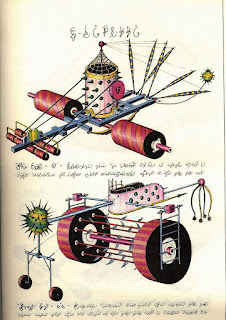
Luigi Serafini's Codex Seraphinianus


The fantastical world of Italian artist Luigi Serafini, born in 1949 and still living in Rome. 

A forest somewhere, in some place,
maybe over the rainbow

I discovered a whole new world recently when visiting my granddaughter Julia and her oldest son Philip, my great-grandson, now 15 years old. He talked about something called the Codex, an encyclopedia of some kind, and he especially liked the drawings. They are weird, these odd scribbles and things, made-up things. Like weird plants, weird animals and birds, weird machines. Hmm, really?  I had no idea what Philip was talking about.

When I got home I messaged his mom to send me more information. What is this book? She said it was called The Codex Seraphinianus. Strange name. I did some research and reading. It didn't take long to realize I had gotten lost in a very unusual, to say the least, fantasy world that was incomprehensible and fascinating at the same time. 

The Codex Seraphinianus is an encyclopedia of people, places and things that exist only in the mind of its creator, Luigi Serafini. It's nothing like the other Codex we know, the one by Renaissance artist and genius Leonardo Da Vinci, which is a collection of his scientific writings and illustrates the link between art and science.  No, this is different. Maybe its title contains some hints. It's peculiar. It's  graphic. It's a combination of the author's name and, ahem, something else. It was created to sound like Latin so it would be taken seriously, which is so amusing in itself, this parody, this play on words. 


Serafini's Codex, as it's called for short, was first published in 1981. That's a longer time ago than I thought. I learned that it became a "cult classic," has been republished several times since then, and that it continues to feed a vast underground of admirers and followers right up to Philip's generation.  

Serafini, who lives in Rome, is an artist, designer, and architect. He spent years creating a make-believe language for his encyclopedia, a sort of flowing script with lots of curly ques and flourishes that looks like a free-floating form of Sanscrit to me. Some reviewers have called it asemic: it looks like writing, but you can't read it.

So the first thing to know about Serafini's Codex is that you cannot read this book. You just look at it and enter into a fantastical place you've never been before. I went to the Library to look through it.  It was strange. It  felt like being embedded in a Salvador Dali painting, actually many Dali paintings, getting into his dripping watches out on a limb in a strange dreamscape. 
What in the world? Whose world?

The second thing is that the people, places and things described in this encyclopedia are also invented. The Codex is wildly imaginative. The made-up language describes made-up people, places and things. Yes, I see what Philip was saying. The illustrations are amazing and weird, drawn in colored pencils, detailed, amusing and sometimes even scary. These fantastical visuals resemble nothing that we would want to look up in any real encyclopedia, but you can't help but be drawn into a surreal enchantment.  Serafini credits the decorative gothic painter Carlo Crivelli and the Surrealists with informing his style. "I have many masters. I really believe in masters. Really, it's very difficult to say what master gave me more than others," he says.  The surrealist masters stand out for me. 

Taken together, the visuals you don't recognize and the language you can't read, add up to a powerful imaginative experience that transports you to another realm. Readers, especially younger readers, are inexplicably mesmerized by this encyclopedia of arcane knowledge you don't need to consult for any reason, except that it's a fun+++ art experience. 

Serafina, now 72, began creating his Codex in the mid-1970s, and I would hazard to guess, maybe under the influence of something!  According to a 2020  Insider article, Serafini spent "two and a half years drawing like a hermit" while wearing out the grooves of a vinyl copy of Mozart's "The Magic Flute."  That was "the soundtrack of the Codex," Serafini said. "I almost broke it."  

His publisher finally forced him to put his pencil down. The Codex was published in 1981, and republished several times after that.

One critic calls Serafini's work  "a cross between a field guide to alien flora and fauna and an assembly manual for bizarre biomechanical devices, like something you'd find on a shelf in Dr. Strange's library – an arcane artifact that's recognizably a book, just not one from our reality."
A panel from a French exhibit of Serafini's work in October 2020

Why has this fanciful encyclopedia of Serafini's world that exists only in his mind, as creative and wonderful as it is, become a cult classic?  Maybe this psychotherapist, Douglas Hofstadter, has an answer. 
At Serafini's house in Rome. He is still writing,
still drawing, so there's no end to his Codex either. 

"On top of dreaming up a magnificently mysterious curly script in which all the articles were written (readable only by inhabitants of that world, sad to say, yet beautiful to behold by outsiders like us earthlings), he painted hundreds of fantastic, surreal scenes that would have sent chills up and down the spines of such madly possessed magicians as Hieronymus Bosch, Giuseppe Arcimboldo, Salvador Dalí, René Magritte, and M. C. Escher. Without any doubt, Luigi Serafini belongs in the ranks of those immortal geniuses, each of whom was gifted with a unique brand of deliciously demonic inventivity. Serafini matches them all at every level and in every dimension. I tip my hat with boundless admiration to this marvelous thinker, miraculous creator, and magistral artist."  Douglas Hofstadter
So, Philip.  Why do YOU like this book you can't read and that you find strange and weird?  "I don't know. It has do with the mystery of it, and the drawings." 

"Lots of people think the made-up language could be an actual language," he says. "There's lots of discussion online about it." 

Why would they think that? "Well, it might have grammatical rules or something. Also, the drawings are the coolest things ever and the art is unique. Where else can you find this information, Nana?"

Some Sources:  

1.  https://birdinflight.com/media/luigi-serafini-on-how-and-why-he-created-an-encyclopedia-of-an-imaginary-world.html

2.  https://contentcatnip.com/2018/09/21/book-review-codex-seraphinianus-by-luigi-serafini/

3.  https://newsrnd.com/life/2020-09-29-france-pays-homage-to-the--codex-seraphinianus-.rJeUvLYgUP.html   A 2020 exhibition in Southern France. 

4.  https://www.insider.com/codex-seraphinianus-luigi-serafini-interview-40th-anniversary-edition-2021-11

5.  https://www.wired.com/2013/10/codex-seraphinianus-interview/

6.  https://www.openculture.com/2017/09/an-introduction-to-the-codex-seraphinianus-the-strangest-book-ever-published.html  two pages from this weird Encyclopedia of a fantasy world

7.  https://en.wikipedia.org/wiki/Codex_Leicester

8.  https://en.wikipedia.org/wiki/Codex_Seraphinianus  "The Codex is an encyclopedia in manuscript with copious hand-drawn, colored-pencil illustrations of bizarre and fantastical flora, fauna, anatomies, fashions, and foods....The illustrations are often surreal parodies of things in the real world, such as a bleeding fruit and a plant that grows into roughly the shape of a chair....Others depict odd, apparently senseless machines, often with delicate appearances and bound by tiny filaments. Some illustrations are recognizable as maps or human faces; while others (especially in the "physics" chapter) are mostly or totally abstract. Nearly all of the illustrations are brightly coloured and highly detailed."  

Wikipedia also describes the structure of the book. "The book is in eleven chapters, in two sections. The first section appears to describe the natural world of flora, fauna and physics. The second deals with various aspects of human life, including garments, history, cuisine and architecture. Each chapter seems to address a general encyclopedic topic, as follows:

  1. Types of flora: strange flowers, trees that uproot themselves and migrate, etc.
  2. Fauna (animals), including surreal variations of the horse, hippopotamus, rhinoceros and birds
  3. An apparently separate kingdom of odd bipedal creatures
  4. Physics and chemistry (generally considered the most abstract, enigmatic chapter)
  5. Bizarre machines and vehicles
  6. The humanities: biology, sexuality, aboriginal peoples, including some examples with plant life and tools (e.g. pens, wrenches) grafted onto the human body
  7. History: people (some only vaguely human) of unknown significance, with their times of birth and death; scenes of historical and possibly religious significance; burial and funereal customs
  8. The Codex's writing system (which is to say, the – or probably, a – writing system of the world (if a world it is) from which the codex originates, or which it documents), including punctuation marks, the text being written, and experiments performed upon the text
  9. Food, dining practices, garments
  10. Bizarre games, including cards, board games and athletic sports
  11. Architecture." 

Monday, February 14, 2022

Russia v. Ukraine: David v. Goliath


Biden says latest intel indicates Russia will invade on Wednesday
16 February 2022.  Pray for Ukraine.

Russia has one of the most powerful militaries in the world. It ranks in the top five nations that spend the most on their military. In 2020, 
A map of Russia and Eastern and Western Europe. The
sheer size of Russia is daunting, and its military budget
even more so. 
Russian military spending amounted to $61.7bn. Ukraine’s was less than a 10th of that at $5.9bn, according to the Sto
ckholm International Peace Research Institute.  The Ukrainian military is bigger than it was in 2014, when Russia invaded and annexed Crimea and then invaded eastern Ukraine in the Donbas region where I served with the Peace Corps.  But it's still David v. Goliath when it comes to war and geopolitics.

It wasn't always the case. In fact, Ukraine used to be the third largest nuclear power in the world. It gave up nuclear weapons in 1994 in exchange for security guarantees from the US, UK and Russia.  These were promises to respect Ukraine's borders. Russia violated these agreements by invading Ukraine in 2014.  Only then did NATO station multinational forces to protect eastern Europe,  and the U.S. and allies imposed sanctions on Russian and pro-Russian oligarchs. These were the sanctions that Republicans sought to end in 2016, and in most cases did, Oleg Derispaka being the prime example.  

Although the NATO nations agreed to increase support for Ukraine, there is still no international accountability for Putin's invasion of the sovereignty and territorial integrity of Ukraine's borders, or for that matter for Russia's shooting down of MH-17 over the killing fields of Ukraine, which killed 298 innocent people, or the blatant breaking of international treaties. 

Crimean Tatars, a peaceful and long-suffering people,
mourn the 2014 Russian takeover of their homeland. 
After heroic efforts to return to Crimea & rebuild their
homes and communities, they find themselves once again
under the genocidal thumb of Russia. 
Few shed tears for the loss of Crimea, the indigenous home of the Crimean Tatars, now militarized, stalinized, and victimized by untold human rights abuses. I weep for Crimea, and for the loss of parts of Lugansk and Donetsk oblasts, where I lived for two years and where the warm and wonderful Ukrainian people took in a stranger and made me feel at home. 
. .

Putin, unchecked, will continue to grab Ukraine into his orbit. It touches the core of his revanchism. He is set on destroying Ukraine and with it NATO in one fell swope. He says this is non-negotiable. Not Ukraine, not any eastern European country, must be accepted into NATO membership. It cannot happen.  
Yesterday's protest in Kyiv. +

Shouldn't these countries be able to make their own decisions, free from the threat of war? It's not what Putin wants.  Nigel Gould-Davis, of the International Strategy Institute in the UK, argues that Putin's immediate fear is not NATO per se, "but its own currently declining influence over Ukraine, whose Western ties are growing deeper, resistance to local pro-Russian figures like Viktor Medvedchuk sterner, and national identity stronger.... Since time is not on Putin’s side, he is seeking to assert dominance over Kyiv while this is still possible.” (reported in Aljazeera, which is on top of this story). 

No one wants war with Russia. I think President Biden is making every effort to work with our allies in Europe to negotiate peace. Putin's aggression has strengthened our alliances, which as we know were severely damaged during the former administration. The president of Ukraine, Volodymyr Zelinsky, was elected by a large majority and is holding fast. He has made progress against corruption and is focusing on Ukraine's economy. I asked historian Timothy Snyder, author of The Bloodlands, if there were Nazis in the Ukrainian government. "There are no Nazis in the government," he said. Zelinsky, who is Jewish, is working on self-determination for Ukraine, and that's across the board.  That's what the vast majority of the Ukrainian people yearn for. 

In spite of the massive amounts of intel the US has, no one knows for certain what Putin will do. He's already achieved his goals of creating chaos and fear in the West. His military build up will make a decision to invade easy to carry out. And it will be devastating.

Biden warns that the latest intel suggests that Russia will attack on Wednesday. This Wednesday, February the 16th. 

Ukraine will resist, but it will not be able to hold back the mighty Russian military. I fear for arial bombings of Kyiv, an ancient and  beautiful capital city filled with extraordinary cathedrals. monuments, and neighborhoods. I fear for the destruction of the beauty of Ukraine across the country, from my town of Starobelsk in the far east to Lyiv in the far west of Ukraine; from Chernigov down to Odessa and around the Black Sea. I fear for my friends who have been in harm's way since Putin's 2014 invasion. 

If Ukraine falls, many Russia experts predict that so will other former Soviet Socialist Republics of eastern Europe. Belarus is already in alliance with Russia. Hopes for self-determination and autonomy will be gone. Western Europe will be on the Russian border, facing Putin's Ukraine strategy. The world will be a sadder place wherever Peace Corps volunteers have served in eastern Europe in their efforts to build fellowship across boundaries. 
Putin's map would look something like this, adding eastern Europe and more
territory to what is already the largest country on earth.
 Putin does not fear for his borders, he's hungry for war and revenge and international dominance over eastern Europe that will bring Russia to the boarders of the West. 
 

The drums of war are getting louder. The echoes of death and destruction are hovering. The saber rattling is morphing into boots on the ground and bombs from the air. President Biden says if Russia continues to advance into Ukraine, retaliation will be swift and forceful. What does that mean? I pray for my friends.  


Here is a powerful take by Anne Applebaum of The Atlantic, "The Reason Putin Would Risk War," February 3, 2022: "Putin is preparing to invade Ukraine again—or pretending he will invade Ukraine again—for the same reason. He wants to destabilize Ukraine, frighten Ukraine. He wants Ukrainian democracy to fail. He wants the Ukrainian economy to collapse. He wants foreign investors to flee. He wants his neighbors—in Belarus, Kazakhstan, even Poland and Hungary—to doubt whether democracy will ever be viable, in the longer term, in their countries too. Farther abroad, he wants to put so much strain on Western and democratic institutions, especially the European Union and NATO, that they break up. He wants to keep dictators in power wherever he can, in Syria, Venezuela, and Iran. He wants to undermine America, to shrink American influence, to remove the power of the democracy rhetoric that so many people in his part of the world still associate with America. He wants America itself to fail."

Sources/Notes:

1.   https://www.reuters.com/business/aerospace-defense/how-ukraines-armed-forces-shape-up-against-russias-2022-02-01/

2.  https://www.aljazeera.com/news/2022/1/25/infographic-military-capabilities-of-russia-and-ukraine-interactive,  Good on options for economic sanctions, which sound severe. 

3.  https://www.aljazeera.com/news/2022/1/27/ukraine-faces-enormous-military-odds-against-russia

“Ukrainian politics is quite a fractious sport because it’s undergoing a period of protracted reform from an oligarchical system. Russia is ruled under the iron grip of the regime and there wouldn’t be any vacillation on the Russian side,” he said, calling any Russian-Ukrainian war “an unfair fight”.

4.. https://www.nato.int/cps/en/natohq/topics_111767.htm

5. https://www.nybooks.com/daily/2022/02/04/an-open-letter-to-the-russian-leadership/

6,  https://francurrocaryblog.blogs+pot.com/2016/02/de-occupy-crimea-end-russian-occupation.html

7.  https://www.trtworld.com/magazine/how-russia-is-slowly-encircling-europe-32596

Don't get out the popcorn yet: The Wheels of Justice Grind Slowly

"Delay, Delay, Delay: From pre-trial motions to negotiations over security, the master of legal stalling has many tactics in his arsena...