Friday, September 17, 2021

There's More to Frida than Meets the Eye


"Frida in Flames" (Self-portrait inside a Sunflower), 1953-54,  a powerful late painting (Credit: Private Collection, USA. Photo courtesy of Mary-Anne Martin Fine Art New York, printed by Taschen publishing.


There's a new book out about Frida Kahlo's hidden, less well-known works, 152 of them, seldom exhibited, seldom seen. "Frida Kahlo: The Complete Paintings," by art historian Luis-Harlan Lozano, with Andrea Kettermann and Maria Vazquez Ramos, offers "the first ever survey of her entire oeuvre." 

I was excited to come across an article by art historian Holly Williams, cited below, that reviews the book. I went to order it on Amazon but it costs $200, and I hesitated. Still, how fascinating to catch glimpses of those 152 paintings. They are not the large dazzling self-portraits that we know and love, inspired by the artifacts, landscapes, folklife, clothing, adornments and decorative arts of  Mexico. They are not surrealism or magical realism. 

The cover of the new book on Kahlo, 
published by Taschen. It's surprising that
it's one of the self-portraits that we
 know her by, but then, it will sell books. 
 
They are portraits of people she knew from here in the US and in Mexico. They are in style, composition, and format different from those we are used to seeing in a Frida Kahlo. They show her range of seeing, her attention to art trends, and some different aspects of her life. They seem to have been  painted early in her life, or toward the end of her life. She died in 1954. She was only 47 years old. These works present interesting facets of her short but often flamboyant and emotionally charged life, her thinking, political passions, range of interests. 

Holly Williams presents an interesting analysis of the painting that begins this blog, "Frida in Flames."

"It's very interesting in terms of aesthetics – when your body is not working anymore, when your brain is not enough to portray what you want to paint, the only source she's left with is to deconstruct the image. This is a very contemporary, conceptual position about art: that the painting exists not only in its craft, but also what I think the painting stands for./  We are left with a painting that is imperfect, certainly a world away from the fine, smooth surfaces and attention to detail of Kahlo's more famous self-portraits – but it nonetheless is an astonishingly powerful work that deserves to be known. There is something tremendously poignant in an artist so well-known for crafting their own image using their final creative act to deliberately destroy that image. Even in obliterating herself, Kahlo made her work speak loudly to us."

Spoken like a true art historian, insightful, penetrating, in cultural and historical context for understanding what this self-portrait might mean. Most of us art appreciators can't claim this kind of expertise, but we are energized just looking at these varied paintings. Some of them are re-printed in Holly Williams' BBC Culture article, and they are fascinating. 

Here's a style, roses in a small blue vase, 1935, that reminds
me, or makes me think of, many other women artists who painted flowers. It's lovely.
It has not been exhibited since 1954 and, according to art historian Holly Williams, 
it shows the influence of the artist's father. I didn't know he was also an artist, a well-known photographer. This painting is not "ethnic," not magic realism, not those large Calla lilies. More traditional it seems, in the western art tradition that her father apparently embraced.    
(Private collection. Courtesy Sotheby's, New York)


Si Adelita (Los Cachuchas), c1927, is another of the lost works.
 "It's sharp Modernist lines are striking."
This one depicts an experience Kahlo no doubt had in NYC,
at a gathering around a game (?) table, artists, poets, surely jazz musicians,
in formal black and white, strong angles and poses.
I think I see Langston Hughes or WEB DuBois or somewhat-familiar jazz musicians.
There's the invitation, a domino, a music score, a woman peering out with a frightened or confused look on her face, maybe Frida feeling like an outsider.  All the subjects look very serious. It's a slice of Frida's life, attentive to detail, emotions, the times.  


Pancho Villa and Adelita (unfinished), warriors for an independent Mexico,
reflecting Frida's strong political interest, painted in 1927.
Holly Williams notes its "avant-garde" style:
 "It indicates Kahlo's interest in Mexican art trends
 before she met Diego Rivera." (Credit: akg-images)


   A still life with white dove, which Holly Williams wrote appeared often
in her late life paintings, this one from 1953/1954, just before Kahlo's death.
I was surprised to learn that she didn't have her first exhibit in Mexico until 1953,
and her art then was hidden in anonymity and neglect until the late 1970s and into the 1990s.    
"Kahlo included the Mexican flag and the dove as motifs in her later work,'
such as this colorful still life, "Long Live Life."
 (Credit: Rafael Doniz/ Banco de Mexico/ VG Bild-Kunst)


Sources:

*https://www.bbc.com/culture/article/20210719-the-unseen-masterpieces-of-frida-kahlo? review article by Holly Williams. "Lost or little-known works by the Mexican artist provide fresh insights on her life and work. Holly Williams explores the rarely seen art included in a new book of the complete paintings."

* https://news.artnet.com/art-world/frida-kahlo-complete-paintings-taschen-1993532

** https://www.artsy.net/article/artsy-editorial-frida-kahlo-georgia-okeeffes-formative-friendship, interesting article, and great juxtaposition of Frida paintings and O'Keeffe paintings. 


Friday, September 10, 2021

Yarema Kosak, Ukrainian-American Artist Shines Light on his Cultural Heritage

Yarema Kozak, "October," 1980s


There are Cossacks living and working in and around Detroit, those Ukrainian warriors whose history is as complicated as any Eastern European country, as conflicted and torn between East and West for centuries. The Yarema Kosak family descends from a long line of Cossacks, but they are not fighters. They are cultural warriors who have made great art across several generations. The Detroit area has been a recipient of their talent. 

An exhibit of Yarema Kosak's work at the Ukrainian-American Museum in Hapensack, MI, is bringing these Ukrainian-American Cossacks to light. His brother Yurko was also an artist and some of his paintings are included. Yurko was a designer for Buicks at General Motors for many years, thanks to the wisdom of GM managers who recognized the value of his versatile talent. Yarema embraced his life as an artist. 

Yarema's Roses
Yarema was born in 1941 on the border between Ukraine and Poland. That's part of the region of eastern Europe that Yale historian Timothy Snyder calls "the Bloodlands," caught for ages between the vicious rivalries of Western and Eastern Europe and the Russian empire. Snyder writes: "Between 1939 and 1945, Joseph Stalin's Soviet Union and Adolf Hitler's Nazi Germany committed mass killings of an estimated 14 million unarmed non-combatants, the majority outside the death camps of the Holocaust." Snyder's thesis is that the "Bloodlands," a region which comprises what is modern-day Poland, Ukraine, Belarus, Russia and the Baltic states, is the area where "the totalitarian regimes of Stalin and Hitler interacted to increase suffering and bloodshed many times worse than any seen in western history."

After the war, Cossacks were "repatriated" back to the Soviet Union, where they were sent to the Gulags and murdered. The same fate befell millions of Ukrainian children who were kidnapped and sent to concentration camps to build bombs for Hitler.  (https://francurrocaryblog.blogspot.com/2018/02/the-book-philip-gave-me-making-bombs.html)

Is it any wonder that after the war, Ukrainians sought refuge anywhere in the world that would have them. Many settled in Canada, many in various countries in western Europe. The Kozaks moved to the US and settled in Detroit in 1949.  And so Detroit became "the seat of the entire American Kozak enclave, which embraced various professions and a host of civil and cultural initiatives. Most of all, the Kozaks influenced the artistic and intellectual life of the Ukrainian diasporan community beyond Ukraine." 
(Ukrainian-American Archives and Museum)

Yarema Kozak, Hutsul Woman. 
 The Hutsuls are a Ukrainian ethnic group
spanning western Ukraine and Romania.
The Kozak family is from this region.
While Yuri worked designing Buicks, Yarema devoted himself to his art. Between 1968 and 1975 he headed an art school for youth at the local Cultural Community Club. At the same time he acquired his individual traits as a graphic artist and painter. His first exhibit was held at the public library in Hamtramck, Michigan, in 1969.

Yarema was a university-trained artists. He followed the most recent trends in American and world art and showed interest in abstract art, "exploring ways to synthesize modernism with his ethnic Ukrainian background."   I found his paintings, the few I've seen, to show different styles depicting a range of subjects, from beautiful roses to Orthodox icons to abstract landscapes and profiles.

I was pleasantly surprised to learn that the Kozak family was involved in creating the large decorative memorial wall honoring Ukrainian heritage at Wayne State University in 1976.  I first saw it in 2013, after participating in friend Laura Kline's Russian language and culture class in Manoogan Hall, talking about what I learned about Ukrainian history and traditions as a Peace Corps Volunteer. After the class, we had a tour of "The Ukraine Room," where a huge map of Ukraine with motifs from Ukrainian history and national culture filled the walls; it was colorful, upbeat, patriotic. The project was completed by another Ukrainian-American artist, Volodymyr Mayorchak, who added a full-wall mural, hutsul-style wooden benches, and a variety of lovely carvings. The Ukraine Room, which served as a classroom for the study of Ukrainian language and literature, was updated and restored in 2003, reflecting the ongoing devotion of Detroit's large and active Ukrainian community. My Ukrainian friends from Starobilsk visited them when they were in the US for an Open World project. I'll always remember that time.  Я никогда не забуду время, проведенное в Украине.

Sadly, Laura informed me, the language classes, always a struggle to sustain, are now taught only sporadically, victims of the declining support of humanities study on colleges campuses across the country.  America is paying dearly right now for this decline in the study of history, literature, philosophy, and the entire liberal arts curriculum that makes for "informed citizens."   . 

The Yarema Kozak and Kozak family heritage, however, lives on, gaining in public and scholarly recognition. Their artistic efforts to preserve Ukrainian culture, along with organizations like the Ukrainian-American Museum and Archives, represent the extent and depth of America's multi-cultural heritage. In this chaotic time, we really do need reminders that this is what America is all about. 


Parts of the mural in The Ukraine Room at Wayne State University.
 I love the quote from Ukrainian poet Taras Shevchenko, below, who longed for Ukrainian
independence. There are Shevchenko statues all over Ukraine,
including in Lenin Park in Starobilsk, where I served with the Peace Corps.


Sources

http://www.thehamtramckreview.com/ukrainian-museum-features-works-by-local-ukrainian-artists/ by Roman Yatsiv.

https://day.kyiv.ua/en/article/close/american-kozaks-mission-and-individuality  Good the Kozaks work was recognized in Ukraine, mainly through various exhibits in various cities.

https://en.wikipedia.org/wiki/Cossacks, for a complicated article on a complicated subject, the Cossacks of Russia, Ukraine, eastern Europe.

https://en.wikipedia.org/wiki/Repatriation_of_Cossacks_after_World_War_II, "repatriated" to the Soviet Union, which sent them to gulags and murdered them outright. A few managed to escape, among them the Kosak family of  Detroit. Not surprising to learn that this story was hidden from history until 1974, with the publication of "The Last Secret" by Lord Bethell. It was made into a documentary that year.  That same year, Aleksander Solzhenitsyn's "The Gulag Archipelago" was published. 

 https://francurrocaryblog.blogspot.com/2013/04/teaching-about-ukraine.html At Wayne State, April 2013.

Talking about my experience in Ukraine for Laura Kline's
Russian Class at WSU, along with a presentation about
Chernobyl.

This artwork is by Yuri Kozak, Yarema's older brother.
St. Trinity Church in Kyiv, 1980s. It takes me back to Ukraine.


Thursday, August 19, 2021

Remembering African-American Artist Beauford Delaney: Restoring the Delaney Family Home in Knoxville, TN

Beauford Delaney, exhibit honoring the friendship of
"Delaney and James Baldwin," at
 Knoxville Museum of Arts, February-May 2020

Beauford Delaney, "Gathering Light," at Knoxville Museum of Art.


The restoration of the Delaney Home is underway in Knoxville. Organized by the Beck Cultural Exchange Center, the primary repository for the history and culture of East Tennessee, the restoration of the Delaney Home (above) will be undertaken by BarberMcMurry Architects of Knoxville. Yellow is an appropriate color for Beauford, his "signature color" it has been called. He used yellow for so many of his paintings, his portraits and in his more abstract art in the late 1950s to 60s. I found it fascinating.

It's always wonderful when the ancestral homes of talented people who have been hidden from history are restored. It's happening in Knoxville, Tennessee, with the restoration of the Delaney Family home, paying homage to Beauford Delaney, African-American painter and mentor to James Baldwin whose legacy was neglected for a long time after his death in Paris in 1979. Beauford's brother Joseph was also an internationally known artist. East Tennessee I learned, during my dissertation research, had more anti-slavery sentiment than Memphis and West Tennessee, where slavery and plantation life flourished. It is honoring its past. 

Beauford Delaney was born in Knoxville, his father a Methodist minister and his mother a former slave determined to educate her children in freedom, an education she never had. Beauford's early talent was recognized by a local white artist, Lloyd Branson, who encouraged him to go to Boston to pursue his education and to take art lessons. 

After a solid education in the arts, Beauford  moved to New York during the heyday of the Harlem Renaissance. He established a solid reputation as a young painter, but he struggled to survive financially. In 1953 he moved to Paris, settling in the Montparnasse district in the Left Bank, an artist colony of international renown that enveloped African-American artists. There he became a close friend and mentor to writer James Baldwin, a friendship that lasted until his death.  Delaney, like Baldwin "relished a sense of freedom as a gay Black man that he did not have in the United States."  Richard Wright, the writer, described Paris as "a place where one could claim one's soul."  

Delaney, James Baldwin,
one of many portraits.
In Paris, Delaney moved toward abstraction. He also painted many portraits of James Baldwin, whose wonderful friendship overtime is a story in itself. The Studio Museum in Harlem had a major retrospective of his work in 1978. A year later the Knoxville Museum of Art acquired several Beauford Delaney paintings for an exhibition, and it is now the major repository of his work. 


Composition 16, at MOMA

"While Paris had in some sense liberated Delaney, there were sorrows he could not escape," a MOMA curator noted. “There always seems to be the shadow,” Delaney wrote to a benefactor, “which follows the light.” Although he was referring to the financial difficulties that plagued him throughout his career, the artist could also have been talking about his struggles with depression and mental illness, which eventually led to his living in a mental hospital at the end of his life. MOMA noted that while Delaney was a mentor to Baldwin during the author’s early years, "Baldwin later became Delaney’s protector, assisting him financially and emotionally."

For an introduction to an exhibition in Paris in 1964 Baldwin wrote, “Perhaps I am so struck by the light in Beauford’s paintings because he comes from darkness—as I do, as, in fact, we all do.” 

 "The vibrant luminosity of Composition 16 is but one example of Delaney’s lifelong quest to find light in that darkness." (MOMA.org on Delaney). 

It is wonderful that Beauford Delaney, a neglected artist for so long, is coming into the light of public awareness and appreciation, reborn in his hometown of Knoxville with the restoration of his childhood home.  Among art patrons and collectors, he is becoming  highly praised and his works highly valued.  

Most of all,  I was taken by Beauford's talent and by James Baldwin's compassion for his friend, his loyalty to an artist who "came from darkness." I was enamoured with Beauford's use of yellow, too, a contrast to the turmoil of his inner life, a color to lighten his burdens and doubts, illuminating his striving to find hope in spite of himself.  A yellow house that inhabits Beauford's soul is a perfect tribute.

Beauford Delaney, "Jazz Quartet." Could that be Ella Fitzgerald at the piano?
It was the Harlem Renaissance and then the post-war New York energy 
when Harlem remained the center of Black cultural life
. 


Delaney, "Oh Freedom," a paeon to the Harlem Renaissance.  I love
his paintings from this period.  


Quess what? This is a portrait of
Beauford Delaney by Georgia
O'Keeffe, in New York, 1943. Yes, it's
an O'Keeffe. I didn't know she
did portraits. Loved discovering this!


Sources: 

1. https://www.culturetype.com/2018/02/10/knoxville-museum-of-art-acquires-of-12-beauford-delaney-works-plans-major-exhibition-in-2019/

2. https://lesamisdebeauforddelaney.blogspot.com/2021/08/the-delaney-museum-at-beck.html?

3. https://www.youtube.com/watch?v=mz2cU5gVfY8

4. https://knoxvillehistoryproject.org/2020/02/26/beauford-delaney-in-knoxville

5. Beauford Delaney, wikipedia 

6. https://www.moma.org/artists/40994, "Beauford Delaney, American, 1901-1979." I like this description of Composition 16:  

“Have been working and living with the many people who make up Beauford,” Beauford Delaney wrote to his great friend James Baldwin in September 1954, “and trying to merge them into some sense of composition and a workable form of painting.” Composition 16, a modestly sized work on canvas composed of swirling...strokes of yellow, red, orange, ocher, pale green, and blue paint, some squeezed directly from the tube, is a vivid example of Delaney’s quest to unite disparate aspects of his interior life and artistic practice while keeping a promise to continue “doing all that is possible with paint.” With its suggestion of ground, sun, sky...Composition 16 fuses landscape and abstraction, depicting light and color as ecstatic matter. The color yellow, scumbled liberally over the surface of the painting as a unifying element and predominating in many of Delaney’s abstract and figurative works from the period, seems to have held a particular fascination for the artist. Philosopher Rudolf Steiner wrote, “If yellow is to be painted—do not only apply yellow, but live in the colour itself,” and canvases such as Composition 16, like a yellow-hued Self-Portrait from 1962 and the yellow-walled interiors in St. Paul de Vence from 1972, show the artist embracing a Steiner-like dictate."

Beauford Delaney, Ella Fitzgerald, "Isn't she beautiful."
Basking in yellow paint, like "Composition 16." 

More on Beauford's use of Yellow:
"Delaney’s most celebrated paintings date to the late 1950s and 1960s. Characterized by fluid brush strokes, these fully abstracted works are explorations of saturated color and strong texture. His signature use of yellow—which he described as “the color of his sacred light” and representational of a “higher power”—reveals a joy that seems to contradict his deteriorating personal circumstances while illuminating a resolve to resist an inner darkness. In 1963, he wrote these hopeful lines to his friend, the author Henry Miller: “I pray for the courage to keep struggling to express in color the substance of what life is directing. The need in the world for beauty, harmony, good confidence, brotherhood, sunlight, music, humanity...was never so urgent. The creative life is holy.”  https://thejohnsoncollection.org/beauford-delaney/  This site also has a brief bio of Beauford's brother Joseph. 


Thursday, July 8, 2021

Barbara Fox: Watercolor Magic

"I crave beauty, peace, and order, and paint subjects and settings that reflect this idyllic view of the world."  Barbara Fox

"

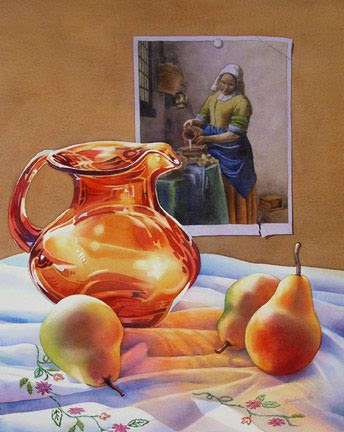
Barbara Fox, American contemporary artist, loves painting marbles! She is mesmerized by their subtle variety of design, fabulous color, and heavenly reflection of light. In this way she reminds me of the late Massachusetts artist Janet Fish and Canadian Mary Pratt, painters of glass and light.
 
  
Here's another example of allusions to Fish and Pratt, at least in my mind:
Barbara Fox delighting in luscious green apples on a lovely glass plate. 


While Barbara Fox's paintings of glass drew me into her art, I discovered that this highly regarded American artist has her own delicious style, methods, and vision that surprise and amaze. 
 
Barbara Fox paints still lifes and floral subjects in watercolor and oil. Her "meticulously crafted" paintings are exhibited and collected internationally, have received numerous awards, and have been selected for publication in fine art books and magazines.

I find it fascinating that she is also an illustrator and designer for the United States Mint. So far, 21 of her designs have been minted as coins and medals, including one commemorating Ellis Island, special to me because it's where my grandparents entered America along with millions of other immigrants. 

Barbara Fox received her BFA in studio art from the University of California, Davis. She is a founding member of the National Watercolor Society and leads watercolor workshops around the country, teaching her method of layering washes and painting details. 
 She currently resides, paints, teaches and exhibits in Little Valley, New York, in far western NY state, not too far south from Rochester where I grew up. She's on facebook and has a lovely website.  

The captivating details and background images of her still lifes also drew me in. It appeared at first as if they had been tacked on, kind of casually, like we tack a poem or image to our refrigerators. But these decorative additions, it turns out, are not after-thoughts. They are intrinsic to her vision and how she sees the world. Where most other artists avoid such artifact and allusions, Fox embraces them. "Her work explores the nature of artifice itself, a fact to which she alludes by the frequent inclusion of paintings and objet d'art in the background of her work. "The art of Barbara Fox is an art that continually examines itself."  https://rehs.com/eng/default-artist-bio-page/    She explains it this way:
"My working method pays homage to the Dutch masters and the tradition of academic painting. I work from life and photographs. Watercolor and oil paintings begin as detailed drawings to which a number of glazes are applied, building deep values and rich colors. The process of completing these works may take many weeks, so I usually have several paintings in process at once. Creating artwork is both a meditation and an adventure that opens my eyes to our beautiful world."   https://art.state.gov/personnel/barbara_fox/  
"Tulip Dance," with Degas dancers
behind the glass vase. 


I was also drawn to Fox's art because she loves flowers, growing them, photographing them, painting them. Her peonies and roses are among the most beautiful of all. I especially love her hydrangea, the exquisite detail and luscious colors. She paints her flowers in lovely vases, like this round cut-glass vase, or in various still-life poses. In "Tulips Dancing," above, the image of a classic Degas captivates, suggesting, perhaps, "in the now" as in the past.  It is signature Barbara Fox. I love it. 

Her paintings have been featured in solo and group exhibitions in museums and galleries throughout the United States and abroad.  For us Midwesterners, they can be viewed at the Phillips Museum of Art in Lancaster PA and the Neville Museum in Green Bay, WI, as well as at her studio in Little Valley, and for international travelers at the MEAM in Barcelona. Wish I had known that when I was there admiring Gaudi in all his glory. For easier access, her works have been published in three editions of the watercolor publication Splash: The Best of Watercolor Painting, and featured in leading national art magazines like American Artist and Watercolor Magic. I hope I can visit her studio in Little Valley, NY, one day, maybe when I'm visiting my Rochester, NY, cousins. 
Hydrangea, "In the Light of Morning."


Shimmering in layers of paint and light. Love the glass pitcher
reflecting the multi colors of the hydrangea.

Barbara Fox seems like a delightful person, accessible, friendly, and she is a meticulous and prolific artist, an American treasure.  Women artists of the present stand on the shoulders of women artists of the past. No one is more aware of this than Barbara Fox. She is "in the tradition," which she illuminates, augments and honors in her own unique and brilliant style.   
"The Pleasure of Randomness."  
"My newest work features glass, origami, historic documents,
and artwork conveying a sense of calm beauty with
 captivating detail. "


Some Sources:

https://www.artistsnetwork.com/art-ediums/watercolor/wc-fox-gallery/    Fox loves flowers(www.bfoxfineart.com) "but she’s not content to stick with what she knows and loves. She’s constantly challenging herself to try new techniques in watercolor and...[new subjects]...In this creative endeavor, Fox has tried her hand at trompe l’oeil effects and experimented with still life settings..."  


    on her designs for the US Mint."

https://rehs.com/eng/default-artist-bio-page/? A gallery that promotes and sells her art

https://www.barbarafoxartstudio.com/ 
My newest work, features glass, origami, historic documents, and artwork conveying a sense of calm beauty with captivating detail. / My work pays homage to the working methods of the Dutch masters and the tradition of academic painting which involves balanced and graceful composition as well as precise execution. These paintings begin as detailed drawings to which a number of glazes are applied, building deep values and rich colors. The process of completing these works may take many weeks, becoming an extended meditation on patience and artistic craft."

Hydrangea in progress, on the easel,
 next to a pallet of paint,
in her studio.  


"Possibilities." 
Glistening clear marbles on a historic Latin manuscript. 
What a wonderful juxtaposition of images. 


A Barbara Fox for my brother Loren


Wednesday, June 2, 2021

Mary Pratt, 1938-2018, Canadian artist: Illuminating Everyday Life

Mary Pratt, Canadian, Jelly Shelf, 1990s
"I think, with my work, even the things that are ordinary are not ordinary, because I don’t believe that anything is ordinary. I think everything is complex and worthy of conjecture, and worthy of a look — worthy of a close look."

Doesn't the painting above, of jars of jelly, look like an Alice Fish painting? I thought so too when I first saw it and seized upon it.  It felt good to recognize a piece of art by its style, composition, subject, color. But I was wrong. It's not an Alice Fish. It's a Mary Pratt. Off to google I went.

Raspberries Reflecting Summer. Shimmering!
Their are several interesting Mary Pratts, I discovered. T
here's a Mary Pratt baseball player from Ohio, a real pioneer. Fascinating story. And a Mary Pratt contemporary artist, based in Atlanta, Georgia, whose paintings are fabulous. I got distracted for a good while, which is how I spend a lot of time.

The Mary Pratt whom I thought was Alice Fish is a Canadian artist, born in 1935. Same year as Alice Fish, same generation. Was that a particular way that some talented women of that time saw life and added meaning to their everyday experiences? Is that how some women painters who came of age during the post-World War II generation added value to the ordinary domestic life to which they were socially assigned?  Interpreters of the Feminine Mystique from women artists' points of view?

Green Grapes, Wedding Presents &
Half a Cantaloupe
Mary West married artist Christopher Pratt in 1957 and had four children. While he painted and became a well-known artist in Canada, Mary's life was filled with domestic chores. She lived in rural St. Johns, Newfoundland, took care of her children and her husband. It was hard to find time to paint.

Still, when some item or other moved her, she felt an "erotic charge," as she put it, that propelled her to pick up her brush. She had taken art lessons as a young girl, studied Fine Art in College, took lots of photos which she later returned to and found images that impelled her to paint them. That's how she found her voice, her medium, her own signature style. She put her painting career this way: “It was a love affair with vision. A real love affair with vision.”   

I don't know whether or not Fish and Pratt knew each other, or knew of each other's work, but they shared a vision. Look at those jars of jelly. Uncanny, the way a golden light runs through them like light runs through Alice Fish's glassware and red cups, jars of salad dressing and cellophane covered peaches. Both infused everyday objects with prisms of light and color. Both transformed the ordinary into the extraordinary.

Pratt like Alice Fish loved red, too.   

"There’s a painting of raspberries that I did, where there were all kinds of little glass blobs, and every blob is different than every other glass blob, and every one of them has to be given its full due. You can’t just say, “Oh well, yes, there’s glass: light on one side and red on the other; now that’ll be enough,” because that’s not the way it is. It’s very intricate. And I just love these intricacies, because they all lend to the truth of the object, or the truth of the vision, and I just think they’re worth doing."

Pitcher with Lemons
Mary Pratt created personal, translucent realistic still lifes. If, as critics said of  Alice Fish "she transformed the still life," well so did Pratt. Both took objects from domestic life and added meaning to them, illuminated them. 

I was fascinated that Pratt painted mostly from things around her at home or from photographs. She preferred being inside rather than outside. After a divorce, as her children grew, many of her paintings became both more translucent and more opaque, with shades of moodiness, some sadness in the darker tones. She also felt a sense of freedom in being alone, relished it. And her art flourished. 


Silver Fish on Foil


Mary Pratt, Red Currant Jelly

"There is a colour between blue and red that is a sort of a “bridger”—allowing the heat of red to melt into the cool of blue. I love it. It has no name."

Her husband Christopher joked with her about that "bridger" color. "Mary, it's called purple!"  But not to Mary Pratt. It went beyond purple. We can see that in these paintings, above, and the way the colors fuse together and rise from that shimmering aluminum foil.  

Her biographer and art critic Mireille Eagan, curator of contemporary art at The Rooms Provincial Gallery in St. Johns, gives us a good look at Pratt's life. She was well known and loved in Canada, her art exhibited in galleries and museums across the country, her art celebrated. She painted until her death in August 2018.

Here we have another fabulous woman artist whose works could be in the permanent collection of the Toledo Museum of Art, and museums around the world, and hung prominently among the male artists of the traditional Western canon. 

"It may be that future texts will position Mary as a footnote, placed alongside artists whose works are perceived to have more gravity. This would underestimate her impact. Good art transforms the walk home from the gallery; it fundamentally changes how one sees the world. Mary’s art did just that. She drew our attention to the margins, to the enveloping space that exists between and around official texts. She showed us the sadness and beauty in the meals we make, the light through glass at a certain time of day, the blood of a fish on tinfoil, the washing of a baby. She showed us how to hold, to cherish, a moment before we must inevitably turn to resume the day." Mireille Eagan, Canadian Art, August 15, 2018.


If Pratt's work were marginalized, as Eagan feared, it would more than "underestimate her impact." It would underestimate the works of thousands of women whose talent has been hidden from public view. Women's art documents women's lives, their perspectives, their experiences. Sure, often you can't tell by looking at a painting if it were done by a man or a woman. Impressionists paintings or Abstract Expressionists, for example. But the talent is there, the skill, the palate and brush strokes, the glories of creation beautifully rendered. How tragic to lose the art, to lose the stories painted by women from across geography and time. In showing us her world, Pratt, like women artists everywhere, illuminates our lives and e
nriches us all. 

Some Sources:
https://en.wikipedia.org/wiki/Mary_Pratt_(painter)

https://www.gallery.ca/magazine/exhibitions/mary-pratt-a-love-affair-with-vision

https://canadianart.ca/features/mary-pratt-1935-2018/  Mireille Eagan on her life and work. 

https://www.facebook.com/groups/864751373634163/? for fabulous  postings of women artists whose art deserves broader public recognition. See also Christa Zaat and Carek Ronk's  https://www.facebook.com/female.artists.in.history/,  pioneers in discovering and posting women artists overtime online. Christa Zaat has put these artists in fabulous albums for art lovers, researchers and scholars, for curators, galleries and museums.  On of my biggest arguments is that museums all over the world need to buy and add women artists to their permanent collections. Sure it's nice to have a special exhibit now and them, but at least 50% of a Museum's walls should display  the art of women in all ages, all genres. 

https://globalnews.ca/news/4388778/mary-pratt-dead/ Obituary

https://www.thestar.com/entertainment/visualarts/2018/08/26/canadian-artist-mary-pratt-remembered-by-friends-family-and-fans.html

"Pratt’s unmatched talent for depicting the mysterious beauty in the detail of everyday things — her hyper-real paintings of jelly jars on the window sill, a bloody fish in the sink, salmon on crinkled tinfoil — captured the hearts and minds of art lovers across the country and around the world." The Toronto Star, August 2018


Don't get out the popcorn yet: The Wheels of Justice Grind Slowly

"Delay, Delay, Delay: From pre-trial motions to negotiations over security, the master of legal stalling has many tactics in his arsena...