Sunday, September 30, 2012

Not Even, the band: Talented Toledo Trinity


Last night I went with Elissa and her friends to Sodbuster’s Bar, a neighborhood pub right across the street, to hear her high school friend Mike McQuire’s band, called Not Even.  I had my doubts, since I haven’t been in a pub for a long time, the band started when I'm usually getting ready for bed, and I was feeling my age.  But Elissa was encouraging; it’s a short walk and there was a brilliant full moon in a clear night sky.  It turned out to be a fun late evening.    

Not Even bills itself as a party rock cover band from Toledo, Ohio 
(www.NotEvenBand.com).  It has three talented artists, a trinity, not an even number, but not odd either.  They are fantastic:  Mike on bass; John on guitar; Rob on drums and vocals.  They are talented and creative, serious and fun,  some of the best musicians I've heard live in a long time.  The band has a great diverse playlist, too, from classic rock to dance rock and country rock, from the Beatles and Rolling Stones to Journey, Van Halen, Cheap Trick, Stevie Wonder.  I wasn’t familiar with all the songs, but all the music made you want to dance and sing along.  I was happy to meet Mike’s mom, Connie, and we both moved to the music--were moved by the music--even at our advanced ages. As the band says on its website: “Any age group, any crowd, will know and love our music.”  And we all did.   Music, the universal language. 

When I was a Peace Corps Volunteer in Ukraine I learned to go along, never to turn down an invitation, to try new things, push myself beyond my comfort zone.   It's how I integrated into my Russian-speaking village in far-eastern Ukraine; discovered fantastic talent; made connections; learned the needs of the community and how to get things done. 

It felt somewhat like that last night, close to home, not even in Ukraine. And you know what? It was terrific!  I've learned it’s always a positive, exhilarating feeling to push beyond your comfort zone, to push the boundaries.  Not Even, the band, made it completely enjoyable!     

Friday, September 28, 2012

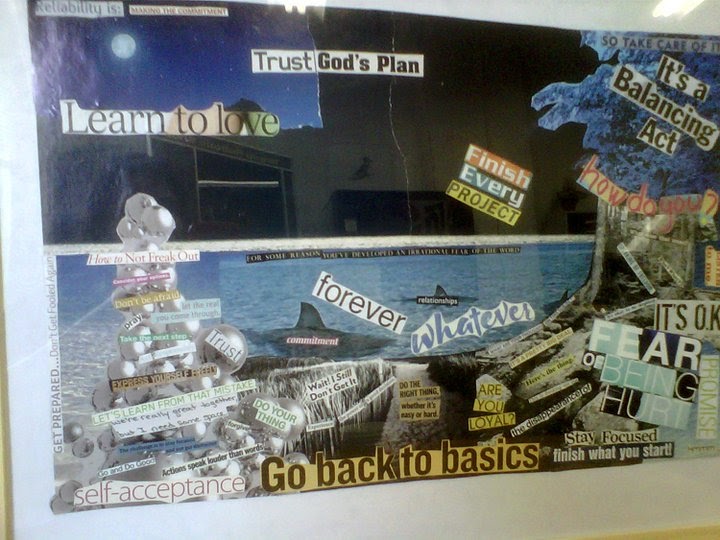
Elissa's thoughtful art


I love my daughter Elissa’s art work.  She does assemblages on paper, creative collages.  She uses cutouts from every magazine imaginable: car magazines, sports and fashion magazines, travel magazines.  She saves them all.  She cuts out words, phrases, sayings, and then adds photos, memorabilia, artifacts, seashells, any things she finds. She’s a collector.  She reminds me of Ukrainian or Mexican artists who use everyday objects to create something new, whether it’s tiling houses with bottle caps, using aluminum can tops for making purses, using pieces of glass, stones, tiles picked up on the road or the beach or anywhere for decorating furniture, using found objects to decorate photo frames, mirrors, table tops, dishes.  Elissa’s artworks are beautiful, sometimes serious, often humorous and fun, and always thoughtful.      

Food for Thought: Lecture Enthralls Senior Audience

Univeristy Center and a sample of the beautiful
 tiles featured on the Mediterranean buildings.
The tile below honors Bishop James Hoffman,
a wonderful man I worked with in 1970s on a
City-County family violence prevention board.  
I went to hear Dr. Gerry Bazer, political scientist and Dean Emeritus of Arts and Sciences at Owens Community College in Toledo, give a lecture on "All You Wanted to Know about Presidential Second Terms, But Were Afraid to Ask."  Good timing!

The lecture, at the Franciscan Center of Lourdes University, once a small college run by Franciscan nuns on their multifaceted campus, provided the opening salvo for the expanding college's 2012 Continuing Education program.  I was glad to be back on the beautiful campus, located not far from my home in Sylvania, and to walk about in the rain under my mom's antique orange and brown umbrella.  I hadn't been on the campus since the early 1980s. I left Toledo for DC in 1985, and didn't return until May 2011. Lots of memories flooded back as I strolled into the lecture hall.  

I'll be teaching about the Peace Corps in a few weeks so I was happy to be on the campus, meet other teachers, and  get to know potential students.  It was a full house, packed with mostly seniors and retired workers. The lecture was  informative, presented clearly and with humor. Dr. Bazer, mindful of his audience, asked good questions, and answered them.   How many presidents won second terms? Did their victory margins increase or decrease? Why did certain presidents lose? How successful were the presidents' second terms?

Needless to say, the members of the audience had something on their minds.  At times you could sense the questions.  Quiet anticipation.  The current election!  Would president Obama be elected to a second term or not? Would the lecture offer any clues?

It did.  Sixteen of our forty-three presidents (37%) won second terms; economic issues determined the election outcomes; and the second terms were often too short to accomplish much.  "You know, after two years a new round of presidential elections starts all over again," Bazer noted.  You can't do much in two years.

Still, those for Obama saw hope in the information. Those for his opponent did too!  Nothing like a balanced, well-rounded humanities lecture to get the juices flowing. A lively question and answer period! I basked in the warm feeling of  students, of seniors, wanting to learn. Critical thinkers.  Intellectual curiosity. Engaged citizens. Civic discourse.

I thanked Dr. Bazer for his lecture and told him how much I appreciated scholars who participated in public programs.  He smiled and informed me that he is a lecturer for the Ohio Humanities Councils' Speakers Bureau.  These scholars, often under siege at modern universities, are willing to share their expertise with the general public, and public audiences still hunger for knowledge.  Dr. Bazer's lecture provided lots of food for thought.  

Tuesday, September 25, 2012

The Community Spirit of Franciscan Sisters

SHS members visit Heritage Room
of Franciscan Sisters on Lourdes campus;
decorative features, tile, arabic lamp; top right,
Gaye Gindy & Sandy Gratop with
sister Rosamond (red dress/white jacket);
nd mingling. 
The Sisters of St. Francis of Sylvania, Ohio, are a remarkable group of women.  They built their first Mediterranean-style building on a beautiful plot of farmland and forest in Sylvania a few years after Mother Mary Angelica was called from Minnesota to Toledo in 1916.  They decorated everything they built with tiles, murals and art they themselves created.  They used imported lamps and furnishings from the Holy Land; brought in more nuns with special expertise in health, education, social work, and environment; had sculptors build beautiful statues of St. Francis of Assisi, who founded the order in the 12th century, one adorned with his beloved animals.  They created special places for the nuns to meditate and pray; two beautiful chapels, one a replica of the chapel of St. Francis of Assisi; lovely gardens; and a higher education institution, Lourdes College, all on the evolving and stunning campus.

Sister Rosamond talks about Heritage 
 Room focusing on the history and 
work of the Franciscan Sisters, 
on  Lourdes University campus. 
Photo, Sandy Gratop.
They continue to expand, growing the college into a fine University; buying and managing properties to house students and others; adding modern assisted-living homes for the elderly nuns and for people living in the area. They have a range of volunteer projects that they develop in partnership with other community groups and institutions, putting into action their mission of "embracing peace, serving the poor and marginalized, and showing reverence for human dignity and the gifts of all creation."

These nuns are not simply "old school."  They are contemporary, creative, energetic.  They understand leadership and marketing. They understand and are fully engaged in the world they live in and want to make it better for all people. They go nonstop.  They grasp new opportunities; welcome change; reach out.

Now they have created a "Heritage Room"  to preserve their own history, share it with others, and prepare for their 100-year anniversary in 2016.  Historian Gaye E. Gindy, co-author with Trini L. Wenninger of "Sylvania" (Images of America Series, Arcadia publishing), is helping the Sisters tell their story. 

SHS Members at the 
 Heritage Room. 
Photos: Sandy Gratop
Gaye told me she is now into the 1920 census to track the membership of the Sylvania Franciscan order and its parishioners.  "Very difficult," she said, "because most of the names are Polish and handwritten by the census taker, nearly impossible to decipher:"  Gaye's plowing ahead with her research and writing; the second volume of an 8-volume series about Sylvania and area history is due out soon.

About 20 members of the Sylvania Area Historical Society (SHS) gathered for a tour of the Heritage Room last week.  Sister Rosamond, a spry 60-something whose knowledge is vast and whose enthusiasm is contagious, gave a lively talk sprinkled with lots of her own memories and good humor.   The Heritage Room has artifacts, documents, memorabilia, photographs, and original art, all nicely exhibited, along with three large video screens, always running, focusing on the history of the Franciscan Sisters who built the order and made Lourdes University and the campus what it is today.

The Franciscan sisters are an integral part of the Sylvania community.  This community has a strong sense of place, many talented people, and involved citizens who care about its past, present and future.   It's a good place to be.

Saturday, September 22, 2012

Bill Clinton's Journey

Bill Clinton in Haiti,
with George W. Bush,
yahoo photos.
"I am the captain of my soul."  Nelson Mandela

I once wrote a blog about my brother Loren and Nelson Mandela, seeing them as spiritual twins on the level of worldview and global perspective. I think I will add Bill Clinton to the mix and make a triad.

I'm aware this takes me out on a limb, but I'm thinking more spiritually than politically.  Beyond the arena of political conflict, on the terrain of democratic ideals and hope, life looks different.

Nelson Mandela, after serving 27 years in prison for his fight against apartheid,  returned to South Africa to finish what he had started. In 1994 he became South Africa's first black president. He served one term, then left politics to younger leaders.   Mandela united the global village in his struggle for freedom. And, thinking about the Middle East, transitions in the Arab world, and Christopher Stevens, he reminded us how long attaining freedom takes.

I believe Bill Clinton is following in Mandela's footsteps.  For many this may be a stretch; sure Clinton has a way to go.   But I have watched him deal with dishonor and move on.  I have watched him work with George W. Bush and former political foes to alleviate world poverty, assist African nations improve their economic future, devote time and money to Haiti to recover from man-made and natural disasters.  His work transcends politics.

After his own mistakes of the past and after the efforts of many to take advantage of them in the most politically motivated hate campaign I ever witnessed, pursued by elected officials in the US Congress whose own honor was sullied, the height of hypocrisy, I saw a man pick himself up, face his shame, and move on to become a better person.   He could have become a bitter man and spun to the margins of political life, stayed in the shadows of activism, but instead he threw himself into the fray.  He defined his purpose in life, against the odds.  Like Nelson Mandela.

My brother Loren once asked me:  "How many people could spend almost 30 years of their life in jail, for the crime of fighting for human freedom, and emerge with forgiveness in their hearts?"  I couldn't answer that.  I think I would have been enraged.

Now I ask: how many of us could be skewered the way Bill Clinton was in the 90s, so harshly, publicly, really inhumanely I thought, and emerge to talk about love not hate, cooperation not conflict, working together not working against each other?

There's something admirable about Bill Clinton's journey.  He's the captain of his soul.  

Thursday, September 20, 2012

Change is Slow:: Remembering Chris Stevens


“The reality is the Middle East is going to be turbulent for the foreseeable future and beyond that,” said Richard Haass, president of the Council on Foreign Relations and a former State Department official in the Bush administration. “It’s going to present the United States with any number of difficult choices. It’s also going to be frustrating, because in most instances our interests are likely to be greater than our influence.”  (Peter Baker and Mark Lander, “U.S. Is Preparing for a Long Siege of Arab Unrest,” NYT, 15 Sept. 2012.)

“The fall of dictatorships does not guarantee the creation of free societies.  There is often a period in which we witness the legacy of tyranny.  The Arab uprisings have overthrown tyrants in Egypt and Libya, but the populations and lawmakers have yet to grasp that democracy is not only about free elections but creating free societies.”  (Ed Husain, senior fellow for Middle Eastern Studies at the Council on Foreign Relations, “Arab Spring nations don’t yet grasp Freedom of dissent, CNN.com 14 September 2012.)
It’s good to be reminded that change is slow,that Arab societies “are on a journey” to find alternatives to intolerant and tyrannical regimes
“It’s hard for younger Arabs born into freedom to understand how individual liberty works in real life,” scholar Ed Husain tells us. They don’t understand that religious freedom and the freedom of expression go together in our American system of democracy, where even heresy and blasphemy are tolerated. 
They grew up under dictatorship and think government controls its citizens,that a film for instance, can't be produced without government approval.  So they hold the U.S. government responsible "for the tacky and distasteful film produced by a right-wing Mulsimphobe," Husain argues.   
The majority of Muslims abhor the violence.  They seek the peaceful essence of their faith.  
Ed Husain tells the story of a Bedouin Arab who desecrated the sacred mosque of the prophet Mohammed in Medina. The prophet cleansed the mosque himself and forbade anyone from reprimanding or attacking the man.This is the way of the prophet Mohammed.  “Where is the spirit of mildness, forgiveness and compassion amid Islamist activists today?” Husain asks.
Slain ambassador Christopher Stevens knew where it was: in the hearts and souls of the majority of Muslims. It fed his love of the Arab world, its language and traditions.  "He plunged into Arab social life...allowed himself to be governed by its habits, proprieties and slower pace...traded personal risk for personal contact," wrote Steven Erlanger in a thoughtful New York Times article (15 September 2012). 

He had high hopes for Libya and other Muslim countries. He shared the dreams of the many. That's why I think we have to keep his hopes alive,to honor his memory.  We have to continue to believe in the process of history and social change in the tradition of Ghandi, Nelson Mandela, and Martin Luther King, Jr.  They never gave up.  Look how long it took us to destroy slavery. Hundreds of years.  
A more tolerant, democratic society will emerge overtime in the Arab Spring nations.  But as Husain and other scholars remind us, it surely will take time, patience, understanding, and a measured, informed and thoughtful U.S. foreign policy.  

In a Washington Post editorial (19 September 2012), Mustafa A.G. Abushagur,newly elected prime minister of Libya,remembers Chris Stevens as "a dear friend of mine who played a key role in helping to liberate Libya from the oppressive regime of Moammar Kaddafi....Libya is a moderate, tolerant country that does not condone violence as a form of expression....What I ask of America is do not lose faith in Libya...If we move forward with...the same optimism and courage that Chris Stevens embodied throughout his service in Libya,there are no obstacles we cannot overcome." 

Tuesday, September 18, 2012

Hey you victims out there, who are you voting for?


Hey all you victims out there, dependent on government handouts, you 47% of Americans, who are you voting for?  That's almost half of all Americans, according to Obama’s opponent Mitt Romney. 

Hey, it’s “not a president’s job to worry about these people.”  So you are unemployed, uninsured, underpaid, working and still struggling to make ends meet, a member of the shrinking middle class.  Stop whining.  Go home and help your stupid, lazy, shiftless selves.   
by armyfamily.wordpress.com

Hey little people, pull yourself up by your own bootstraps. Like those victims of floods after a hurricane hit Louisiana again:  "Go home and call 211."  Like my daughter who works as a graphic designer for a community newspaper, a job she loves.  She works more than 40 hours/week, makes less than $10/hour (more like $5 factoring in all her overtime), has no health insurance, has a second job.  Just like most working Americans.  Like my granddaughter, who works as a supervisor at a nursing home; she's on-call at all hours of the day and weekends, responds when needed, has a 5 year old son, pays $400 a month for pre-school and after-school babysitting. She does some modeling on the side, to earn extra money.  She abhors welfare.  And then there’s lazy, irresponsible me, living on Social Security income like millions of other senior women, seeing the cost of everything go up and any increases in our “handouts” (which we earned throughout our working lives) eaten up by increases in the cost of health care.  I’m not complaining.  We are blessed.   

But the belief that almost half of all Americans are irresponsible victims dependent on government handouts, held with conviction by someone who is running for president, is hard to swallow.  So are politicized comments about foreign policy after an American ambassador is murdered.  Four American citizens murdered abroad, for God's sake, and the first thing out of your mouth is a political statement! 

“This is a reprehensible act, and all Americans should come together in mourning and in solidarity at this difficult time.”  Did Mitt Romney say this? No. As a citizen, as a Returned Peace Corps Volunteer, as a senior, I’m offended at Romney’s remarks, at the lack of compassion.   

When a reporter asked Romney, after his “victims” remarks in Florida, if such statements represented his “core convictions,” he got mad and stormed out. Good lord.

I told myself I wasn’t going to blog about this political campaign; I held back. I have dear friends who are Republicans and support Romney and Ryan.  It’s okay.  It’s America.   

But Romney’s ongoing outrageous responses and “off the cuff” comments, thoughtless and hurtful, reveal a man who doesn’t care about most Americans, doesn’t care about cooperation and community, doesn’t understand our complex world and global relationships.  

Romney's core values are those of Bain’s current president, who tells us to thank our lucky stars for the wealthiest one-percent of Americans because they keep us going and they deserve whatever tax breaks and other welfare benefits they get from the government.That includes large corporations, banks, oil companies, too.   Government help for the rich is okay; the rest of us can...well we are just irresponsible people.  

How can you become president of all Americans when you've disdainfully dismissed half the nation, as one pundit put it.

Hey you victims out there, who are you going to vote for? 

Don't get out the popcorn yet: The Wheels of Justice Grind Slowly

"Delay, Delay, Delay: From pre-trial motions to negotiations over security, the master of legal stalling has many tactics in his arsena...