Saturday, December 24, 2011

Christmases Past

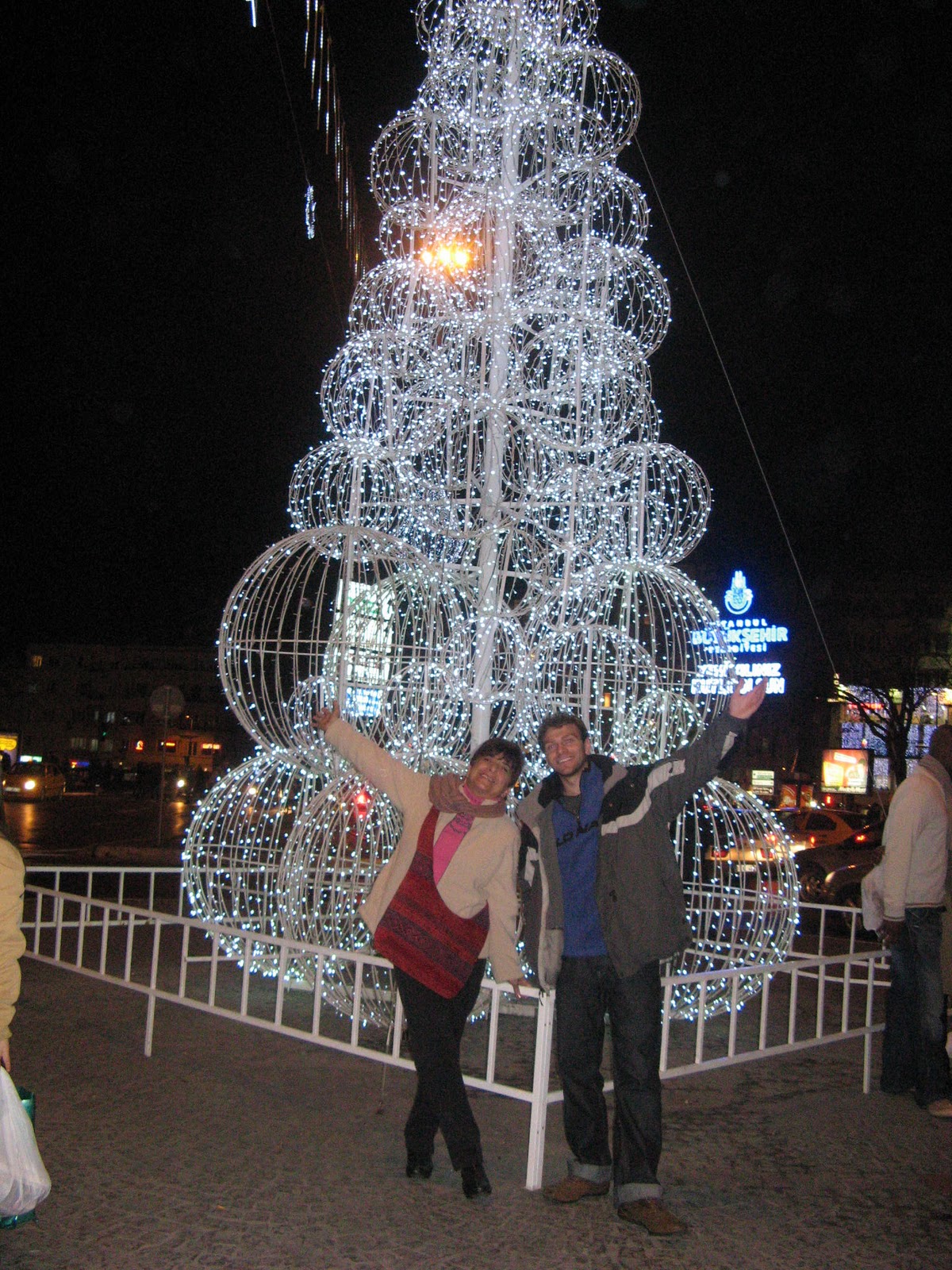
Photos: Christmas tree in Starobelsk; with Jason in the heart of Istanbul, Christmas 2009; in the Luxor desert, New Year's Eve, 2010. 

In the desert outside of Luxor, Egypt, January 1, 2010.

Last year at this time, in Ukraine, I bought a few holiday trinkets at the Bookstore in downtown Starobelsk and a few ornaments at the Bazaar and decorated my room at Natalia’s on Kyrova, as I had done the year before when I lived with Luba on Panfelova. 

I had to work at getting the Christmas spirit, because nothing really happens there until after December 25;  the orthodox Christmas is celebrated on January 7, but it is not such a huge holiday as it is here.  

I walked around town looking for signs of the season.  I took photos of a little decorated tree in front of the Children’s House of Culture on one of my walks through the University to the center of town. We spent English Club meetings talking about the meaning of Christmas and made trinkets for a  tree made out of branches I had collected on my walks.  I watched workmen put up the large tree in front of the main Cultural Center, awhich took weeks of labor, nd went with my friend Nicolai on a cold winter’s night at the end of December to watch the lighting of the giant tree and to join happy people dancing around it.   The global village alight.

In 2009 I celebrated Christmas in Istanbul with PCV friends Jud and Jason.   I remember walking in Sultanabat, around the Blue Mosque and St. Sophia’s, in the heart of the old city, marveling at the dazzling blue and white lights and the ancient and present beauty.  Breathtaking.  The whole city sparkled, and best of all, we got to stroll along the colorful main street  to the very Church where Pope John 23 preached.  It was a holy night in Istanbul.


Last year, I was in Egypt with Jud, Cairo then onto Luxor by train. One of the most memorable trips I've ever taken.  In Cairo we stayed at a hostel, Egyptian Nights, right across from the Egyptian museum, where a few weeks later protests erupted and tanks filled the street.  We spent New Year's eve in the moonscape desert outside of Luxor, savoring the stunning night sky, a fantastic traditional meal, and good cheer with people from around the world.   

Of course there were lots of  Christmases here in the States, with kids in Toledo, with my parents in Rochester, with friends in Washington  and in balmy Florida, where houses and boats are lavishly decorated,. 

Now, here in Sylvania, a whole new set of traditions is growing out of the fertile soil of old traditions.

The memories evolve like a string of lights around all the places I have been.

They float over Christmases past and present. 

They decorate trees, windows, and wreaths.  The lights of memory, stretching on forever, expanding the tapestry of Christmases past into the now and the unknown future.  

Merry Christmas to all, and to all a good night! 

Thursday, December 22, 2011

Channeling Loren

flickr photo by 'developmentcorporate' (only name given), which I used in my Hitchens blog for several symbolic reasons, including that the windmill looks almost like a cross, plus Loren after a hike by his friend Linda with Florida Trails Association.

I must be channeling my dearly beloved brother Loren, or is it Christopher Hitchens?  My rants are becoming more acerbic, strident, defiant.  When I read my blogs I am almost surprised at the outrage they express.  I never thought I’d be so openly critical of Obama, for example. The state of the economy, fine. The end of the "NOTHING ACCOMPLISHED" war in Iraq, okay.  But Obama's been kind of off-limits, and my friends remind me when they defend against my attacks.  As one wrote in  response to one of my blogs, “Lots of truth there, Fran, but kind of harsh!” 

Yeah. Wow. But you know what?  I think this is the first time I am hearing from my brother since he died too fast, too early on his last hike along the Aucilla River in northern Florida.  All of a sudden he was gone, and I am still unbelieving. I look for him. I look for any signs.

Loren wasn’t one to screen his thoughts and ideas.  I seem to be following in his footsteps lately.  I certainly wasn’t so critical during my Peace Corps years in Ukraine. I kept my thoughts to myself and went with the flow.  Except when Loren and I emailed.

Now I seem to be ranting against injustice and inequality like an occupied Wallstreeter. It’s not always the best thing to do, or perhaps I should say the best way to do it.  Maybe this is an excuse, but somehow I feel Loren’s spirit when I rant about things I know he cared about, and I am moved.  I cry for my brother, whose insights and honesty, and outrage and anger, were unsullied.     

Unsullied. That's the key.  I don't think I can match that.  I could tone down the rhetoric, as we used to advice Loren from time to time.  But then it wouldn’t be Loren, or me, and I’d be channeling someone else.    Maybe it's Christopher Hitchens, but not as eloquent!  

Tuesday, December 20, 2011

Life After Peace Corps: Unhitching Hitchens

Life After Peace Corps: Unhitching Hitchens

Unhitching Hitchens

Don Quixote goes at a Windmill, art by GA Haqher,
flickr photo by DevelopmentCorporate


I have friends who admired Christopher Hitchens (1949-2011) for his acerbic wit and fearless views about everything from religion to culture to politics.  He was a master of the English language and he wielded it like Don Quixote  attacking the windmills of injustice wherever he found them.  I didn’t follow Hitchens closely, but I did read some of his rather outrageous, in the broadest meaning of that word, essays on Mother Theresa. Gutsy irreverence, for sure, which he carried even to the hallowed walls of the Vatican.  No one was sparred.  Few took freedom of speech and religion as seriously as Hitchens.   He devoted his too-short life and unmatched talent to them until the very end.  He died of cancer last week, writing and unbelieving unto death, believing only, and as strongly as ever, in his own beliefs.  


Washington Post columnist Gene Weingarten put his sentiments into a poem for Hitchens for ArtsPost (quoted in Cara Kelly, “Remembering an Icon,” Washington Post, 19 December 2011):
Christopher Hitchens ceases to be;
A remarkable life he led.
He isn’t in heaven; he isn’t in hell — 
He is simply, emphatically, dead.


Saturday, December 17, 2011

The Secret Speech


Former Communist Secret Police Headquarters, now The Terror Museum, Buadpest,
a few blocks from the magnificent Opera House, and below, book cover (yahoo image).
I finished reading Tom Rob Smith’s The Secret Speech (2010), and sent it on to my RPCV friend Jud.  It was slow going.  A sad book. This painful story, about the unraveling of Soviet Stalinist society, went on and on, endlessly, without pause, without respite. Relentless agony to the very end.

The novel, the second in a planned trilogy, is based on the titanic social, political, and  personal  impact of the Stalin years and their aftermath.  Its symbolic force is the speech Nikita Kruschev gave to the 20th Communist Party Congress in 1960 exposing and condemning the “Cult of Stalin” and its “perversion” of Communist principles.  That's when all hell broke lose, when Soviet society started to crumble, leaving no one unscathed, an unstoppable blood-letting.

Kruschev’s speech didn’t remain secret for long, and that's the heart of Smith's story.   Its message spread immediately throughout every level of Soviet society, from the cities to the farms, from the schools to the gulags, from the highest ranks of Soviet society to the lowest, like wildfire on dry timber.  The speech ignited the long, fiery road to “perestroika” and the dissolution of the USSR, but along the way, along the tumultuous path, a whole society twisted in the wind, blowing people apart, literally and figuratively.

This is a story of revenge, self-loathing, guilt, betrayal, murder.  It's about the enduring effects of vicious totalitarianism on the human spirit: a whole society in the throes of Post Traumatic Stress Syndrome. 

A NYT review of the book was titled “Inner Gulag,” an appropriate image for this story about the inner turmoil and shame that afflicted Soviet citizens who were either former participants in Stalin's  reign of terror or its victims.  The main characters, Fraera and Leo embody both.  Forged in tragedy, these characters survive to get revenge or redemption against the black and bleak backdrops of a painfully changing Moscow, the gulags, and Budapest, Hungary during the Revolution.  The birth of freedom there was as tortured as the birth of freedom anywhere in the world, in any country, in all forms, throughout the ages. 

I can’t help but think of Ukraine, and the pain, and the lingering effects, and of Buda and Pest, the scenes of unbelievable misery and destruction.  I visited the Terror Museum, the former home of the Communist Secret Service, full of painful stories, and walked the whole area around the Opera House, once so murderous, now so beautiful. I  wasn’t aware of the depth of despair these streets witnessed, the struggle, the raw scabs opened and bleeding from every pore. The beautiful city of Budapest blown apart, before it was rebuilt in freedom.

Former secret police like the main character Leo, who routinely betrayed family and friends, are raked with guilt, their psyche’s permanently damaged. One character, shameful of his part in the purges. says what haunts him is “the blood.  My arms are covered to my elbows in blood.  That is the most terrible thing that lies in my soul.”   Survivers become reformers, like Leo, or criminals, like Fraera, but their wounds are the same.  The victims themselves grow twisted and unforgiving, giving rise to the vory, a gang whose members are as ruthless as their betrayers, maybe the birth of the Russian Mafia, using the survival skills they learned in the gulags to exact revenge. No one is more unforgiving, more treacherous than Fraera, who lost her soul and sane sensibilities when she lost her priest husband and her former life to betrayal and terror. 

Tom Smith’s book is in a formidable tradition that includes Alexander Solshenitsyn’s “A Day in the Life of Ivan Denicovich” and “The Gulag Archipeligo,“ which won the Nobel prize in literature in 1970.    Since then an extensive body of scholarship and literature have emerged on the Gulags and their tragic impact, and documentation about the horror's of the Stalin era continue to be unearthed and, sometimes reluctantly, made public.

My daughter’s friend Laura Kline, who teaches Russian language and literature at Wayne State University in Detroit, is one such scholar.  Laura’s research focused on Varlama Shalamov, who, along with Andrei Platonev, was an early anti-Gulag exposer and writer. Shalamov died in poverty and obscurity in 1951, his work eventually translated by Robert Chandler and his story retold through Laura's study.    

The repugnant stories these writers and scholars uncover are not make-believe; they are grounded in the monstrous realities of an injured society and the broken spirits of ordinary and extraordinary people, like Tom Rob Smith's novel.  The saddest part is that the demons are not yet fully exorcised. They live in the present, in Russia, in the former Soviet republics, in the complex mosaic of modern post-Soviet life.  The struggle continues.   


Thursday, December 15, 2011

"NOTHING ACCOMPLISHED"


So we are out of Iraq? So what? It's been a hopeless, helpless cause since day one, the people's voice muted by the war machine and the corporations who profited from it. NOTHING ACCOMPLISHED.

So over ten years later, and the loss of thousands of American lives and many thousands of innocent civilians, and the wounding and maiming of thousands more, theAmerican flag is down.  So what?  What is there to celebrate?

It doesn't feel like a victory.  Far from it.  What did we accomplish? What was it about? This Bush-Cheney-Halliburton war that a few got rich off of, and Obama continued.  Same with Afghanistan. But for the valiant efforts of Secretary of State Hillary Clinton to maintain our integrity, we'd be bombed out all over the world, our reputation in tatters, like the flag just lowered in Iraq.   The end of the war? So what?  NOTHING ACCOMPLISHED.

Wednesday, December 14, 2011

"мы требуем честных еревыбров!!!"


The People's Will: "мы требуем честных еревыбров!!!"


Amazing how a simple issue like "We demand fair elections" (from a Russian protester's sign, above)  can ignite a conflagration of protest, like a match thrown in dry timber.     

Pent-up frustration and discontent, building up over years and years, are now erupting at the slightest nudge, worldwide.   TIME magazine's new 2011 "Man of the Year" issue confirms the phenomenon.  

"The Protestor."  Everywhere in the world, protestors are having their say.  From Tunisia to Egypt to Russia to Europe to America, like rolling thunder.  The message: We want to be heard; we want to have some control over how we are governed; we want change.    

It's almost like the 1960s, when the Civil Rights and anti-Vietnam war movements in the US erupted from the grassroots level, from the farms and fields of Mississippi, from the towns and cities of North and South, and gave hope for social change.  

It's happening again, and this time it's happening around the globe, in every region of the earth. 

It's time.  It's time for economic and political ruling elites worldwide to pay attention.  It's time for Obama to listen too.  America is not immune to the global outpouring of protests.

"The Protestors" will hold their title and claims into the new year.  Maybe the "Man of the Year" in 2012 will be "the Reformers," the rulers who listen to the protestors, bring them into the process and lead the charge for the end of poverty and for economic opportunity and justice for all.   

Don't get out the popcorn yet: The Wheels of Justice Grind Slowly

"Delay, Delay, Delay: From pre-trial motions to negotiations over security, the master of legal stalling has many tactics in his arsena...